
The secrets of Preston Cemetery revealed from above in our fascinating drone footage
More than 46,000 people are buried at Preston Cemetery.
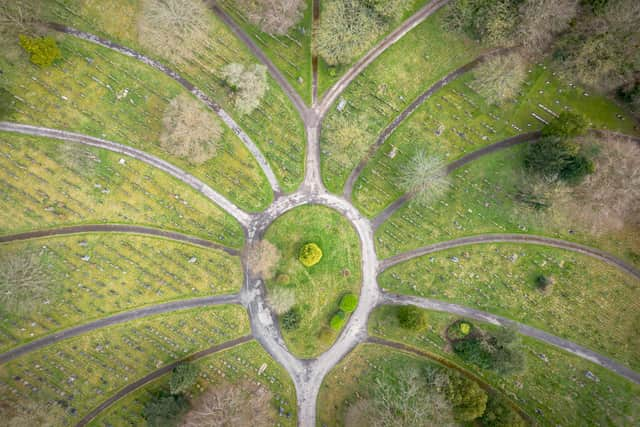
Seen from above, Preston Cemetery reveals a secret.
Opened on July 2, 1855 on 18 acres of former Ribbleton farmland by the Preston Burial Board, the cemetery off New Hall Lane was created to ease the pressure on the town’s overcrowded burial grounds during the height of the Victorian era.
There had been growing complaints regarding foul smells, disease, and lack of space in swelling urban churchyards.
In St Paul’s burial ground, the town’s poor where buried in open graves designed to take 25 coffins. One campaigner who lived close by wrote to the Preston Guardian in 1849 voicing his concerns. By his calculation, more than 40 coffins had been crammed into one of the open graves, with the final coffins barely beneath the surface.
Similar complaints were expressed by those who lived close to St Wilfrid’s graveyard, with one correspondent remarking: “A strong noxious smell often arises and I am consequently obliged to breathe in the poisonous air, which has been known to leave me feeling unwell.”

Symbolism
Designed by local architect Thomas Denville Barry, the 45-acre site forms both a butterfly, pomegranate and knot shape when viewed from above, representing different religious groups and the resurrection of the dead and eternal life.
The main religion in the cemetery is Church of England and these graves are located in the centre where a butterfly symbol is use. This layout is said to represent transformation, life, and renewal.
The area for Roman Catholic burials is on the north-western side of the cemetery, and is laid out as a half pomegranate - a symbol used a lot within catholic religious paintings, with the seeds tightly packed together under one tough outer rind mirroring the Catholic church where many diverse believers are united as one body of faith.
The Non-Conformist area of the cemetery is to the South-eastern side. The path layout was that of a knot pattern which went around so the paths had no ends and no beginnings.”
Within the cemetery three chapels of rest were situated within the different religious nominations. These were built and designed by the Irish architect Thomas Denville Barry, the city surveyor for Liverpool who also designed the gates and the lodges within the cemetery. They were demolished in the late 20th century.
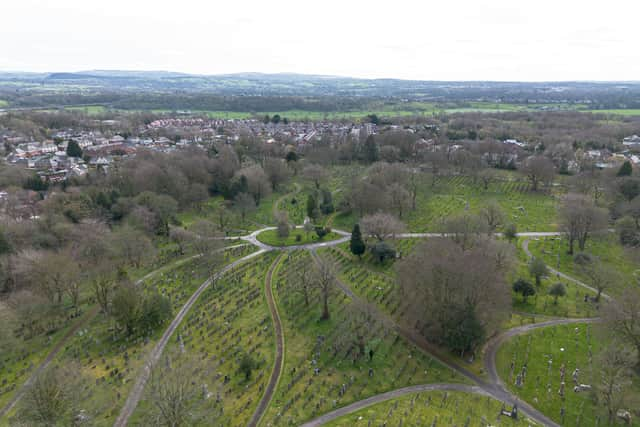
The cemetery expanded in the mid-1920s through the creation of a new, adjacent burial ground across Miller Road, increasing the total site area to roughly 30 hectares.
A Jewish burial area was established within the site in the early-1900’s, followed by a Muslim area.
First burial
The first burial which took place in the cemetery was in the Church of England section. The burial was of a bricklayer’s daughter, Elizabeth Frances Christian who died at the age of five in July 1855. On the same day two other children were laid to rest but they had no stone as they were buried in public graves.
Within 30 years of opening, Preston Cemetery had become the last resting place of thousands of people. Some of the gravestones were paid for by Victorian ratepayers to mark the graves of the borough police officers who were so badly paid that they would leave little to pay for a memorial. Similar purchases provided for nurses who ‘mainly stayed single and died without loved ones’.
Notable gravestones include:
- Joseph Livesey: The founder of the Preston Temperance Society and a pioneer of the anti-alcohol movement.
- Padre George Smith: The chaplain to the forces at Rorke's Drift who helped defend the station against 4,000 Zulu warriors in January 1879, an event immortalized in the film Zulu.
- Private William Young: A recipient of the Victoria Cross who was awarded the medal for bravery in 1916 during World War I.
In total, the cemetery houses 14,000 individual graves, including 506 identified Commonwealth war graves (324 from World War I and 166–167 from World War II, plus a Belgian war grave) managed by the Commonwealth War Graves Commission.
Is it still open?
The Preston City Council continues to facilitate funerals, cremations, and burial options—including woodland burials—at the New Hall Lane/Miller Road facility. But city officials have noted that existing burial space is running low, with projections indicating the current grounds will reach near capacity over the next decade.
Find out more about visiting and how to find a grave here: https://www.preston.gov.uk/article/1035/Cemetery-and-Crematorium-opening-times