
New Preston Guild Hall ‘could be built elsewhere’
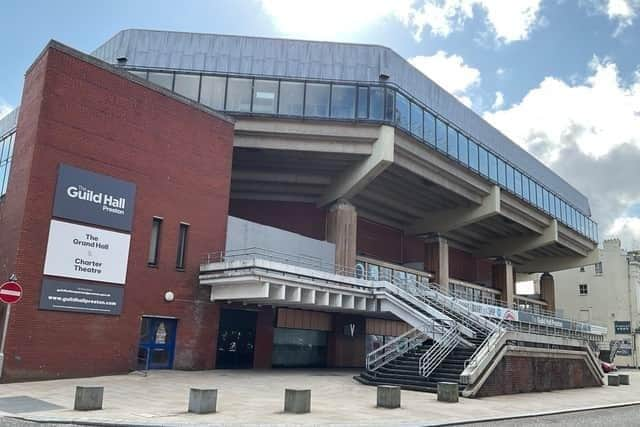
A replacement for Preston’s Guild Hall would not necessarily have to be built on the same site, the politician leading the process of bringing a major entertainment venue back to the city has said.
Preston City Council announced last week that it will spend the next 12 months establishing whether it is possible to secure the estimated £60m-£100m in funding required to rebuild the landmark attraction, which opened back in 1973.
The authority’s deputy leader, Martyn Rawlinson, said that creating a 21st-century incarnation of the hall as a “multi-functional, modern concert and conference/exhibition centre” would be “the best outcome” for the city.
However, because of the eye-watering price tag that comes with that option, he also committed to costing the renovations needed to enable the existing building to reopen safely, after its main performance spaces were found to contain so-called ‘crumbling concrete’.
It seemed that what the Labour-run council described as its “twin-track” approach would mean the current Lancaster Road site would remain the Guild Hall’s home, irrespective of whether it was refurbished or rebuilt.
But asked by the Lancashire Post whether the plot was the only place the authority would want to see a brand new venue constructed, Cllr Rawlinson said he was open to other proposals – while acknowledging that moving the hall elsewhere might make matters even more expensive.
“We are not wedded to the Guild Hall site for a potential future venue if any partners or investors felt other locations would be better,” he explained.
“However, other sites could be more costly, as they would be unlikely to be in council ownership.”

During the budget-setting meeting at which the announcement about the Guild Hall’s future was made, the opposition Liberal Democrat group put forward an alternative financial plan for the year ahead in which they pledged to pull the plug on trying to save the current building – and to press ahead with preparations to develop a new one.
The party’s finance spokesperson, Cllr Neil Darby, told the Post he would also be willing to think about an alternative location for a new-build venue.
“We [have suggested] the Fishergate [Shopping Centre] site as an example of somewhere we might consider – because the current Guild Hall’s footprint actually isn’t that large,” he said.
Long-term plans to redevelop Fishergate as part of a regeneration of the area around Preston station include repurposing the shopping precinct plot for a mix of residential, leisure and retail uses.
Cllr Darby added: “But there are also works being undertaken [to redevelop] St John’s Shopping Centre – and there’s not much distance between that and the Guild Hall, so maybe there is scope to work between them.
“Our policy is to be very flexible, because [the project] is a big ask. By its nature, we don’t have the power that we’re going to be able to say, ‘This is what we want and this is where we want it.’”
However, Cllr Darby said he believed that keeping the hall in the heart of Preston should probably be “a red line” for any replacement.
“We want it to increase the offering [of] the city centre. Retail is much harder than it used to be, trying to compete with online – and so in order for all the offerings in town to be able to thrive, you need things that are going to draw people [in].
“Also, the Guild Hall is carrying on the tradition of over 800 years of us having a Guild and a mayor – it all comes together in that sort of package.and is part of the living history of Preston.”
The Guild Hall closed in May 2019, sparking what would become a four-year legal wrangle when the city council subsequently retook control of the building, five years after selling a 999-year lease on the premises to Preston businessman Simon Rigby for just £1. At the time, the Guild Hall was costing the local authority £1m a year to operate, just as austerity started to bite.
Cllr Rawlinson – who was then, and remains, the cabinet member for resources – said at last week’s budget meeting that the council never would have transferred ownership of the site if it could have afforded to keep it But that would have meant making savings elsewhere, he added, which “wasn’t feasible” against the backdrop of the wider spending squeeze then gripping local government.
After the resolution of the legal issues in early 2023, the venue was poised to reopen later that year. However, that plan was derailed when fears emerged surrounding the suspected presence of reinforced autoclaved aerated concrete (RAAC), as it is officially known, in some sections of the building’s roof. New safety advice issued at the time suggested that the material could collapse without warning.
An investigation confirmed that the material had been used in the Guild Hall’s construction in the early 1970s – forcing the doors to remain shut on the 2,000-capacity Grand Hall and 780-seater Charter Theatre, ever since.
A smaller events space in the building’s foyer – now billed the Guild Lounge – has been in operation since autumn 2024. That part of the building is unaffected by RAAC.
...