
Groundbreaking 'pill-on-a-thread' cancer test comes to Tesco and Asda near you
there are around 9,300 new cases of oesophageal cancer in the UK every year. It is the seventh most common cause of cancer death in the UK, with around 22 deaths a day from the disease.
A ground-breaking clinical trial which could lead to a new screening programme for oesophageal cancer has come to Lancashire.
The BEST4 Screening trial will find out if a new ‘pill-on-a-thread’ test could be used to screen people with heartburn for Barrett’s oesophagus – a condition that can lead to oesophageal cancer. The trial is backed by £6.4 million of funding from Cancer Research UK and the National Institute for Health and Care Research (NIHR).
Following the initial roll-out of the trial in Cambridgeshire in November 2024, mobile screening vans have now arrived in Lancashire. Patients have received text messages from NHSresearch inviting them to join Heartburn Health and will be randomly selected to participate in the BEST4 Screening trial.
The mobile screening van will be based at Tesco in Penwortham until Wednesday, October 28. It will then move to Asda at Fulwood, Preston until Friday November 6.
What is it?
A capsule sponge test takes 10 minutes to do and can be done by a nurse – making it much faster and less expensive than an endoscopy. The trial will find out if the capsule sponge test can detect oesophageal cancers earlier, reducing the need for intensive treatments and preventing deaths.
The capsule sponge starts off as a small, coated pill attached to a piece of thread. When a patient swallows the pill and it reaches the stomach, the coating dissolves and the sponge inside it expands to the size of a cherry tomato.
The sponge collects cells from the oesophagus as it is gently pulled out from the stomach by a health professional. The cells are then sent for testing for two proteins which tell doctors if someone has Barrett’s oesophagus or oesophageal cancer.
The researchers have also developed artificial intelligence (AI) tools to speed up the analysis and get results to people faster, reducing the anxiety of waiting for answers.
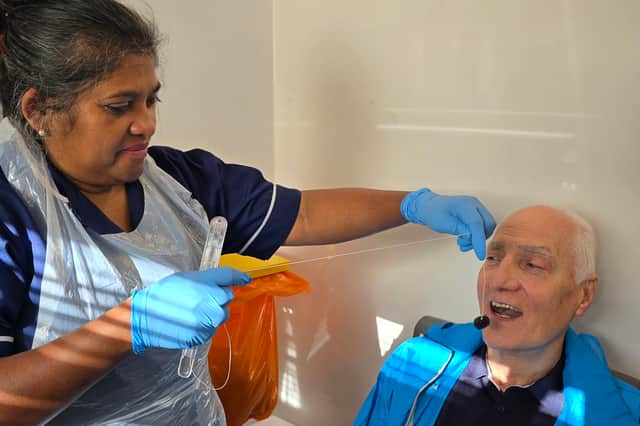

Paul Burrows has suffered with heartburn for the past decade. He initially used off the shelf remedies before they became ineffective and he more recently started taking daily prescribed medication.
The 70-year-old, who is retired after running his own business and lives in Inskip, said: “The pill on the thread sounds fascinating. I’m more than happy to be a guinea pig and help out in a clinical trial if it will help others in the future.”
Christopher Howarth, from Longton, suffers with acid reflux and takes omeprazole tablets which are prescribed by his GP. He said: “The medication I take does control the acid reflux, but I absolutely welcome any new development which makes it cheaper and less intrusive for these kind of tests and it’s exciting to be involved in something which could help create a future screening programme.”
The aim
The trial aims to recruit 120,000 people who regularly take medication for heartburn. Heartburn is the most common symptom for Barrett’s oesophagus which is a precursor condition to oesophageal cancer, where cells in the food pipe start to grow abnormally.
The trial is being led from Cambridge University Hospitals NHS Foundation Trust (CUH) and the University of Cambridge, with the Cancer Research UK Cancer Prevention Trials Unit at Queen Mary University of London designing the trial and analysing results from it.
According to analysis from Cancer Research UK there are around 9,300 new cases of oesophageal cancer in the UK every year. It is the seventh most common cause of cancer death in the UK, with around 22 deaths a day from the disease.
Alexandra Williams, Senior Clinical Research Nurse at Lancashire Teaching Hospitals NHS Foundation Trust Centre for Health Research and Innovation, said: “Oesophageal cancer is becoming more commonly recognised in the UK. Despite advances in treating the disease over recent years, only one in five people survive this cancer for five years or more.
“To turn the tide against this deadly cancer, we need to find those people who are at the greatest risk much earlier than we do now. This group includes people over the age of 55 with chronic heartburn. Current methods to diagnose Barrett’s oesophagus and oesophageal cancer are slow and require a hospital appointment for a camera test, which can be uncomfortable for patients.
“The capsule sponge test is much quicker, less expensive and can be delivered in the community. We hope that the BEST4 Screening trial will help us identify more people earlier and crucially reduce deaths from oesophageal cancer.”
Chief Executive of Cancer Research UK, Michelle Mitchell, said: “Around 59 per cent of all oesophageal cancer cases are preventable. Yet endoscopy, the gold standard for diagnosing and treating this cancer, is labour-intensive and not practical for a population screening programme.
“Backed by funding from Cancer Research UK, the capsule sponge has become one of the most exciting early detection tools to emerge in recent years. It’s a remarkable invention by Professor Fitzgerald and her team, and previous trials have shown how powerful it can be in identifying cancer earlier.
“We are proud to be supporting this landmark clinical trial, bringing the capsule sponge test to Lancashire and offering it to a much wider group of patients. After many decades of research, we’re on the cusp of transforming oesophageal cancer diagnosis forever.”
How to join the trial
The trial is open to men aged 55 to 79 and women aged 65 to 79 who currently receive medication for chronic heartburn/acid reflux. More information about how to join the trial can be found at https://www.earlycancer.cam.ac.uk/our-research/our-clinical-studies/best-4-trial or by contacting [email protected].