
Grave of Lancashire’s ‘unknown’ WWI soldier identified in Belgium
For 108 years, nobody knew where Major Francis George Wynne had gone - now, his grave will finally bear his name.
The body of a World War One soldier who was unidentified for over a century has been confirmed to be that of a Lancashire Regiment soldier.
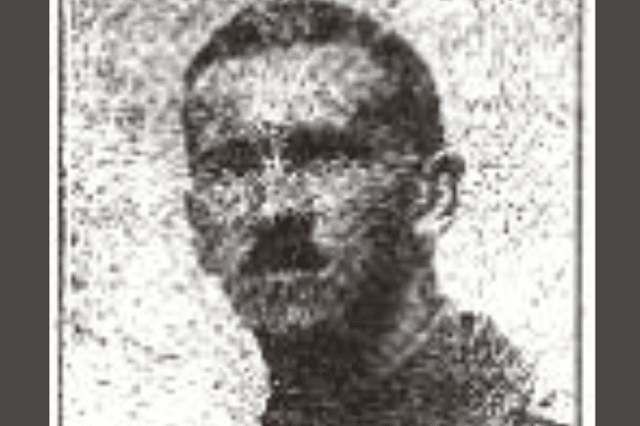

Major Francis George Wynne was born on November 7 1885 to a military family in Pembrokeshire.
At 16, he attended the United Services College in Westward Ho!, which at the time trained students to become officers in the armed forces.
Six years later, at 22, he was commissioned halfway across the country to the Loyal North Lancashire Regiment, where he took the role of 2nd Lieutenant. By 1911, he was stationed with them at the Ghospurri Barracks in India.
On September 26 1915, after war broke out in Europe, Francis went with Loyal North Lancashire Regiment’s 8th Battalion to France.
By the next July, he he had already achieved the rank of Major. It was then that he performed an unknown action which led to him being awarded a Distinguished Service Order - an honour which recognises exceptional leadership and gallantry.
In February 1918, the 8th Battalion was disbanded, which meant that Francis was instead sent to the Wiltshire Regiment.
During the First World War, it was common for soldiers to fight for regiments belonging to other towns.
Doing so meant that if a regiment was wiped out, their town didn’t lose a generation of local men at once.
It was while fighting for the Wiltshire Regiment that Francis met his end, aged 32.
On April 10 1918, Francis found himself in the trenches north of the River Lys in Belgium.
The day had started with an extremely heavy bombardment, which by 3:30pm, resulted in an enemy attack from both sides.
A section of the battalion was cut off, while the rest resisted the attack for more than an hour before retreating to another position, which they held for the rest of the day.
15 people were killed, including two officers, with 90 wounded. A further 78 were missing, including three officers.
It was already confirmed that Francis died in battle that day, but by the end of the war, nobody knew where his body rested.
As a result, his name became on of over 11,000 inscribed on the Ploegsteert Memorial to the Missing in Belgium.
Two years later, in February 1920, two sets of human remains were found in unmarked field graves between Poegsteert Wood and Warneton.
One of them was an unknown soldier form the Wilshire Regiment, and the other, an unknown officer of the Loyal North Lancashire Regiment. Both bodies remained unidentified, and were buried at the Missines Ridge British Cemetery.
Now, more than a century later, researchers from the Commonwealth Graves Commission, the National Army Museum, and the Joint Casualty and Compassionate Centre (JCCC) confirmed that the remains belonged to Major Francis George Wynne.
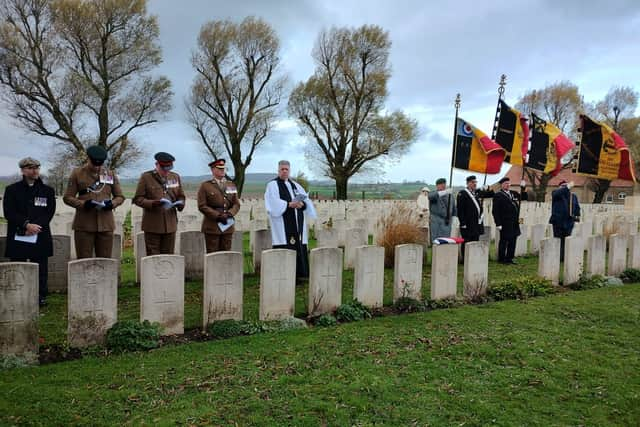
This week, serving soldiers from the Duke of Lancaster’s Regiment and a bugler from The Rifles visited the Messines Ridge British Cemetery in Belgium for a rededication service, organised by the JCCC.
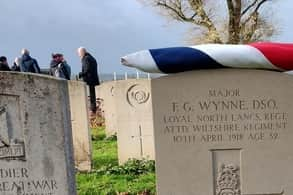
Francis’ headstone, which for 108 years was dedicated to an ‘unknown soldier’, was replaced by one with his own name. It will be cared for in perpetuity by the Commonwealth War Graves Commission.
“It has been an honour to work on Major Wynne’s case, and to have contributed to the research which has ultimately resulted in his identification,” said JCCC caseworker Alexia Clark.
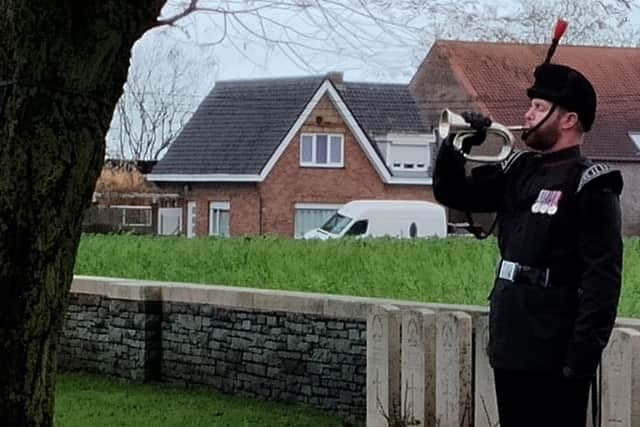
“As he has no close living kin, it has also been a privilege to stand here at his graveside with his military family to witness the rededication of his grave and to pay our respects for the sacrifice he made.”
Dr James Wallis, the Head of Commemorations at the Commonwealth War Graves Commission, said he was thankful to the researchers who helped identify the lost soldier.
“A poignant moment over this remembrance period, positive identification for a previously unidentified grave is always the culmination of thorough research – and the Commission expresses its gratitude to those involved in each stage of this case,” he said.
“Transferring Major Wynne’s name, from a memorial to a named grave, allows us all to remember the bravery and sacrifice of a Loyal North Lancashire Regiment officer killed near Messines.”