
Preston War Memorial marks 100 years since unveiling
Preston War Memorial in Market Square celebrates 100 years since its unveiling. The cenotaph honours those who sacrificed their lives in the Great War and subsequent conflicts.
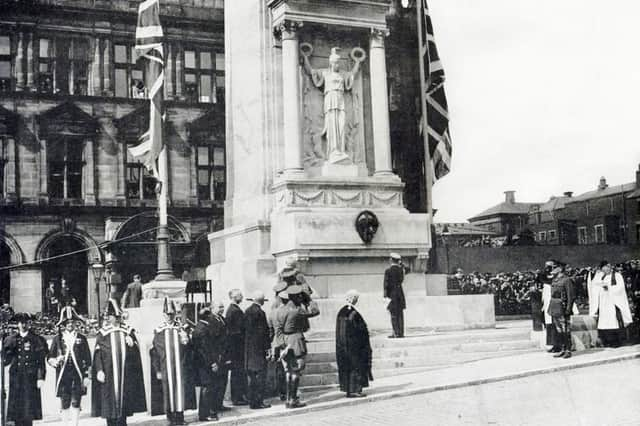
A century has now passed since Preston War Memorial was unveiled in Market Square, in front of the Preston General Post Office, on Sunday, June 13, 1926, writes Keith Johnson.

The site chosen was where the Boer War Memorial had stood since October 1904. That 25ft obelisk, dedicated to the 86 men who had lost their lives in that conflict, had been moved to Avenham Park, where it stands to this day.
It is doubtful that a larger crowd had ever gathered in Preston Market Square than the one that assembled that afternoon in mid-June 1926 to witness the ceremony. A dense crowd even filled the adjoining streets. Several hundred people had an excellent view of the proceedings from the steps of the Harris Free Library, and every window overlooking the square had its onlookers, while in some cases spectators had even ventured on to the rooftops of surrounding buildings.
A stirring military spectacle was provided when the guards of honour, consisting of members of the Royal Fleet Reserve and Ex-Naval Men’s Association, the Depot of the Loyal Regiment and 4th Battalion Loyal Regiment, swung into the square to take up their positions around the base of the memorial. In the centre of the square the military gathered and the vicinity of the memorial was lined with ex-servicemen and women.
The man chosen to perform the ceremony was the distinguished Admiral of the Fleet Earl Jellicoe, who was greeted by the Mayor of Preston, Jeremiah Woolley. The mayor introduced the admiral with the following words: 'Mindful of the men of this town who suffered unto death in the Great War, and wishing to keep the memory of their great sacrifice ever alive before the eyes of our children’s children, we, their fellow-citizens, have erected this cenotaph; and we ask your lordship, who knows their service, and who has yourself done such great service for the nation, to unveil it.'
In response Earl Jellicoe remarked: 'It is a great honour to take part in a ceremony in recognition of the 2,000 men of Preston who have given their lives for King and country during the Great War. The object of the memorial is to perpetuate the memory of the fallen and remember their great acts of courage, self sacrifice and devotion to duty.' He then pulled the cord that saw the Union Jack fall away to uncover the sculptured figure of Victory and the magnificence of the monument.
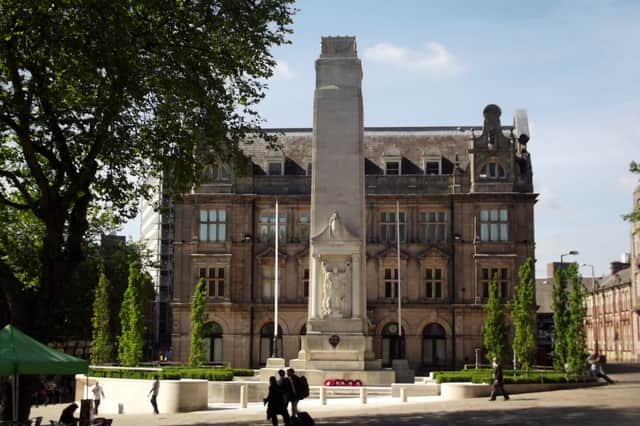
The Cenotaph was built to the design of Sir Giles Gilbert Scott, grandson of Sir George Gilbert Scott, the man who had designed Preston’s Victorian Town Hall. The sculptor who toiled long to create the 70ft monument was Henry Alfred Pegram.
Carved from Portland stone, the Cenotaph has a square, slightly tapered column and at the front is the tableau depicting grieving Victory in armour, holding aloft two laurel crowns, surrounded by representations of the dead. At the very top of the monument is a sculptured empty tomb, with cherubs and strands of foliage carved around it. The names of the servicemen honoured are inscribed on marble tablets within the Harris Museum, with that Roll of Honour on permanent display on the ground floor.
Since that day of unveiling, numerous significant events have been commemorated at the Cenotaph down the decades, besides the annual Remembrance Day ceremony held each November. One of the most significant took place in November 1945, with the Second World War having finally come to an end after Japan signed a surrender document on September 2, 1945. This followed the end of the war in Europe on May 8, 1945, with Germany's unconditional surrender. Those events meant Preston folk, along with the rest of the nation, could once again conduct the traditional Armistice Day ceremony in a peaceful environment, commencing at the eleventh hour on the eleventh day of November, marking the time in 1918 when the First World War ended.
Significantly the date in 1945 was a Sunday, and a sunny day at that, thus allowing the pageantry to take place in a colourful environment. In those days the role of Mayor of Preston changed hands in November, so there was an opportunity to combine the Armistice Day ceremony with the Mayoral Sunday ceremony.
The Mayoral procession from the Guild Hall to the War Memorial was led by the band of the Loyals, with the new Mayor, Alderman Herbert Rhodes, accompanied by civic dignitaries and representatives of various public institutions. Massed on Market Square to greet them were detachments of service and ex-service men, including veterans of the Boer War and a little band of Preston military men who had spent the last three Armistice Days as prisoners of war in Japan.
Flanked by banners, flooded with sunlight, and guarded by four motionless soldiers with arms reversed, the War Memorial was the centre of an impressive picture. The Mayoral party halted before the plinth, where the Vicar of Preston conducted a simple service that ended on the stroke of 11 o'clock. Then, most impressive of all, came a two-minute silence as the people in Market Square remembered the gallant, unforgotten dead. Then followed the traditional wreath-laying ceremony, with symbolic age-old poppies in abundance.
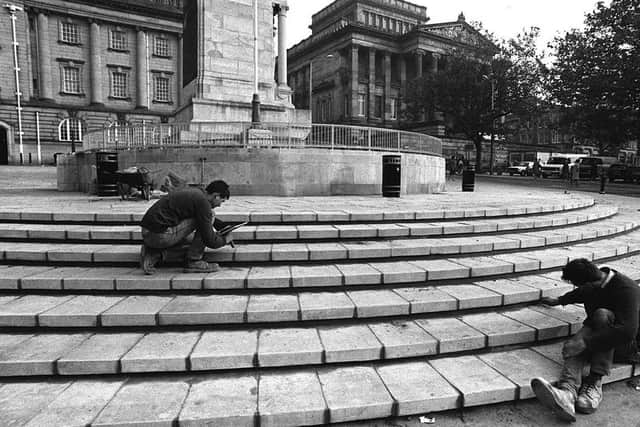
In 2013 the Cenotaph was fully modernised and extended and now includes carvings in recognition of those who lost their lives in the Second World War and subsequent conflicts. The Cenotaph is regarded as an exceptional Grade I listed war memorial.
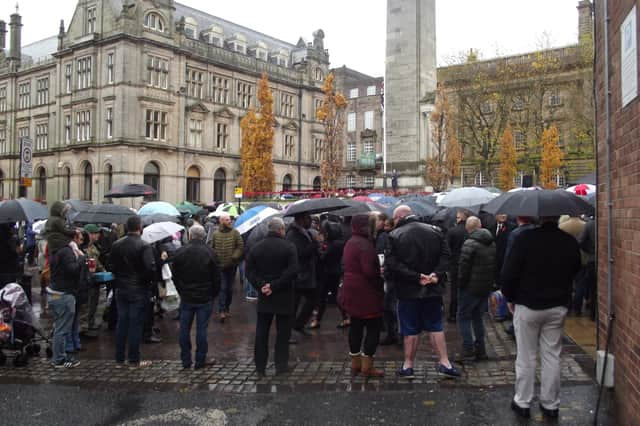
It was fitting in November 2018 that a great crowd gathered around the Preston Cenotaph and fell silent to mark 100 years since the end of the First World War. That conflict, and all those wars before and after, are part of the military heritage of our city. The event involved much preparation and brought back stirring memories of the generations who had endured the days of war and hostility.
As part of that anniversary of the Armistice, a number of silhouettes of the once familiar 'Tommy' soldiers appeared around Lancashire and a couple stood either side of the Cenotaph to mark the centenary. Preston Railway Station, a roundabout at Eastway and the new Preston Market Hall also provided settings for those lone figures during the year. They were a reminder of all those who joined up to fight for the country and paid the ultimate price.
Indeed, wherever you wander in Preston or its neighbourhood, you are likely to come across a memorial that recalls the brave deeds of those lost in battle. These war memorials and much more can be found within the pages of my book, 'Preston Military Heritage', published by Amberley.