
Kirkham baby with '1 in 5,000' condition to undergo life-changing surgery after hospital ordeal
“The only way I can explain it is that me and Matt are just so used to trauma that we just crack on.”
A Kirkham family who spent their entire savings to stay with their chronically-ill newborn have launched a fundraiser to recover their lost earnings.
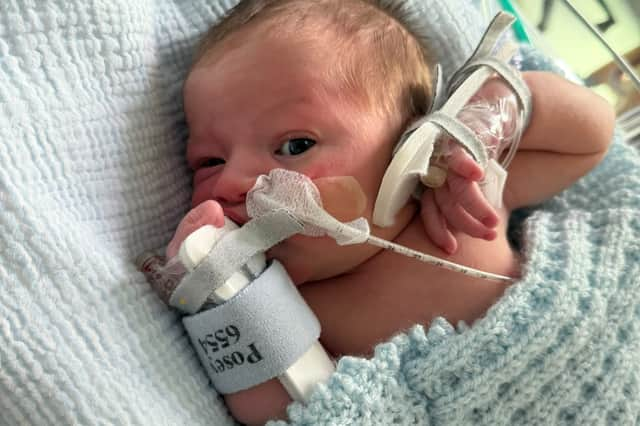

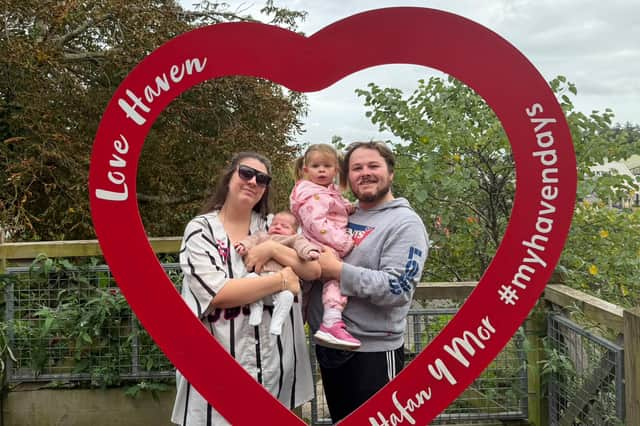
Matthew and Jasmine Pote, 27 and 28, had spent months counting pennies to pay for six weeks of paternity leave after the birth of their son Eli.
Already the proud parents of two-year-old Brooke, the pair had been excited to welcome their baby boy to the world on September 5 - but when he began to vomit his food just a day after he was born, they realised something was very wrong.
“Everything was absolutely fine for the first couple of feeds, as you can expect,” Jasmine told the Post. “The first two feeds were fine, and then after that, he just stopped feeding.
“We were calling the midwives in, and she said, ‘I agree, this doesn’t seem right’. But I think they just dismissed us at first, thinking that we might have just been worried parents.
“But we’ve had a kid before, we know what to look out for. Something’s not right, every feed he was drinking, he was throwing it back up.
“It got to about ten o’clock on the Sunday night, and and just before the doctor came around the corner, he threw up some green vomit. His stomach was super distended, dead hard, dead big, and as soon as the doctor saw it, he took it a lot more seriously.
“The senior consultant was down within minutes, and they did an X-ray. The X-ray showed that part of his bowel was distended, which we now know is an indicator of Hirschsprung’s disease.”
Affecting only one in every 5,000 babies, Hirschsprung disease is a rare condition which affects the body’s ability to push out faeces.
Nerve cells, known as ‘ganglion cells’, control the muscles which squeeze the intestine to move faecal matter. However, in babies born with Hirschsprung disease, the ganglion cells are missing from parts of the intestine, meaning faeces can’t be pushed out.
“He can push his poo out to a certain extent, but he can’t get it all the way out,” Jasmine said. “The black, tarry poo - the meconium - that babies pass when they’re first born, he couldn’t pass it through because obviously, his bowel doesn’t have the ability to do it.”
At the time, Jasmine herself had been struggling with complications of her own - a spinal leak caused by an epidural complication, which left her with a “debilitating” headache whenever she lay down.
It left her “unable to think straight”. As Preston Royal Hospital didn’t have the facilities to help baby Eli, he was whisked away to Manchester Royal Infirmary with Matthew while she was forced to stay behind for treatment.
“At four o’clock in the morning, Eli and Matt went in the ambulance, on blue light, to Saint Mary’s. I couldn’t go because I had that spinal leak, so I had to stay behind on the very first day and have that done, halfway.
“I was like, ‘Look, I know you normally wouldn’t discharge me, but I need to go to Manchester. I can follow up with the maternity unit in Manchester, but I need to be where my son and partner are’.”
Jasmine would arrive at Manchester at around 1am, where she found that the team had started performing manual bowel washouts on Eli.
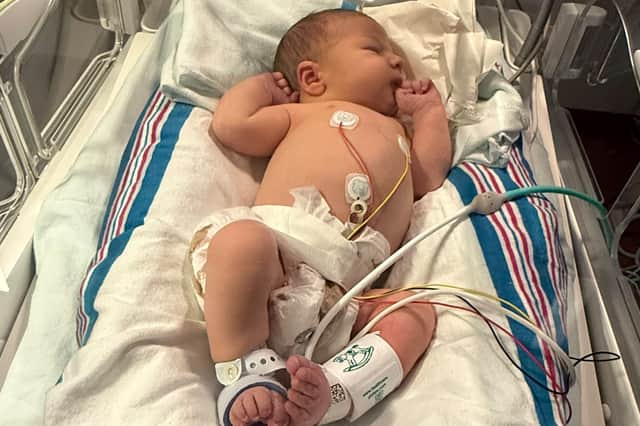
The process is done twice a day, and involves slowly pushing saline into the rectum to loosen faecal matter in the intestine, making it easier to empty the bowel.
It’s to prevent faeces from clogging up the intestines and stop a lethal infection known as enterocolitis, caused by faeces remaining in the bowel for too long.
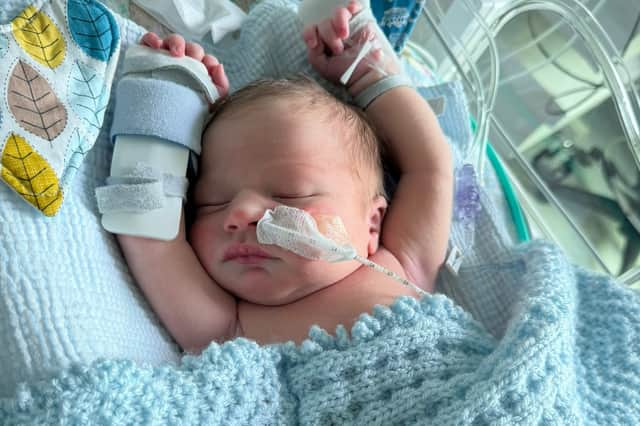
The next day, doctors performed a biopsy to eventually diagnose Eli with Hirschsprung disease, as the family remained in hospital for the next three weeks.
“We were in a situation where we had to keep going and keep going each day, we were just locked in,” Jasmine said. “There was the odd day or two where one of us would have a bit of a wobble.
“It was literally head-on every day, we just cracked on with it. We were doing whatever we needed to do to get through it.
“The only way I can explain it is that me and Matt are just so used to trauma that we just crack on.”
While Eli was undergoing tests and treatment, Jasmine and Matthew stayed at the Ronald McDonald House in Manchester, which allowed them to stay close to Eli while he was in hospital.
However, as the couple had only packed a small overnight bag for Eli’s delivery, they found themselves forced to spend far more money than they expected on basic essentials.
“We burnt through all the money that we’d saved for in anticipation of paternity pay,” Jasmine said. “I expected to spend two days at the hospital, and I spent three and a half weeks in Manchester.
“I had no proper clothes, I had no proper anything, really. We didn’t have the car because we got blue-lighted to Manchester, so we had to get milk delivered to us all the time. That was a costly thing.
“Matt had saved all his annual leave so he could take six weeks off: two weeks of paternity leave, and four weeks of annual leave, so we could spend six weeks as a family. But we lost three of them in hospital.”
Though the family are hoping to get some money from the government via neonatal care leave, Jasmine said it was significantly less than what they normally brought in from work.
In an effort to ease the financial burden, the couple launched a GoFundMe to bring in some extra money to help recuperate what they had lost.
The original goal had been £200, but it has now exceeded £1,000.
“The result has been absolutely, overwhelmingly positive,” Jasmine said. “It’s amazing.
“We maxed out our credit cards trying to survive in Manchester, so being able to pay those back off and have them as a backup, it’s just everything.”
Now looking ahead, the family are preparing to send Eli to hospital once again - this time for surgery which may allow Eli lead a “relatively normal” life.
On December 2, when Eli is nearly three months old, he will undergo a pull-through surgery on his intestine, where the section missing his ganglion cells is removed, and the healthy sections of intestine are stitched together.
However, Jasmine said that there is a chance the surgery could leave Eli needing a stoma bag until he is one, if he has a condition called ‘long segment Hirschsprung’s’.
Join our WhatsApp channel
If that is the case, he will need another surgery later down the line, but doctors won’t know until the day of the procedure in December whether it will be needed.
“We’re less than a month away, and I can feel that cloud over my head,” Jasmine said. “I’m definitely feeling the anxiety more and more.
“Once the pain’s managed, he’ll be able to go home and live a relatively normal life. He might be constipated or have diarrhoea more than normal kids throughout his life, but at that point, he should be as normal as he can get.”
Jasmine and Matthew’s GoFundMe is still live, with the pair welcoming any donations they can get to help ease their situation.
It is available here.