
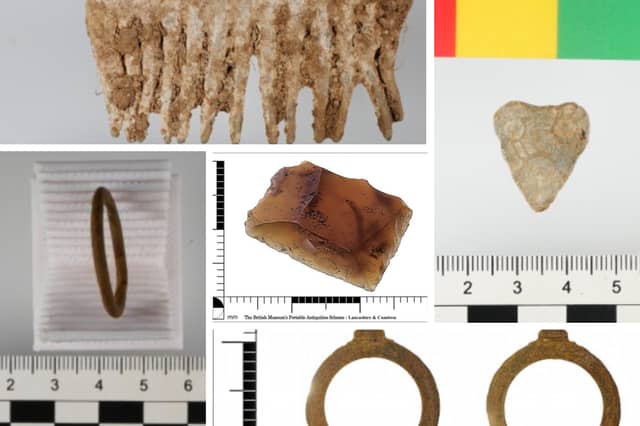

The Portable Antiquities Scheme, run by the British Museum, records archaeological objects found by members of the public in England and Wales.
Every year many thousands of archaeological objects are discovered, many of these by metal detector users, but also by people whilst out walking, gardening or going about their daily work
In the last three months, a Bronze Age axe, an ancient hair curler, and a piece of flint that could date as far back as 9,000 BC have all been discovered in the Red Rose county. And there’s many more on the database to look at.
To find out more about some of the objects discovered, click on the pages below:
9. Scraper tool
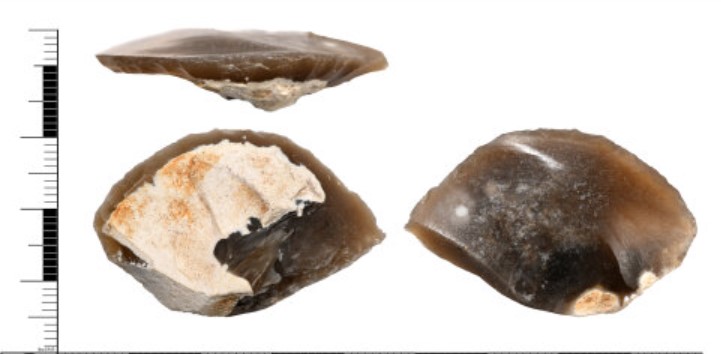
A flint scraper of unknown date, Mesolithic to Bronze Age, 9000 BC - 1000 BC. It is formed on a secondary flake of grey flint, cortex on the dorsal face. It is a pointed oval shape, wider than it is long, with short, semi-abrupt, sub-parallel retouch along the curved distal edge. It is 26.2mm long, 40.8mm wide and 10.5mm thick. 9.8g. Found near Burnley. | Portable Antiquities Scheme
10. Regency button
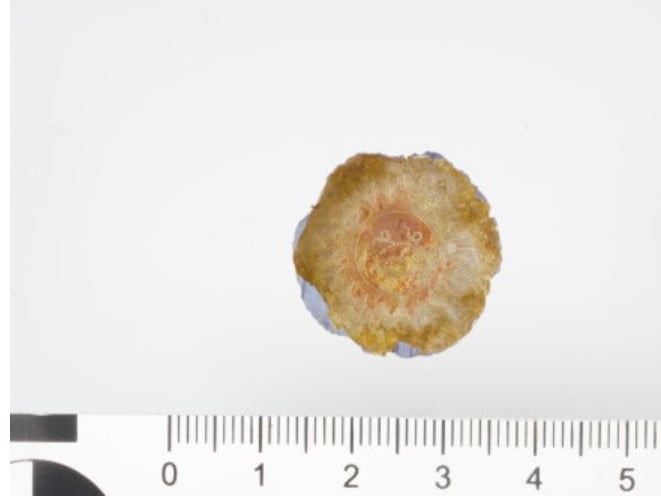
Composite two-piece copper-alloy and lead-alloy 'dandy' button with a white metal coating. It is discoidal and flat, with a copper-alloy base, a lead-alloy layer and a decorated white metal coating. The decoration is formed by a central circle containing two flowers (daisies) with stems. The circle is surrounded by petals and then radiating lines. The shank is missing. Suggested date: Regency period,1795-1837. Found in Burrow-with-Burrow, near Lancaster in November 2025. | Portable Antiquities Scheme
11. Medieval ring
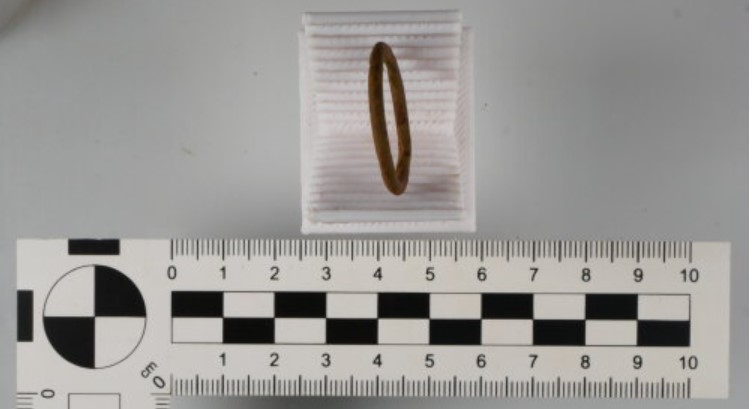
Medieval to early Post Medieval copper alloy accessory ring. It is circular, with a circular cross-section. These rings were widely used in a multitude of different ways, including as strap distributors and suspension points. Thickness: 4.5 mm Weight: 11 g Diameter: 34.1 mm. Found near Cliviger, November 2025. | Portable Antiquities Scheme