
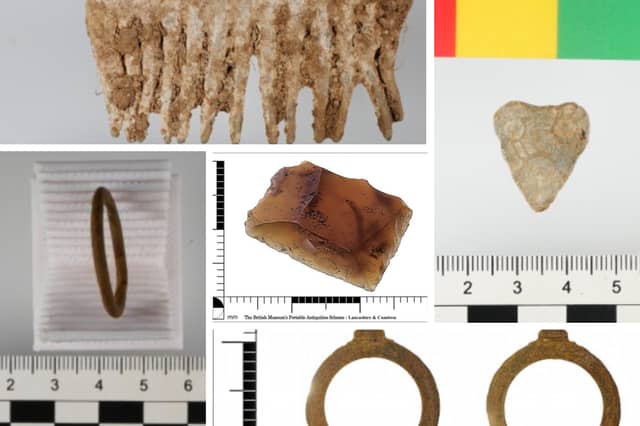

The Portable Antiquities Scheme, run by the British Museum, records archaeological objects found by members of the public in England and Wales.
Every year many thousands of archaeological objects are discovered, many of these by metal detector users, but also by people whilst out walking, gardening or going about their daily work
In the last three months, a Bronze Age axe, an ancient hair curler, and a piece of flint that could date as far back as 9,000 BC have all been discovered in the Red Rose county. And there’s many more on the database to look at.
To find out more about some of the objects discovered, click on the pages below:
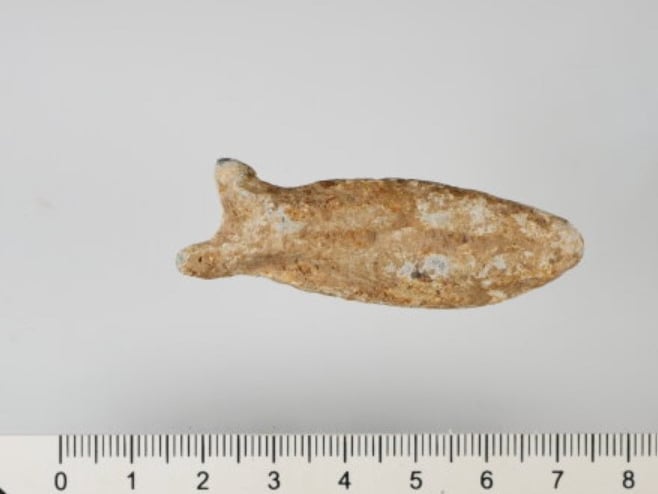
1. Medieval suspension weight
Lead-alloy suspension weight, probably dating to the medieval period. The body of the weight is oval, with a lenticular, or lentoid, cross-section, and has an incomplete suspension loop at one end. There is a central longitudinal depression on both faces. Length: 55 mm Width: 17 mm Thickness: 9.9 mm Weight: 47.64 g It is similar to an object found in London, which was described as a pendent weight, probably for industrial use, or as a net sinker, plumb bob or sounding weight. Found in Goosnargh, January 2026. | Portable Antiquities Scheme Photo: Portable Antiquities Scheme
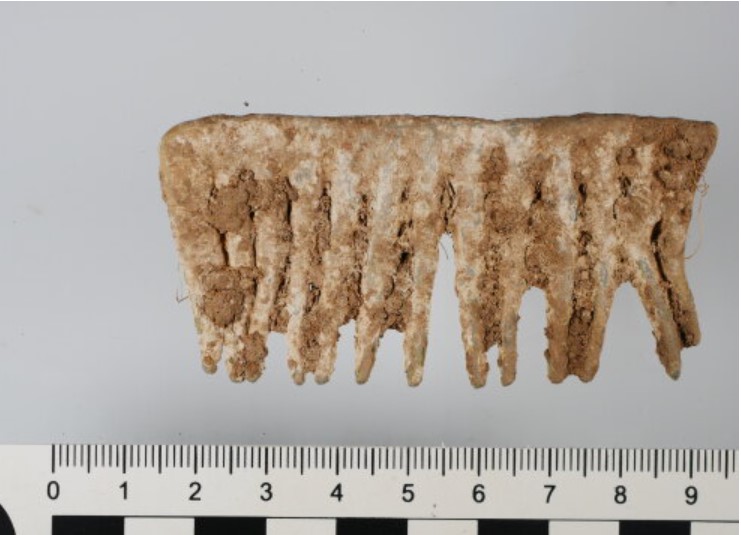
2. Comb
Incomplete post-medieval lead-alloy comb. It has a straight spine and integral teeth, and is undecorated. The teeth are are sub-square in cross-section, tapering to a rounded point. Length: 76.6 mm Width: 38.7 mm Thickness: 4.9 mm Weight: 61.76g. As the lead is quite soft, the material suggests against an industrial use. Lead combs are mentioned in sources from across the post-medieval period as a method for darkening hair. Found in Goosnargh, January 2026. | Portable Antiquities Scheme Photo: Portable Antiquities Scheme
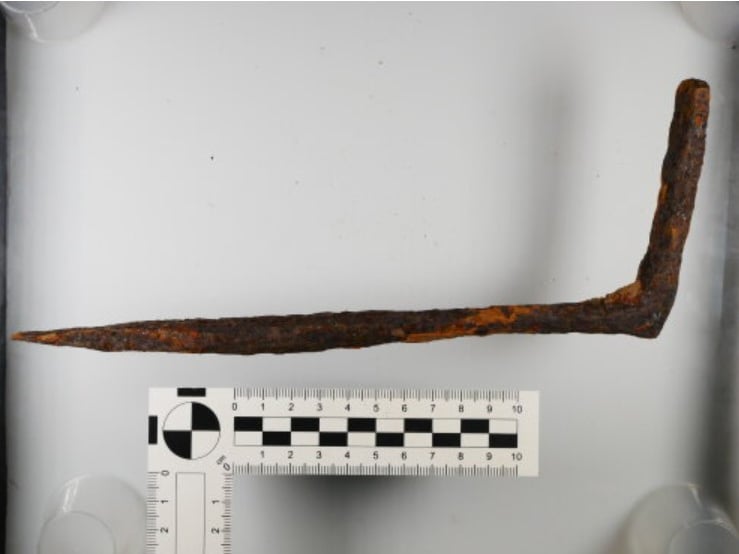
3. Spike
Post-medieval wrought iron spike, which would have been nailed into a building and used to support something such as a pipe or a cooking vessel. The angle between the two ends is just over 90 degreews. It has a spatulaed end and a pinched corner, which suggests it was designed to be placed somewhere visible. There is some cement on the inside of the corner. This could date from the 1500s to about 1910, when local blacksmiths began to disappear, but is most likely from the 1700s or later. Found in Ribchester, recorded in January 2026. | Portable Antiquities Scheme
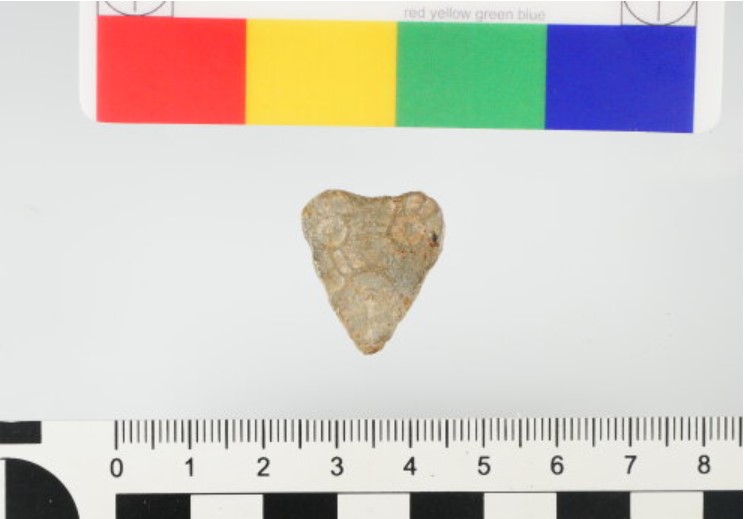
4. Heart-shaped token
Medieval or post-medieval lead-alloy token or personal faith object. It is heart-shaped and flat. One face depicts a human head and torso, with arms stretched out and upwards at about 45 degrees. There is also a strip above the figure featuring a geometrical design, possibly a lattice or criss-cross. The other face has three annulets, each with a central pellet. The pellet in the pointed corner is slightly larger. Each pellet is connected to the other two and to the nearest corner. Each connection is formed of three parallel lines. There may also be another pellet in the central triangle form. Found in Brindle, Chorley. Recorded in January 2026. | Portable Antiquities Scheme Photo: Portable Antiquities Scheme