
Wallace and Gromit and a bear in a bath: Inside the church at Lancashire Conservation Studios in Preston
The Lancashire Conservation Studios, based in a grade II-listed Victorian church in Preston, is one of the biggest conservation studios in the north of England - and the only place you’ll find Wallace and Gromit next to a dead polar bear in a bath.
Having a 15th-century surcoat, a dead polar bear, and the original prototype of Preston’s Wallace and Gromit statue in your office would usually be grounds for arrest.
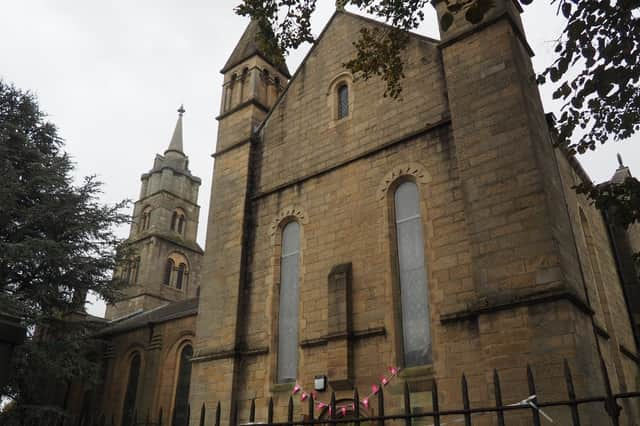

And while the team at Lancashire Conservation Studios may work just over the road from Preston Prison, they can assure you, what they’re doing is perfectly legal.
Since 2007, Lancashire Conservation Studios has become one of the biggest, and only, conservation studios in the north of England.
Boasting a range of departments including textiles, painting restoration, and natural history, it operates as one of the most diversely-skilled organisations in the UK - all from within a grade II-listed Victorian church.
Rot, mould, dirt, and infestation are just a handful of the issues the team resolves each day on behalf of museums, councils, and private collectors, who submit priceless artifacts each day hoping to give them a new lease of life.
Painter Ines Madruga is one of two conservators who work in the upstairs studio. By far the biggest room in the conservation building, the studio is dominated by a large table littered with paints, varnishes, and damaged frames.
Meanwhile, against the wall sit three paintings of increasing size: a portrait of Samuel Cheetham, from the Conservation Studios’ own collection; ‘Family Group’ by Samuel Sidley, currently held by Tameside Galleries; and ‘Landscape of Birds and Animals’ by Frans Snyder, which is more than three metres in length and currently awaiting display at Manchester Town Hall.
“It’s the oldest painting we’ve got here, from the early 1600s,” Ines said.
“This was the latest one Manchester Town Hall had put up for tender, and we were very excited because it’s a very exciting project for a conservator to do: it’s got so much going on, but it’s also got so many damages.
“As [the redevelopment of] Manchester Town Hall is a little bit delayed, we’re trying to align completing this with them finishing so it just goes straight on display. It hasn’t been on display since the 1930s!
“Once we’ve got a clear table, we’re going to address any losses in the canvas. At the back of the studio, we’ve got a low pressure heat suction table, which not many studios have.
“It’s got an aluminium perforated top, and we can apply heat and controlled pressure. We use a conservation adhesive that’s got wax in it, so we need the heat to activate it, the pressure to keep it flat, and a cold setting stage for it, so it’s really useful.”
Only across the hallway from the painting studio entrance is a windowed storeroom, used to organise the materials of the natural history department downstairs.
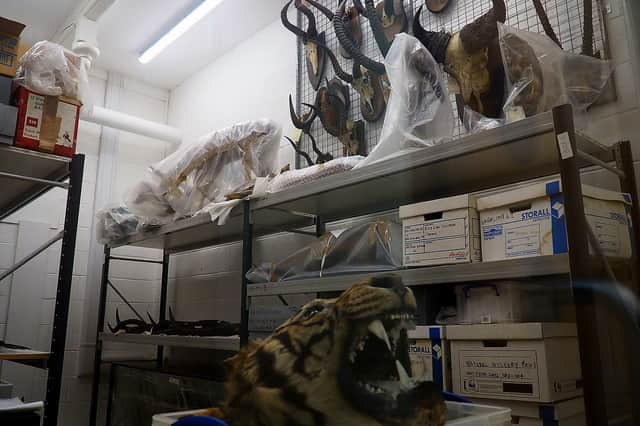
In contrast to the rest of the building, the locked room is not filled with brushes, varnishes, or high-tech equipment - rather, it is filled floor-to-ceiling with a vast collection of animal skeletons.
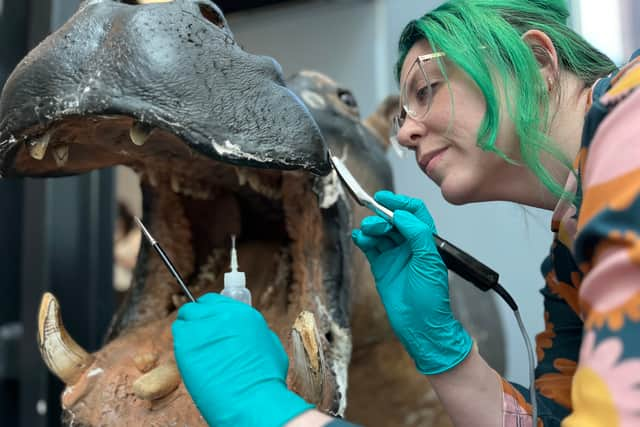
Lucie Mascord is the studios’ resident taxidermist. Specialising in fluid preserved specimens, bone, and human remains, as well as botany, entomology, geology, and palaeontology, she said she is the only natural history specialist currently living in the north of England.
Her workshop downstairs is scattered with taxidermy sculptures, including a zebra, African wild ass, and a collection of birds.
“A lot of people don’t like taxidermy,” Lucie said. “I respect that. But part of my job as a conservator is is to also conserve the artistic intention behind pieces, even if they’re not very good.”
While working on her own specimens, Lucie relies on a combination of goat skin and salvaged parts. As new materials can be difficult to acquire, she said she often finds herself taking pieces from specimens which cannot be repaired.
“You can get goat skin [legally], so that’s not too difficult. Goats will still be skinned and prepared as hides and eaten. But polar bear skin is not as easy to get hold of.
“When something is too far gone, you will take what you can from it. I have lots of cupboards just full of feathers and stuff, just whatever I can find. But goat skin is really good because it’s something I can readily get, and I can also dye it and stain it.
“There’s a couple of museums who have a monopoly on it all,” she continued. “The National Museum of Scotland have an active taxidermy department, so they still actively make new taxidermy for their museums, so they have a monopoly on what they want.
“I have my freezer full of dead animals, so if I needed something like a squirrel or particular British bird, I could take from that. I’m not getting a leopard or a yak coming through, though.”
However, even without matching materials, there is little luxury of working slowly in taxidermy. On her desk sits a desk drawer with a glass lid, with rows of nails neatly hammered into the bottom.
It had once displayed moth specimens in Dunham Massey. After months of being left untouched, the entire case was eaten by insects.
“Carpet beetles,” she said. “Little terrorists.
“This probably only happened over a couple of weeks. There is a point of no return, but we can use things like this as an educational material as well.
“We’re not very on it in the UK, in comparison to America, who will throw money at things like this a little bit more. We have a lot of guidelines that say we’re not allowed to use a lot of [pesticides], so we just watch bad things happen in a sense.
“Our main way of managing pests is vigilance, but that’s very difficult in an underfunded, under-resourced sector. When you see something, it’s really upsetting and you take it really personally.”
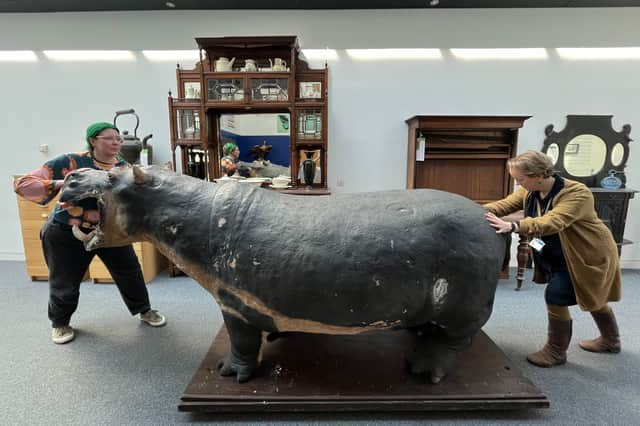
While less severe, insect infestations are a problem Lucie happens to share with her office neighbour Jenny Truran, who oversees object restoration across the hall.
“We’re always looking for clothes moths, carpet beetles, and furniture beetles,” Jenny said. “Our taxidermy collections can be effected by the first two, and so can our textile collections, and obviously our furniture gets woodworm, so we really need to be vigilant.
“Sometimes it’s the insect that does the damage, but more often than not, it’s the larvae. It’s only once we’re confident something is pest-free that we’ll put it back into collections.”
At the front of Jenny’s office sits a giant polar bear in a steel bath. Mochie, who belongs to Arbuthnot Museum, Scotland, is currently having her legs resewn after splitting, and Jenny has spent the past week helping Lucie wash her top to bottom.
She stands opposite a giant laser device, which Jenny uses to clear debris from marble busts, including the statue of Clytie which is currently on display at The Harris Museum.
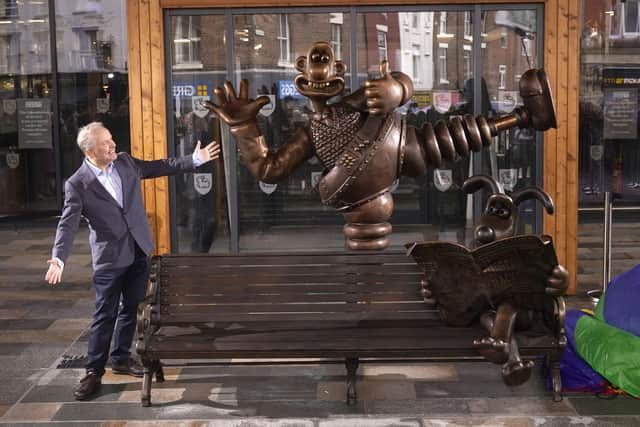
Scattered around her office desk is an assortment of projects she is currently working on. A crowd of Nativity figures - sans Jesus - sit half-restored on the table, while next to them sits a small, grey statue which looks distinctly familiar.
“This is the maquette, the working model, for the Wallace and Gromit sculpture in town next to the market,” she said.
“This was broken, it was sheared off at the ankle. There was a little bit of damage to the bench, and it had been repaired, but it had broken again.
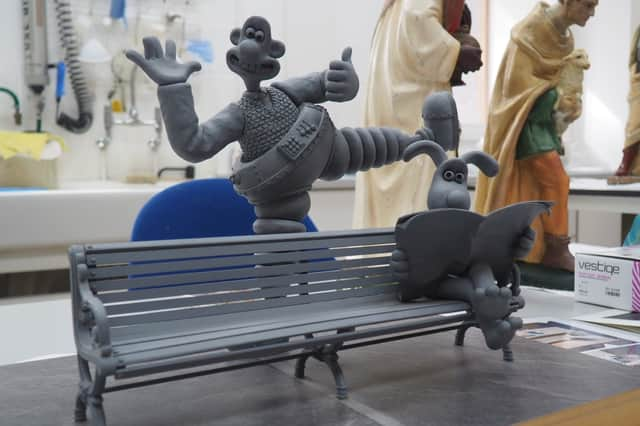
“We’ll have to be really careful in its transport, and then hopefully it will be fine - this wasn’t something that was made to last. It was a working model to make a sculpture, but now it’s become an object in and of itself.”
The Lancashire Conservation Studios is closed to the public, but last week opened its doors as part of Preston’s Heritage Week.
“We’ve got a particularly unique outfit here, “ said conservator Mike Bowden.
“We’ve got a lot of skills under one roof, and a lot of conservators under one roof, so we support other museums and galleries that don’t have these facilities in-house.
“We use the skills that we have to support people around Lancashire.”