
Preston recalls Fishergate’s greener past, present and future
I recently came across an article printed in the Preston Guardian in 1888 titled Some Trees and Gardens in Preston, writes Keith Johnson. Its evocation of greenery along Fishergate is timely, with a new nature-inspired canopy installation soon set to bring colour above the historic street once more.
In the feature, an old Prestonian approaching his seventieth year contributed the following:
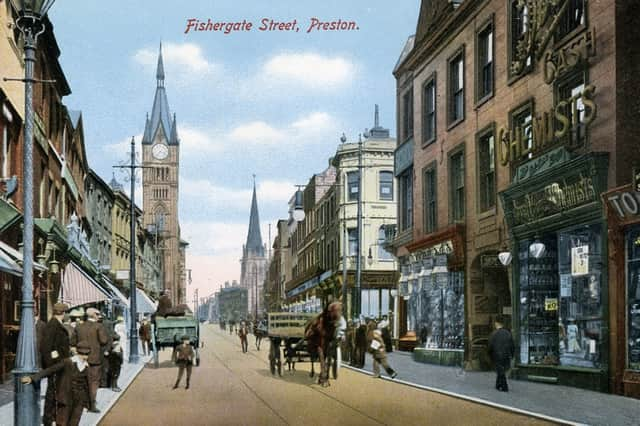

“I remember so many trees that once were growing in Fishergate – real trees, elms and poplars, not laburnums nailed up to the houses. The highest of those was against a bank of which Mr Christian was manager. You went to the bank up a flight of steps, and it was nearly opposite George Horrocks’s house, which had evergreens in the narrow front garden. What a treat it was to pay him a visit on a bright clear night in winter, and be permitted to stare with awe at the stars and the moon. Guildhall Street has done away with Mr Horrocks’s garden now, and Miss Booth’s also, with its stately gateway leading from one terrace down a flight of steps to another terrace. You can see the gateway and dwarf wall in Buck’s print of the South Prospect of Preston of 1728.”
“A laburnum was nailed against Mr Septimus Gorst’s house, which later became Bailey’s the stationers, being next but one to an archway that led to a timber yard, and opposite the Shelley Arms, being about where the Preston Gas offices now stand. A third laburnum graced the walls of a house nearly opposite Betty Redhead’s shop on the corner of Mount Street, with a fourth on the same row. A vine was still trained over the front of the house that Mr Hall had until he took over Mr Dixon’s premises at the corner of Fox Street.
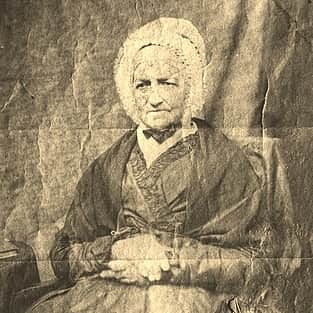
I remember so many trees that once were growing in Fishergate – real trees, elms and poplars, not laburnums nailed up to the houses.
“But the glory of Fishergate was the pyracantha in front of the two houses with ten windows in their upper row, opposite the Theatre. One was occupied by Madam St Clare and her handsome daughter. Madam was a rather formidable person; she sat in state in an upstairs drawing room, with a green shade over her eyes. In the bright long days the pyracantha was a mass of white blossom, which later in the year became a blaze of scarlet berries.
“Below that the real trees began, on the slope to the tramway – spindling things to be sure, but still trees. Under a willow, with his back to the paling and his face to the sun, sat ‘Blind Egypt’ for many a year. He had been a soldier in Sir Ralph Abercrombie’s army and lost his eyes, as many another brave fellow did then, and many more since from ophthalmia. He never begged, at least I never heard him. He sat very solemn and still, this old soldier, from year to year.
“Opposite and along the side of the house Mr Cartwright built, occupied by Mr Birchall, a house handsomely faced with stone, there was a row of poplars which waved about. On one side stood the ivy-covered house of Mr Palmer, the town clerk; on the other little gardens with evergreens all the way to where Mr Cooper lived in Maxwell House, originally with a carriage sweep and two gates that were cleared away and the garden laid up to the street.
His memories were of Fishergate before Queen Victoria took to the throne, when the gentry occupied houses on either side of the street – days before the arrival of the railways and before Fishergate became the busy shopping thoroughfare of the twentieth century where trees were no longer commonplace.
“Opposite came Captain Chapman’s field, then his house with a carriage sweep and numerous trees between the house and the road. Mr Leighton’s house was at the brow of the hill, occupied successively by Mr Newsham, Mr Winstanley and Mr Seed – garden and house a pretty sight before they were levelled and Stanley Place built there.
“I must not forget the tiny front gardens of the row of whitewashed cottages between Maxwell House and Mr Bairstow’s, where the laurustinus flourished, cared for by elderly ladies. Across the road you could see the tops of trees in Mr Robinson’s garden, and further along Fishergate Hill a walled garden with fine pear trees where four boys lived. The top branches of those trees lost their fruit to eager youths using a tin can on the end of a pole. The rim edge was cut into vandykes which caught hold of the pear and loosened it from the tree. There were also apple trees for us to plunder.
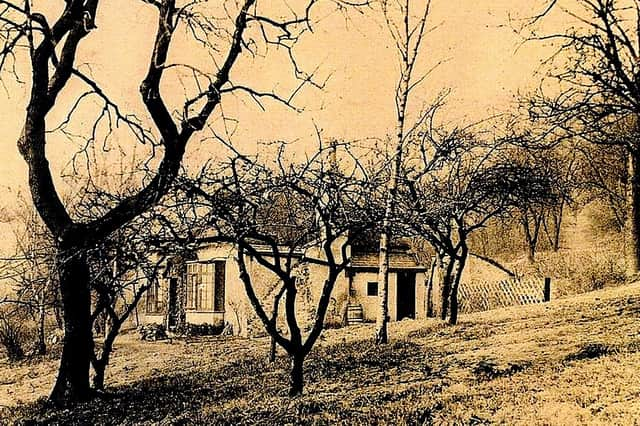
“At the bottom of Fishergate Hill Taylor’s grounds had an abundance of shrubs and fruit trees, but farther afield Jackson’s Gardens on the Avenham slopes was the best place to get flowers. You entered by a gate in the footpath, made of twisted, crooked oak branches, and Jackson’s rustic thatched cottage was a picture in itself, just big enough for himself and his wife. In front grew an aloe – an object of great reverence, for it only blossomed once every few years, and in those early days I wondered if it would ever bloom in our time in the garden that was sweet with oleanders.”
His memories were of Fishergate before Queen Victoria took to the throne, when the gentry occupied houses on either side of the street – days before the arrival of the railways and before Fishergate became the busy shopping thoroughfare of the twentieth century, where trees were no longer commonplace. The new Canopy of Colour installation will again introduce nature-inspired forms above the street, echoing in spirit the greenery once described here.

In line with modern thinking, in 2015, as the first phase of the shared space Fishergate upgrade was carried out, the first six of some 30 planned trees appeared, courtesy of Lancashire County Council.
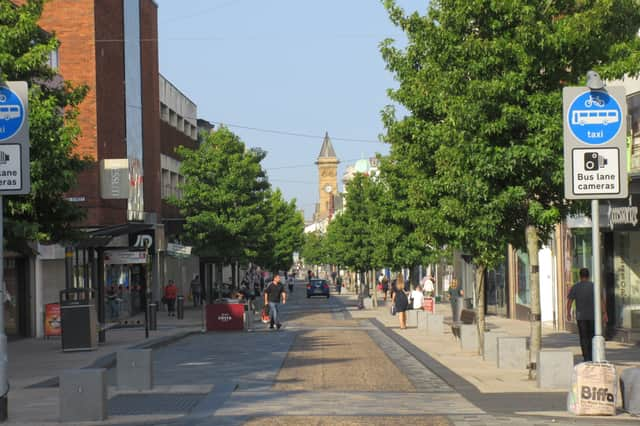
They were sweet gum trees called Liquidambar Red Star, standing around 20 feet tall – trees whose deeply cupped star-shaped leaves are green in spring and summer before turning red and orange in autumn.
Those trees, along with others added later, have helped turn Fishergate into a tree-lined thoroughfare once more – a character now complemented by the forthcoming canopy of colour above the street.