
Red crosses painted on slave traders' gravestone at Lancaster Priory

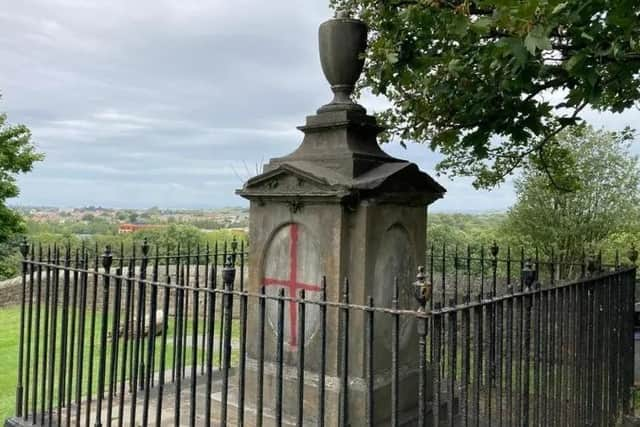
A historic gravestone at Lancaster Priory has been daubed with a red St George’s Cross.
The symbol was painted on two sides of the Rawlinson family monument, which marks the grave of one of Lancaster’s most prominent slave-trading families.
It is not the first time the grave has been defaced.
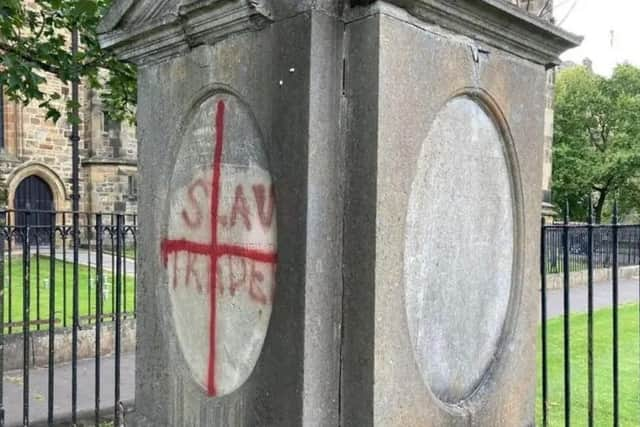

In 2020, the words “slave trader” were scrawled across the stone - graffiti which the church chose to preserve as part of an educational project to highlight the family’s role in the transatlantic slave trade.
Rev Craig Abbott, Area Dean of Lancaster and Morecambe, said the latest vandalism was “not helpful” and confirmed talks would be held on how to deal with the new markings.
“The defacement of any gravestone is concerning and unacceptable,” he told the BBC.
“That said, this particular gravestone belongs to a figure with a complex legacy involving the slave trade.
“The Priory had consciously decided to keep previous graffiti in relation to that legacy as part of a wider educational project.
“In doing so, the Priory is holding the space for both sorrow and truth. Sorrow for the desecration of a grave and truth, acknowledging the pain that such legacies continue to cause; so the addition of the flag graffiti has not been helpful in this context.”
The red cross appeared as St George’s flags have been placed across Lancashire in recent weeks, including on mini roundabouts, crossings and lampposts in Blackpool, Lancaster, Morecambe and Carnforth.
The Rawlinson family rose to prominence when Lancaster became the UK’s fourth-largest slave-trading port in the 1750s and 1760s.
Abraham Rawlinson, head of the family, served as MP for Lancaster between 1780 and 1790 and opposed abolition.
He was expelled from the Quakers in 1779 for his involvement in the trade.
The Priory says it may now seek expert advice on whether and how to remove the latest graffiti.