
University of Lancashire named as one of the best universities for improving a student's social class

The University of Lancashire has been ranked as one of the best English universities for social mobility.
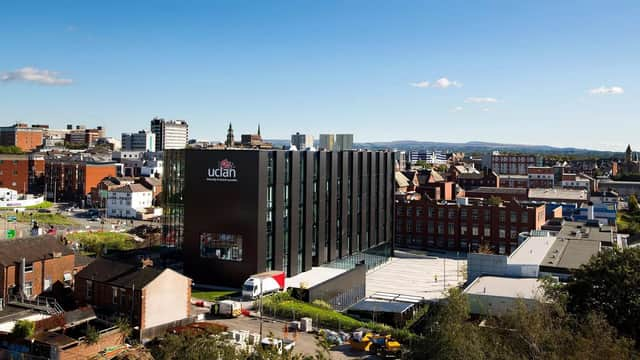
The Preston based university, previously known as The University of Cental Lancashire (UCLan), has been ranked at number 16 in the latest English Higher Education Social Mobility Index.
This makes the University of Lancashire the third best university in the North West for social mobility - just behind the University of Salford and the University of Greater Manchester.
Their 2025 success follows a rise in 13 places in the 2024 Index, which saw it go from 31st to 18th out of 100 institutions and up to 4th in the North West.

What is the index?
The annual English Higher Education Social Mobility Index measures the social mobility of graduates
It is compiled by London South Bank University (LSBU) and has been published by the Higher Education Policy Institut since 2021.
The newly published results, which cover last year (2025), show the number of socio-economically disadvantaged graduates AND the social distance they travel for each registered higher education institution in England.
The rankings are based on several factors including access to education, continuation, and the outcomes of undergraduate students from disadvantaged backgrounds.
What has the university said?
A University of Lancashire spokesperson said: “Our advancement in the English Social Mobility Index reflects the University’s longstanding commitment to making higher education accessible to all, regardless of background.
“We have many initiatives in place to enable this, including offering a suite of access bursaries to remove financial barriers and support students from underrepresented backgrounds and a comprehensive Fair Access Scheme, offering up to a 16 point UCAS reduction and targeted support for students facing educational disadvantage.
“We remain firmly focused on strengthening this work and further enhancing the life‑changing impact of higher education.”
How did other universities fare?
The results for 2025 show:
- Bradford (1) and Aston (2) take the top two places – both are former Colleges of Advanced Technology (CATs);
- The University of Wolverhampton (3) comes next, followed by Birmingham Newman University (4) and another former CAT, the University of Salford (5);
- The University of Greater Manchester (6) and Birmingham City University (7) also make the top 10, as do Imperial College London (8), The University of Huddersfield (9) and the London School of Economics and Political Science (10).
Notably and in part due to the weighting of graduate salaries by region, introduced to the Index in 2024 to account for salary differences across the country, universities in the West Midlands make up four of the top 10, alongside two institutions from Yorkshire and the Humber, two from the North West and two from London.

Have the people behind the index said?
Professor Antony Moss, Pro Vice-Chancellor Education and Student Experience at LSBU, who compile the Index for HEPI, said: “Despite the progress that has been made in widening access to higher education over the last fifteen years, long-standing inequalities both in access and outcomes persist for many disadvantaged learners. Institutions need to do more, both individually and collectively, to close the access and outcome gaps for these learners, and I hope that LSBU’s Social Mobility Index continues to provide a helpful tool for universities to understand the efficacy of their approaches to supporting disadvantaged students.”
Nick Hillman OBE, Director of the Higher Education Policy Institute, who publish the Index said: “At a time when there is a lot of criticism of universities, it is important to be reminded of the critical work they do transforming lives. The Social Mobility Index is different to other rankings because it puts the focus wholly on students and their real-world outcomes. The diversity of institutions in this year’s top 10 suggests the Index measures something valuable that institutions of all types can do well at, if they choose to adopt a dedicated focus.”