
'From Libya, to Italy, to Chorley, I was working with my heart': Doctor retires after 45 years in A&E
Dr Younes Bazza has spent nearly half a century working in A&E at Chorley and South Ribble Hospital, and is now retiring to save lives around the world.
A doctor in Chorley has told of how his childhood promise to his father in Libya led him to spend nearly half a century saving lives in A&E.
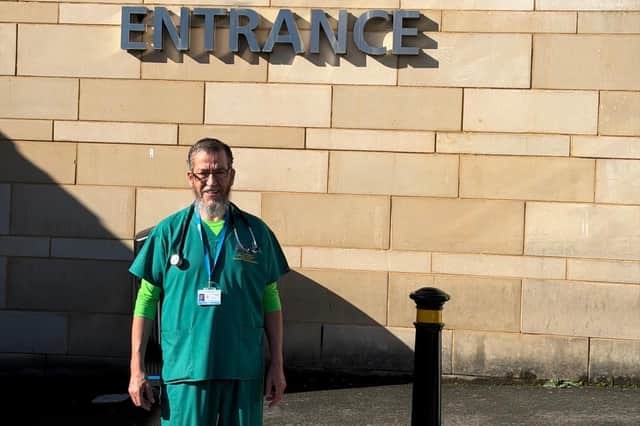

Dr. Younes Bazza, 69, this week worked his final shift after a whopping 45 years as a doctor.
Originally starting his career at home in Libya, he moved to the UK in the '90s, where he spent a further 31 years working in Chorley and South Ribble Hospital.
Speaking to the Lancashire Evening Post, Younes said it all began with a promise he made to his father.
“When I was young, about ten years old, my dad was very unwell,” he said.
“He held my hand as I sat near to him, and he said to me, ‘You need to become a doctor to treat me’.
“I concentrated on my studies to get good grades, and finished my high school in Libya. After that I migrated to Italy to go to the medical school there, because the medical school in Libya had very limited numbers.
“I stayed there for a few years post-grad, and then went back to Libya to work.”
While in Libya, Younes worked in general surgery, a job he said he greatly enjoyed.
But it wouldn't be until 1990 that he set off for the UK to complete a doctorate in Manchester, before being offered a job in Chorley five years later.
Younes remembers rotating through several specialties before landing on his role in A&E, but said he would never forget his first cases when Chorley and South Ribble Hospital opened its new A&E department.
"It was the 26th August, '96," he said. "I was on call for surgery, and there was a patient brought into A&E. He had a deep laceration in his neck, and he was pouring with blood.
"He was dying. He'd been thrown out of a window.
"I started to resuscitate him, to stop the bleeding, and the consultant asked me to take him to theatre.
"I spent about six hours operating, and he survived. He's still alive.
"There were many other accidents," he continued. "One time, the paramedics brought me a patient, and asked me to certify that he was dead.
"But when I went and felt his chest, I could hear: he was slightly gasping for air.
"He had a chest injury, and his lung had collapsed and was causing a cardiac arrest, stopping his heart. I told the paramedic, 'No, we can take him inside and put a tube in his chest'. He survived as well.”

Younes said that during emergencies, medical staff cannot afford to panic.
Instead, they must rely on their training alone to ensure the patient’s survival.
“You have to be patient,” he said. “Despite the severity of the case, you should always have very good knowledge and stay calm. You cannot be nervous.
“If you don't treat a patient in those golden minutes, you will lose them. To face this, you should be calm. You should be brave. But I was not alone: a good team will help you a lot."
Ahead of his final shift on Wednesday (September 30), Younes said he fully believes his team will continue to work well, though admitted they had already asked how they will manage without him: "They're very upset!"
But after 45 years saving lives in Lancashire, he said he felt it was time for a rest - or as much a rest as he could get, while also spending more time with his ten children and 22 grandchildren.
"Eight of my children have finished university: there's three pharmacists; one optometrist; one legal surgeon; one physiotherapist; one is a media translator from Arabic to English and English to Arabic; and one is an aeronautic engineer as well.
"My two youngest kids are still studying."
However, despite hoping to dedicate more time to himself and his family, Younes has no plans to give up medicine for good.
"I will spend a few months in Libya to help with health services for free," he said. "I want to be a charity doctor in Africa and third-world countries: they need more help for poor people.
"I'm not going to get any money or anything, I will do it for the sake of God. I'm always thanking God, and the support of my family and colleagues.
"I will never say no if any of them need help. Even when I'm not working, if they ask for help, I go and help in the department because I am aiming to help people: when they need us, they need us.
"All this time, I was working with my heart, sincerely. I have loved to work in Chorley."