
I went cheesemaking at the home of Blacksticks blue - here's how hard it was
This article was first produced in July 2014.
I love cheese, but I’d always turned my nose up at the thought of eating ‘mouldy’ blue cheese until one Christmas when Blacksticks Blue was wheeled out with crackers.
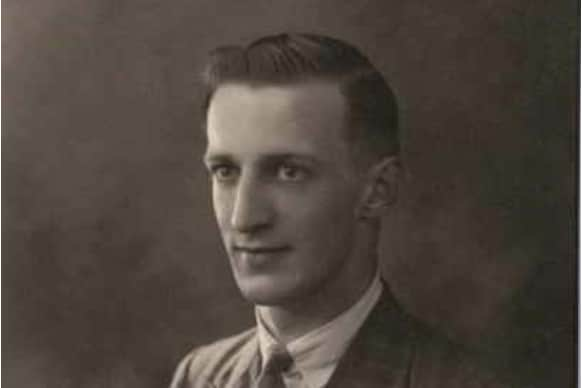
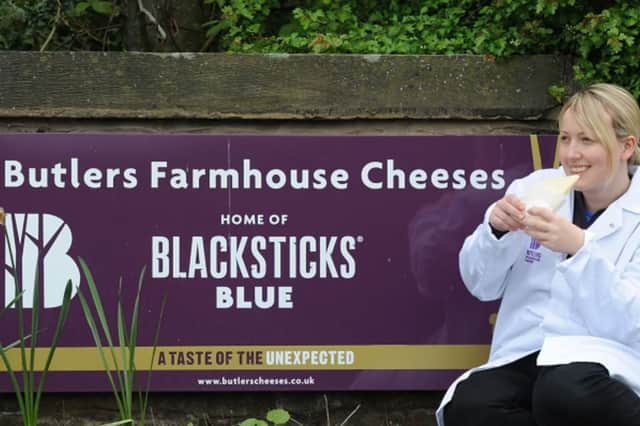
Recently launched, it had been bought because my grandad, Richard Robinson Pye, had been born in 1919 on the farm where it is now produced. Sceptically I tried it, and from then there’s been no looking back. I’m a convert to blue cheeses of all varieties, and it’s all down to Butler’s Farmhouse Cheeses at Wilson Fields Farm in Button Street, Inglewhite.

So, imagine my delight when I was invited along for the day to try my hand as a real-life Little Miss Muffet, complete with curds and whey. Well, it turns out that cheesemakers start even earlier than journalists, so at 6am I rolled up to the farm where my great-grandmother’s family used to live until the 1920s, minus make-up, jewellery, perfume, nail varnish and with my hair tied up, as hygiene rules dictated.
I know what I was expecting to see, but what struck me was that the dairy, which supplies most of the country’s supermarkets, whose cheeses are coveted by top chefs worldwide, and which has a prestigious contract with Marks and Spencer, was really quite small. After filling in a health questionnaire, being told that under no circumstances must I touch my face after cleaning my hands after every process with soap and sanitiser, and changing into dairy whites - white wellies, white trousers and a white t-shirt, covered with two lots of blue aprons - I was led to where the action takes place.
First impressions
First impressions - it’s warm and everywhere smells like sickly, sour milk. Two giant stainless steel baths called open vats sit on a mezzanine floor and at that time there was a lumpy orange mixture. This is where pasteurised milk from cows in the fields surrounding the dairy is pumped to, and where starter culture is added to acidify the milk, as well as rennet, which helps the curds and whey form. That day the dairy was making Red Leicester, and the hot, lumpy liquid was in the first stages of production.
On the dairy floor beneath, connected by pipes, are two even bigger open vats, each with a capacity of 10,000 litres of milk. They would receive the mixture a short time later, to drain off the whey, and leave scrambled-egg-like curds in huge piles. Guided by Daniel Hall, son of owner Gillian Hall, it was at these baths that I was first allowed to have a go. Grabbing a large, blunt knife, I had to cut out two channels down each the side of the bath, then scoop it out, throw it on top, and the whey could flow easily through a sieve at the end.
Curds are heavy, especially when you’re dealing with 1,000kg of them, and the knife kept getting stuck as I dragged it down the seven-metre-long vat. Then I had to reach over the side, stick my hands and arms in all the way up to the elbows, and heave the curds out to land in a pile on the top. This was repeated all the way down one side, and back up the other.
Then, after the acid-levels were taken, to indicate how quickly the cheese will mature, and a little time passed, it was repeated again until the curds were in more solid chunks and could be salted. To my surprise, very little mechanisation of the process was to be found. The dairy is keen to keep craft in the cheesemaking business. The salt was thrown by hand from buckets, and it was only then that a huge industrial mixer started whirring above the bath, churning the curds up.
At this point, Daniel handed me a chunky blue shovel, and we worked up and down the sides of the bath once more, thrusting the curds into the middle, so that it was all seasoned evenly. The shovelling was the hardest part. The curds were even heavier now, I was very hot in my whites and two aprons, and I couldn’t do it very well. I just about managed to move small shovels working right to left, but when the shovel was in my left hand, going in the opposite direction, I could barely pick it up.
After the salting comes the moulding process. In the case of Red Leicester, it gets put in big square moulds that need assembling from two pieces of metal. It’s all hands on deck for this process, and I was assigned the task of lining 50 moulds with two sheets of gauze - one in one direction and one in another, making sure all four corners were covered, and all sides are equal in length.This starts at one end of the bath, with everyone working their way up as quickly as they can, because the cheese is changing all the time.
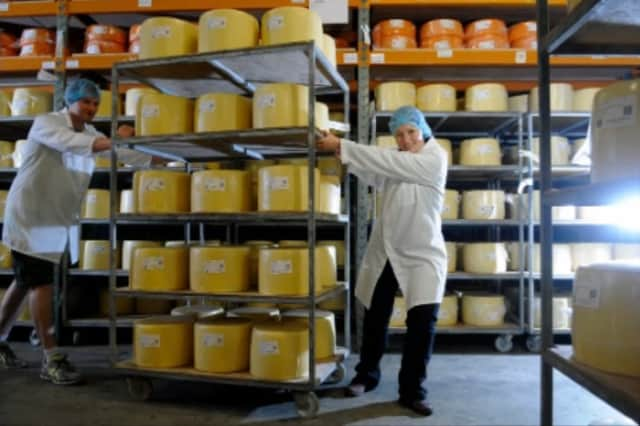
Big slabs of cheese, each weighing up to 20kg are taken away on trolleys into the cold storage area - a huge warehouse full stacked from floor to ceiling with thousands of cheeses of 21 different varities - of all shapes and colours. Daniel explained about each cheese having a different life-span, and the unpredictability of it all. Some cheeses take 12 months to mature, but most supermarkets don’t put their big Christmas orders in until July, meaning production has to be estimated.
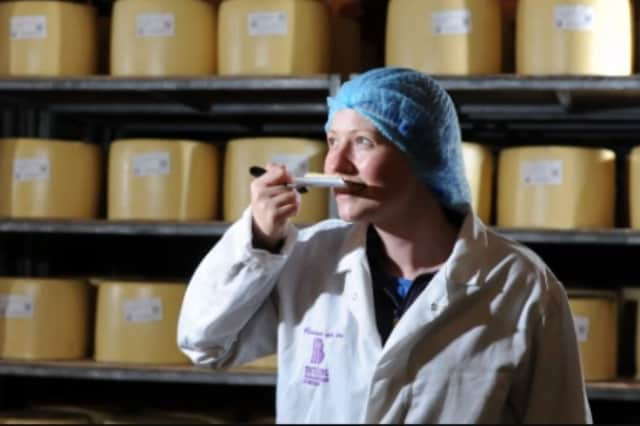
Later, with Gillian, I tried some of their Tasty Lancashire, to check the maturity. Even that wasn’t was easy as it looks. Driving a cheese iron - a small metal shoe-horn - into the side of a waxed round of hard cheese takes serious effort. When the semi-circular channel was pulled out, I was told to look for feathering on the edges of the cheese, before tasting to check the cheese was developing a “rich and complex” flavour.
Because there’s a lot of human input into the process, every step along the way is recorded, incase of any problems, but also so that if there is a particularly good batch, it can be traced back to “what went right” that day, and who was the cheesemaker. I was even promised that if the Red Leicester I helped produce that day scoops a cheese award, it can be traced all the way back to me.
Tired and achy, I left the dairy in the early afternoon, pleased I had seen a part of my heritage and what goes into producing one of my favourite things. But would I want to swap careers with one of the 15 in the dairy or one of the 45 in the packing plant? No, not really. I’m just not strong enough. It’s back-breaking stuff.
Oh, and as for the Blacksticks Blue? Well, the making of that is all kept very secret...