
'Hospice care helped my husband live to see our daughter turn 4 - but they're facing financial crisis'
“The long-term effect of not funding hospice care is that it will add to the burden on hospitals, which cost more. It’s madness.”
A Lancashire widow whose husband died of a rare cancer aged 38, is fighting to raise awareness of a “funding crisis” threatening hospices across the country.
Victoria Bassett, from Burscough, has launched a petition calling on the Government to fully fund specialist palliative care provided by hospices, claiming that more than 50 per cent were in financial deficit last year and nearly 60 per cent of hospices have made or are considering cuts to vital services.
She promised her husband Richard that she would raise awareness of the issue before his death last November at Queenscourt Hospice.
The petition has already gained nearly 8,000 signatures, but 100,000 are needed for the topic to be discussed in Parliament.
It comes as South Ribble MP Paul Foster launched a new ‘St Catherine’s Law’, aimed at making sure that essential hospice medication for people receiving end-of-life or palliative care is paid for by Intergrated Care Boards (ICBs). Mr Foster spoke in Parliament in June, claiming that some hospices are instead being forced to use charitable funding to pay for medicines that the NHS is supposed to cover.


Victoria said: “People might know that hospices need charitable donations, but they might not know how much work hospices do that really ought to come out of the ICB budget.
“On average just one third of funding for hospices comes from government, forcing over-reliance on charitable giving which is no longer sufficient. Over 50 per cent of hospices were in financial deficit last year and nearly 60 per cent of hospices have made or are considering cuts to vital services. Palliative care needs are projected to increase 25 per cent by 2048. Loss of hospices further increases pressure on hospitals and NHS services, is more costly to the NHS, and results in non-specialist care for palliative patients.”
Queenscourt Hospice in Southport, which cares for patients from across West Lancashire, Sefton and Formby, announced in March that it was facing the most severe financial challenge in its 35-year history. The hospice has launched a Keep Queenscourt in Service campaign, as it reports a £2m annual deficit - and had to reduce some of its services in July.
Victoria said: “I can’t tell you how valuable the work of the hospice was to my husband and to our family.
“A lot of people want to die at home now, and hospices do a lot of work with this. If they have to reduce their inpatient facilities and can’t fund hospice at home facilities, then just imagine how many more people will end up in hospital.
“The long-term effect of not funding hospice care is that it will add to the burden on hospitals, which cost more. It’s madness.
“I don’t think the way to fix this is by asking the public to donate more money. There has to be long-term, sustainable funding.”
She added: “Hospice nurses are also experts in end of life care. They were able to more effectively manage Richard’s pain, made him more comfortable and gave him extra quality time with his family, including putting on a fourth birthday party for our daughter. I can’t praise them enough.”
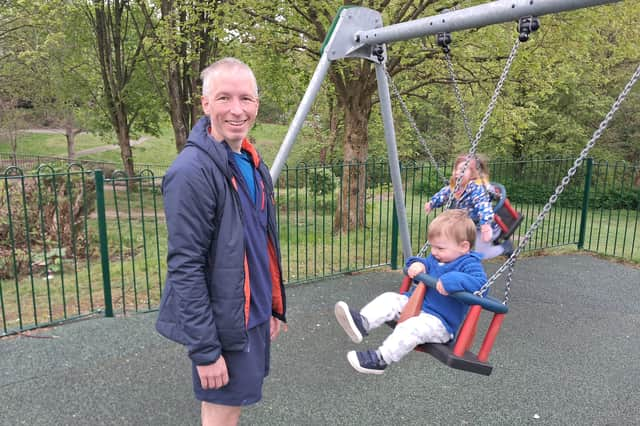
Richard
Richard, an award-winning scientist, was in his 20s when he was diagnosed with a gastrointestinal stromal tumour, better known as GIST. The rare form of cancer, which has no cure, meant he had to endure regular and often gruelling six-week chemotherapy treatment cycles.
Despite this, he regularly took on Park Runs, cycling events and skiing trips.
Victoria, 39, a university lecturer, said: “Richard had cancer for a long time, yet everything he did was just phenomenal. When you factor in what he had to deal with; the gruelling side effects, it’s even more phenomenal. But he never complained, he just wanted to get on. He was the bravest person in the world.”
Victoria said he was a “brillant” father to their children, Amelia, 5, and Mark, 2. She said: “He was so calm with them. It’s so cruel that they’ve lost their Daddy so young.”
Queenscourt
A spokesman for the hospice said: “Queenscourt Hospice is proud to support Victoria Bassett's petition calling for long-term, sustainable funding for hospices. We have been actively promoting the petition across our social media channels and will also be featuring it on our website as we introduce the next phase of our financial recovery marketing campaign.
“We would like to say a heartfelt thank you to Victoria for speaking so openly and courageously about the compassionate care her husband Richard received at Queenscourt Hospice, and the difference hospice care can make to people living with a life-limiting illness, as well as to the families and loved ones they leave behind. Her determination to help protect hospice care for future generations is greatly appreciated by everyone at Queenscourt Hospice.
“Like many hospices across the UK, Queenscourt continues to face significant financial pressures. Despite the incredible support we have received from our local communities, which has helped us continue delivering vital care, we have unfortunately had to make difficult decisions as part of our recovery plan, including reducing some of our services at the beginning of July.
“Hospices provide compassionate, specialist care for thousands of patients and families every year, yet the current funding arrangements continue to present significant challenges for hospices across the UK. We hope Victoria's petition helps to raise awareness of the importance of securing long-term, sustainable funding for hospices, helping to ensure patients and families can continue to access the specialist care they need.
We remain committed to working collaboratively with our NHS partners, including our local Integrated Care Boards, to help secure a sustainable future for hospice care.”
Derian House
Caroline Taylor, Deputy Chief Executive of Derian House Children’s Hospice, said: “Hospices provide vital care and support to families at some of the most difficult times in their lives, and we fully support calls for a fairer, more sustainable approach to funding hospice care. At Derian House, we rely heavily on our incredible community of donors who help us raise the £6million we need to continue every single year, with less than 30 per cent of this coming from government funding.
“The pressures being experienced by hospices across the country are very real, and we believe there needs to be a long-term funding model that recognises the essential role hospices play alongside the NHS and gives organisations the ability to help families in need now, as well as plan for the future.”
Don’t miss out
Want the latest Lancashire news straight to your phone? Join our WhatsApp channel
ICB
When asked about funding hospice care when the issue was raised by MP Paul Foster, NHS Lancashire and South Cumbria ICB, Peter Tinson, director of primary and community commissioning, said: “Historically there have been different NHS funding arrangements for hospices across Lancashire and South Cumbria going back to the days of Clinical Commissioning Groups, before we came together as the ICB. In some of those arrangements, medication has been explicitly separately funded, but in others that is not the case.
“We’ve previously stated that we would welcome national guidance around ICB responsibilities with regards to hospice funding for medication, which would provide a lot more clarity. We are still working closely with Lancashire and South Cumbria hospices to review wider hospice funding arrangements and have provided increased investment both this year and last year.
“We are also working with hospice and hospital colleagues with the aim of further increasing investment in future years to enable more people to be cared for at home and in hospice settings.”