
Former North End footballer spreads awareness of incurable myeloma
‘Incurable blood cancer had eaten holes in my ribs, spine and skull’ - Mel Tottoh recalls his devastating diagnosis
With the 2026 World Cup in full swing, former Preston North End footballer Mel Tottoh is urging fans not to ignore the warning signs of an incurable blood cancer that is often mistaken for ageing or sports injuries.
Tottoh, who hails from Freckleton, was told his agonising back and rib pain was likely a pulled muscle for more than a year before discovering he had myeloma in 2021, an incurable blood cancer that had already eaten holes in his ribs, spine and skull.
He is now speaking out with a stark warning - by the time the World Cup final whistle blows this summer, around 670 people across the UK will have been newly-diagnosed with myeloma - many after long delays and severe complications.
To help people spot the tell tale signs earlier, Tottoh - who famously appeared in one game for North End in the 1980s - is fronting Myeloma UK’s Know the Warning Signs campaign.
As part of the national initiative, the father-of-three is featured with yellow warning signs painted directly onto the area of his body where his symptoms first started, to empower others to speak to their GP if something doesn’t feel right.
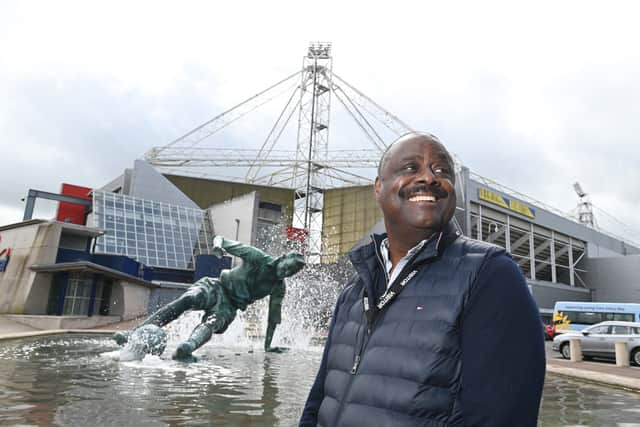

“When I was diagnosed, I had holey bones in my ribs, thighs, spine and skull,” said the 69-year-old.
“I had had symptoms for a year and a half. Ultimately, I’m supporting Myeloma UK’s campaign because I don’t want people to have to go through what I went through.
“As survivors of myeloma we have the benefit of hindsight and we can share it with others, so they go to see their doctor and help their doctor join the dots between their presenting symptoms. Maybe it’s not just a pulled muscle, maybe it’s something else. And this something else could be myeloma.
“The thing that’s astonished me more than anything with my own diagnosis is that it was a simple blood test that gave them a clue as to what was really wrong – but they didn’t do that blood test for months and months.
“A key learning for me is to take responsibility for your health and wellbeing. In the beginning I was very deferential to my GPs but, as time went on, I became more assertive about pushing for answers, and asking for investigations. If they are passive, then respectfully push them to get your needs met. Nobody knows your body better than you, so own it.”
Myeloma affects more than 35,000 people in the UK
According to Myeloma UK, myeloma occurs in the bone marrow and currently affects more than 35,000 people in the UK. It is two to three times more common in black people.
Despite being the third most common type of blood cancer, myeloma is frequently missed, as its symptoms, including back pain, easily broken bones, fatigue and recurring infection, are vague and often linked to general ageing or minor conditions.
One in four people wait more than 10 months for a diagnosis. Yet, a simple blood test can, in most cases, pick up signs of myeloma.
Because describing vague symptoms and being heard can be tricky, as part of Myeloma Awareness Week, Myeloma UK has released a symptom translator to help conversations with GPs and make sure no patient falls through the net.
Designed with the help of people living with myeloma and GPs, the handy guide, which can be downloaded at myeloma.org.uk/warning, lists examples of symptoms in patients’ own words alongside the corresponding medical term for each.
Dr Sophie Castell, chief executive at blood cancer charity Myeloma UK, said: “You wouldn’t ignore a red light on the road or a caution sign on a freshly-mopped floor, so why ignore the warning signs that your body sends you?
“Myeloma has one of the longest times to diagnosis of any cancer. One of the biggest barriers remains identifying and piecing together the symptoms quickly and before too much damage is done.
“The most important thing you can do is get your symptoms checked. We know that myeloma can be difficult to diagnose, so bring the Myeloma UK Symptom Translator with you to the GP, ask for answers and get to the bottom of what’s causing your pain, infections or fatigue. Know the warning signs, put your health first and help us catch myeloma earlier.”
While it is incurable, myeloma is treatable in the majority of cases. Treatment can lead to periods of remission but the cancer will inevitably come back.
Looking back Tottoh had had twinges in his ribs and back for a year and a half before his diagnosis, but initially put them down to playing a lot of golf.
When the pain got worse in the middle of 2020, he consulted his GP who told him he’d likely pulled a muscle and that the twinges would sort themselves out.
“It progressed over months to being quite debilitating,” he recalled. “It was excruciating. I wasn’t able to sleep at night; I was incredibly tired. I had special pillows for the settee to be more comfortable, but it was never successful.
“I had to sleep downstairs because I couldn’t go up the stairs. It got to a point where it started having a real impact on my life. I couldn’t spend time with my family and my little grandson.”
Things came to a head in March 2021, when he felt such searing pain taking a swing on the golf course he thought he might have broken a rib.
“I had to walk off the golf course,” he said. “It felt like there was some serious damage there and I knew I needed to pick up the cudgels and get some investigations done. When I’d gone before they said it was a pulled muscle or ligament pain because I was overstretching and to give it a few weeks.
“But this went beyond muscle pain. I thought I had broken a rib; that’s the kind of pain I was in.”
Diagnosis was a complete shock
Tottoh went back to his GP determined not to leave until he’d been booked in for tests.
Test after test, including X-rays, CT and MRI scans, a cortisol test and a colonoscopy, came back with nothing pointing to myeloma.
Until, finally, a locum at his surgery ordered a full set of blood tests in May 2021.
The results showed some abnormalities and an iron deficiency. He was diagnosed with myeloma in August 2021. Scans later revealed he had holes in his skull, spine, thighs and ribs.
“Being struck down with this was a complete shock,” said Tottoh, who owns a coaching and team performance consultancy business.
“The GP at my practice asked me to come into the surgery as I was anaemic, so I thought they were going to prescribe some tablets, but he said, ‘We’ve got your blood test results back and you’ve got myeloma’.
To this day I don’t remember a single word he said after that. My dad had died of cancer and then, in the last 12 years, two of my brothers died of cancer. I thought it was the end.”
His consultant at Blackpool Victoria Hospital helped him wrap his head around his diagnosis, but Mel went into treatment braced for the worst.
“My consultant and the haematology team were amazing,” he said. “Initially my consultant told me that to be free of cancer for five years would be a good measure, but I took it as an indicative timeline and started making provisions for my family as if I wasn’t going to be here longer than six months. Thankfully I need not have worried so much.”
He had radiotherapy to treat the damage to his bones. He then received chemotherapy, followed by a stem cell transplant. He has thankfully been in remission since November 2022.
Throughout, the support of family and friends has been invaluable.
“It takes a small army to get you through this ordeal,” said Tottoh, who is still on maintenance treatment to keep his cancer at bay for as long as possible.
“I had always been the one who took care of everybody, but since 2021 I’ve learned to be open to help and support from others.
“The most important thing now is having people in your corner, people who care, people who lift you up when you’re down. My family and closest friends have done that. My wife has been amazing. She’s my rock, the cornerstone of my life and I owe so much to her.”
Be first to know. Get Lancashire’s biggest stories delivered direct
Nearly five years on from his diagnosis, Tottoh is determined to live life to the full, build a strong professional and personal legacy and, above all, make memories with his family and his grandson Theo, nine.
“My mindset is really positive,” he said. “I will see my grandson go to university and get married – if that’s what he wants to do. I will see my kids fulfil their dreams.
“My wife and I have structured our life around our family, providing for them, and doing as much as we can to make life wonderful for all of us. Right now, I’m in an amazing place and I’m on the path to living with myeloma for a very long time.”
You can download the symptom translator here: myeloma.org.uk/warning
For more information about myeloma or to get in touch with Myeloma UK go to myeloma.org.uk/warning. Myeloma UK runs an Infoline on 0800 980 3332.
WHAT IS MYELOMA?
- Myeloma is an incurable blood cancer that occurs in the bone marrow
- Despite being the third most common type of blood cancer, myeloma is difficult to detect as symptoms are often linked to general ageing or minor conditions
- While it is incurable, myeloma is treatable in the majority of cases
- Treatment can lead to periods of remission but the cancer will inevitably come back
10 RED-FLAG SYMPTOMS
- Persistent or unexplained pain for more than 4-6 weeks, particularly in the back or ribs
- Tiredness that doesn’t improve with rest (fatigue)
- Frequent or hard-to-clear infections
- Easily broken bones or unexpected fractures
- Experiencing either frequent urination or minimal to no urination
- Swollen legs or abdomen
- Nosebleeds or unexplained bleeding or bruising
- Unexplained weight loss
- Numbness in the feet, hands, or legs
- Unexplained shortness of breath
KEY STATISTICS
- There are over 35,000 people living with myeloma in the UK
- There are over 2,400 people living with myeloma in Scotland
- On average 17 people are diagnosed with myeloma every day in the UK
- 8 people die from myeloma every day
- Around 6,200 people are diagnosed with myeloma every year in the UK
- Around 3,200 people die from myeloma every year in the UK
- More than half of all people with myeloma will survive for 5 years or more
- Around 1 in 2 people with myeloma have to wait more than 5 months before they get the right diagnosis
- 1 in 4 people have to wait more than 10 months before they get the right diagnosis
- Around 1 in 3 people with myeloma are diagnosed through an emergency route
- Over a third of people with myeloma attend at least three appointments at their GP practice before getting a diagnosis
- Around 4 in 5 people diagnosed with myeloma every year are over the age of 60
- Myeloma is two to three times more common in black people
- Myeloma is the most common blood cancer affecting black people
ABOUT MYELOMA UK
- Myeloma UK is the only UK charity dedicated to providing support and influencing access to treatments, while researching a cure
- We are here for people affected by myeloma and related conditions, for healthcare professionals and researchers – and anyone who wants to be part of the cure
- We receive no government or NHS funding and rely entirely on voluntary donations, fundraising and gifts in wills
- To find out more visit www.myeloma.org.uk or follow us on X @MyelomaUK, Instagram and TikTok @myelomauk, and Facebook facebook.com/myelomauk/
- Our free Infoline is available on 0800 980 3332, Monday-Friday 9am-5pm