
Lancaster University chiefs bite back at accusations of poor management & governance in redundancy plan row

Chiefs at a top Lancashire unviersity have bitten back at accusations directed towards its management and government during a huge redundancy row.
Lancaster University has defended its management and governance from accusations of poor leadership, poor risk management and a lack of independent scrutiny, as it considers potentially making over 400 staff redundant.
The Local Democracy Reporting Service has received accusations criticising the university’s management and governance, plus decisions on buildings, land and facilities, following its redundancy plan announcement and discussions and questions about the issues at Lancaster City Council.
The university says fewer international students are among the key reasons why it needs to save £35million. Overall, it says it is in sound financial health but significant changes, particularly less foreign students, mean savings must be made.
But new accusations have been made, which were put to Lancaster University this week.


Which accusations?
‘NO PLAN B’
Despite immigration being a key political debate in the UK for years, the university’s top managers developed no ‘Plan B’ to potentially having fewer foreign students. One critic said: ‘Surely the top management’s role includes assessing risks and considering the future political environment?’
University management has focused on buildings and land at the expense of education. Solar farm and air source heat pumps plans ‘could have been delayed’. Upgrading a management school ‘could have waited’. Ten years ago, a new engineering building was created from a former sports centre ‘at immense cost’. Now the university is building another engineering building. How much has all this cost?
Recruitment policy, vice-chancellors and ‘churn’. The university council, a governing body, insists on recruiting from outside, according to one accusation. But Lancaster is arguably a small university so vice-chancellor applicants typically see the role as their first but not last. Examples of churn include vice-chancellors leaving Lancaster for jobs in Australia or Dundee. One former vice-chancellor proposed a merger between Lancaster and Liverpool, which would arguably have left Lancaster the ‘unfashionable campus’, according to one accusation. This year, it was announced that Andy Schofield is going to Glasgow University this autumn.
‘Bloated administration influences decisions’. Decisions have been based not on what is best for students, scholarship and research but instead for facility interests – such as estates,the library, hospitality and conferences, it is claimed.
‘Top management has taken control of the university’. In the past, each department chose its own head, signed off by the vice-chancellor. Several departments were grouped in faculties with elected deans. There involved open nominations with a ballot and hustings if needed. Associate deans were also elected on open nominations. But now, the vice chancellor chooses the dean, associate dean and all department heads. The university’s nine colleges used to elect their own principal. But now it’s done by the vice chancellor, according to accusations.
GOVERNANCE
‘A lack of independence and effective governance’. The senate, the chief academic authority, includes department heads, deans, top management, college principals, some junior lecturers and a handful of students. The vice chancellor appointed nearly all of them, said a critic. The university council, the main governing authority, used to be elected. This is not good for independence in governance, it is argued.
‘Outside directors were got rid of in the past’. Outside directors are reliant on information they are given but management controls the information, it is claimed. The only others are elected from the student union So there is no really effective governance. One accusation stated: “There has been a big power grab and a backing-away from having different voices. So we have a council and senate that are, in effect, echo chambers. That has been a concern for years.”
Other accusations included a shared office system for lecturers, which is arguably unsuitable for students, office rents paid by different departments in an internal market system used across the university.
Another accusation stated: “Last time there was a problem at Lancaster University, there was a big review by a law expert. But that was put away. However, I think this latest situation is the tip of the iceberg now. We could have weathered the storm better if we had not spent so much on buildings and land acquisitions. We could have had a cash pile to help us through the lean times.”
How did the university respond?
The accusations were put to Lancaster University. In a statement, a spokesperson said: “Lancaster University is a top ten university with global standing in terms of both our research quality and teaching excellence, and we have been a force for good in our community for more than 60 years.
“In the light of financial pressures impacting the whole UK higher education sector we are now making some very difficult decisions to enable us to protect that legacy.
“International students have always been an important part of our community but, in the last two years, the nature of the student recruitment market has changed significantly.
“At the first sign of this shift, the university leadership team began making plans in anticipation of a range of potential outcomes and have opted to be as strategic and transparent as possible about those plans.
“We know that through working together our impactful researchers, excellent teaching staff and strong professional services make Lancaster University successful. Every effort will be made to mitigate the need for compulsory redundancies as far as possible through voluntary means. This process will be overseen by robust governance structures and practices. ”
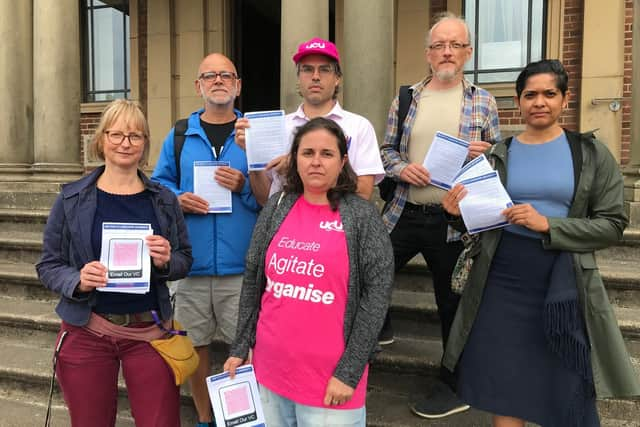
Staff in the University & College Union (UCU) are campaigning about jobs.
The union has been contacted for comment reports Local Democracy Reporter Robbie Macdonald.