
Catholic Church warns six-day school strikes in Preston and Fleetwood will have ‘grave’ effects
Staff walkouts are planned across three weeks.
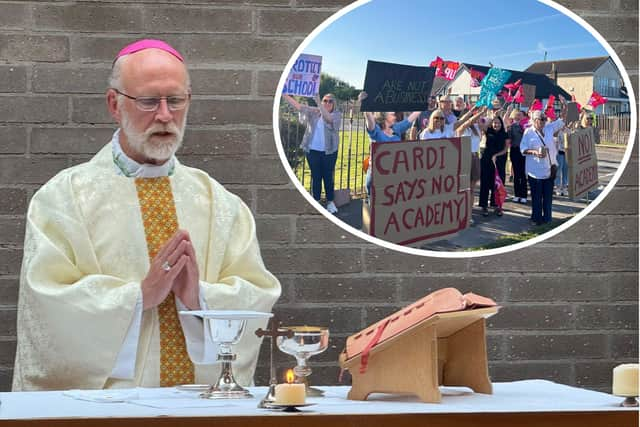
The Catholic Church says it is “saddened” by forthcoming strike action at four Lancashire schools - and the “grave problems” it will cause.
The scheduled walkouts - over the Diocese of Lancaster's plans to turn all of the schools it operates into academies - will see the members of three unions down tools on a total of six days over the next three weeks.
Corpus Christi Catholic High, Our Lady’s Catholic High and English Martyrs Catholic Primary - all in Preston - and Cardinal Allen Catholic High in Fleetwood are amongst the minority of diocesan schools not yet to have adopted academy status.
The diocese - which covers Preston, North Lancashire, the Fylde coast and South Cumbria - wants all 80 of its school facilities to be converted and to join a church-run multi-academy trust (MAT).
So far, 53 have made the switch, mostly in the six years since the Bishop of Lancaster, the Right Reverend Paul Swarbrick, set out his ambition for blanket academisation - which he says is necessary to protect the future of Catholic education in Lancashire.
However, the National Education Union (NEU), the NASUWT teachers’ union and the National Association of Headteachers (NAHT) claim the move will suck money out of the classroom, because of the way MATs are run.

Follow us on Facebook for the latest from Preston, South Ribble, Chorley and right across Lancashire - as it happens.
The Lancashire Post understands that while the diocese has offered to meet the NEU to discuss their concerns, the suggested dates fall after the strikes begin on 24th November.
It has also emerged that while the NEU requested cross-union talks, the diocesan offer was to meet with the NEU alone. The NASUWT - which backed a joint meeting involving all unions - told the Post that it had been refused a separate, one-to-one discussion.
The Post approached the Lancaster diocese for comment on its approach to negotiating with the unions, but had not received a response by the time of publication.
However, the diocese has issued its first statement on the latest round of strike action, which is taking place at an increased number of schools - following previous, shorter stoppages at Cardinal Allen and Corpus Christi.
A spokesperson said: “The diocese is saddened by the opposition of the unions and some MPs to academisation on principle, not least because this is the educational model which is being advanced by the government as well as the church.
“The diocese is open to dialogue with unions and will work constructively to avert the prospect of any strike action and the grave problems this will cause to pupils and their families.”
On the broader issue of the claimed need for academisation, Michael Merrick, Lancaster’s Diocesan Schools Commissioner, added: ‘We are enormously proud of what we have achieved through academisation over the past six years and we are grateful to those who have responded generously to the invitation to the vision of the Bishop of Lancaster to secure the future of Catholic education.
“We now have the opportunity to build on what has been achieved to extend support, expertise and solidarity in education throughout the entire diocese.
“These proposals are designed to protect and strengthen our schools by creating a system capable of preserving Catholic education for future generations. In this endeavour we follow our forebears who laboured hard to establish the original educational settlement some 80 years ago.
“We therefore encourage all to enter into consultations with optimism.”
Following a one-day walkout by teaching an non-teaching staff at the four striking schools on 24th November, further strikes are planned for 1st-2nd December and 8th-10th December.
‘One big family’
The diocese has also unveiled plans to create a single new MAT to replace the three it currently operates for academies in different parts of its patch.
Currently, the Mater Ecclesiae MAT operates 17 of the 23 Catholic schools in Preston and the surrounding area, the Blessed Edward Bamber MAT controls 20 of the 22 across the Fylde coast and the Mater Christi MAT runs 16 of the 36 in Cumberland and Westmorland.
The process of merging that trio of individual trusts will temporarily pause the conversion of any other schools to academies in the Lancaster diocese.
A letter, seen by the Post, and sent to headteachers at all Catholic schools in the diocesan area - academy and non-academy - explains the shift to a single MAT.
“The original vision of our schools working as a family in support of one another, both locally and across the diocese, remains our guiding principle; the ways in which this might be achieved have continued to evolve.
“In light of this, we now have the opportunity to build on what has been achieved and to consider how the support, expertise and solidarity developed within our three trusts might evolve to embrace all our diocesan schools as one family.
“We have a clear vision for what we want to achieve: a strong and sustainable family of Catholic schools, able to share expertise and resources and provide the best possible support to our schools, staff and pupils. There is, however, much still to explore about how we best deliver this.”
However, the NEU says headteachers are concerned that the change will mean less funding for frontline education.
Academies within MATs have their budgets topsliced to contribute towards the cost of central support services that would previously have been provided by the local authority that used to operate them - in this case, Lancashire County Council or Blackpool Council.
The unions say the arrangement swallows up far more cash than schools had to surrender to the local authority support system before they became academies - at around five percent of their total funding.
The NEU estimates that converting to an academy would cost Corpus Christi, as an example, £300,000 in topsliced cash - and an amount equivalent to the funding for five teachers at Cardinal Allen.
The union told the Post that leaders of existing academies feared the creation of a single MAT would see the topslice proportion increase further. The Diocese of Lancaster was approached for comment on that suggestion.
Meanwhile, Claire Ward, the NASUWT national executive member for Lancashire, told the LDRS earlier this week: “The projected costs of academisation being quoted to staff keep rising, demonstrating the threat posed by these plans which would see precious funding syphoned away from the front line.
“Public money should be focused where it is most needed – in the classroom.
“We continue to urge the diocese to recognise the strength of opposition to these plans among the school communities and to engage meaningfully with all unions on a collective basis to resolve this dispute.”
The NEU’s Lancashire branch secretary, Ian Watkinson, added that the strike plans were sending “an unmistakable message to the diocese”
“[They] now have an opportunity to listen, engage meaningfully with the unions and respect the wishes of school communities. They should take it before further industrial action becomes necessary,” Mr. Watkinson said.
‘Potential for disruption’
Moves by the Archdiocese of Liverpool to academise all of the schools in its area - which includes South Ribble, Chorley and West Lancashire - have met with similar union resistance to that encountered in the Lancaster Diocese, as well as growing political opposition.
A letter to the Archbishop of Liverpool, the Most Reverend John Sherrington - signed by MPs including South Ribble’s Paul Foster and Ribble Valley’s Maya Ellis - warns that academisation has “the potential to disrupt the stability of schools...which are currently serving their pupils, parents and communities well”. It highlighted a recent report showing “a significantly increased turnover of staff” in the run-up to conversions.
However, Paul Barber, director of the Catholic Education Service - an agency of the Catholic Bishops’ Conference of England and Wales - said every diocese in the country ultimately wants its schools to become academies.
“Over half of Catholic schools have academised and are now in academy trusts.
“Schools also do this for various practical reasons such as moving from support provided by a non-Catholic organisation to receiving it from a Catholic organisation; curriculum continuity for pupils from primary into secondary; and collaboration with other schools in SEND provision, chaplaincy or particularly RE teachers, where there is a national shortage.
“Being part of a Catholic family of schools sharing resources helps to protect against this and any austerity agenda of future governments.
“Ultimately, the decision for a Catholic school to become an academy only comes after a full and thorough consultation with school leaders, staff and parents, and is taken by its governing body,” Mr. Barber said.
The Lancashire County Council area – which excludes Blackpool and Blackburn with Darwen – has seen a far slower academy conversion rate than the national average. As of January 2026, just 20 percent of schools in the County Hall patch are academies or free schools – 128 out of 618. Across England, the proportion was 46 percent in January 2025, the latest date for which figures are available.
Academies are state funded in the same way as maintained schools and, from a policy perspective, there should be no financial incentive to convert, nor any financial penalty for doing so.
However, there were claims that early waves of schools that converted in the 2010s, which became standalone academies rather than joining trusts, were overcompensated by the grant they were given to cover the cost of the services they no longer received from the local authority. But now there are suggestions, like those being made by the NEU and NASUWT, that schools within MATs are being disadvantaged for the reverse reason.
History lesson
When academies were first created in the early 2000s, they were seen by the then Labour government as a way of driving up standards in failing schools.
The Conservative and Liberal Democrat coalition government opened up the programme to all schools a decade later and encouraged them to convert in high numbers.
Schools rated inadequate by Ofsted were later ordered that they had to join an academy trust on the basis that the support they would receive would help them to improve.
In its ‘Every Child Achieving and Thriving’ white paper, published earlier this year, the current government set an expectation that all state-funded schools will join or form a “school trust” in order to extend the number of multi-school groupings across the education system.
However, under that plan, local authorities would, for the first time, be allowed to establish their own trusts – potentially slowing the 15-year trend of councils having less involvement with schools.