
Is This the Blackburn Banksy?
A Hidden Masterpiece Beneath Ewood Park
Tucked away beneath the Riverside Stand at Ewood Park, down in the service yard behind the main façade of Blackburn Rovers, lies a scene so layered with symbolism it could well be a work of contemporary art in its own right.
At first glance, it’s a mishmash of old furniture, forgotten fittings and oversized photographs. But on closer inspection, it feels more like an open-air installation. Not just a scene of neglect, but a carefully composed commentary on memory, power, and the state of the modern game.
Dominating the space is a large print of Jack Walker, the steel magnate whose name is still sung at Ewood, caught in a quiet exchange with Alan Shearer, the striker he famously brought to Blackburn in a record-breaking deal that helped deliver the Premier League title. This moment, immortalised and pasted onto a cold, grey wall of concrete blocks, is more than nostalgia. It’s a statement. A portrait of legacy, pride, and the steel-built identity of the club.
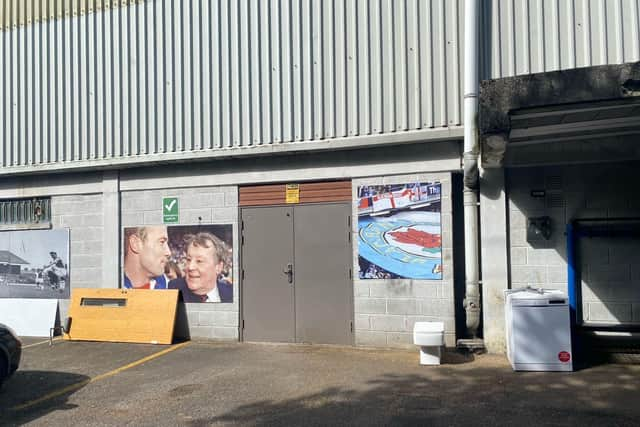

To the side, a broken door slumps on the ground, having come away from its hinges. It lies there like a fallen monument, its absence from a doorway acting as a metaphor for lost access, lost leadership, or perhaps the crumbling state of something once strong. In front of it, a toilet and dishwasher have been dumped, as if by accident, but their presence is too peculiar, too pointed. These are domestic objects that, in the right light, echo the rebellious spirit of modern art. The toilet instantly brings to mind Marcel Duchamp’s infamous piece, while the dishwasher sits like a mute commentary on the everyday chaos behind the scenes.
There’s humour here, certainly but also sadness. These items don’t just say “rubbish”. They say “disregard”, “disrepair”, and maybe even “disrespect”. In their own strange way, they raise questions. About how the club is being run. About what has been thrown away. About what legacy really means, years on from Jack Walker’s passing.
To the right, another image shows a colourful view of the stadium from above, packed with fans. A visual burst of energy and optimism. But sat next to the scene around it, it feels like a postcard from a better time, one that may be slipping further into the past.
And then there’s the speculation. Could this be a piece of street art? A statement from someone in the know? After all, DJ Goldie who once nearly let slip the true identity of Banksy was recently spotted in nearby Darwen at an Adidas event. A coincidence? Maybe.
But this strange visual set-up beneath Ewood Park feels deliberate. Subtle. Loaded with meaning. Just like a Banksy.
What’s more, the shadow of Venky’s hangs over it all. Their controversial ownership of the club, the broken promises, the sharp decline from Premier League glory all feel strangely represented in this composition.
The door, off its hinges. The industrial fittings left to rust. The club’s proud past staring out into a grey void.
Art critics often talk about “found art” and “social sculpture” the idea that art doesn’t have to be made in a studio. It can happen in the real world. Accidentally. As a mirror to society. This might be one of those moments. A public installation not in a gallery, but in a car park. One that speaks to Blackburn’s past, its frustrations, and maybe even its hope that someone, somewhere, is still paying attention.
Whether or not Banksy was involved doesn’t really matter. What matters is that people are stopping to look. To question. To remember. And maybe that’s exactly what this scene was meant to do.