
Shroud of Turin life-size replica of Christian relic to go on display at Blackburn Cathedral this Easter

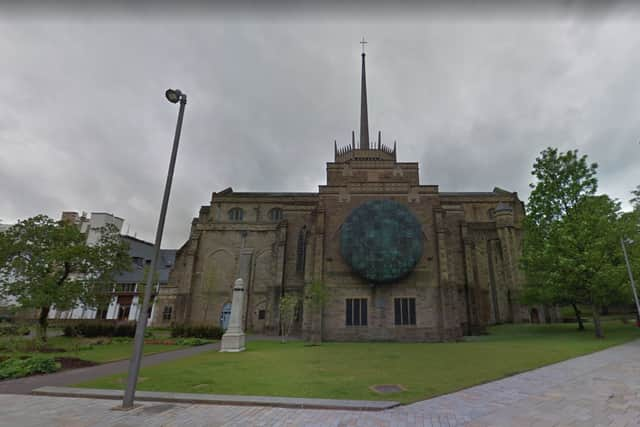
A life-size replica of one of the most mysterious Christian relics - the Shroud of Turin - will go on display at Blackburn Cathedral this Easter.
The special exhibition - part of the cathedral’s centenary celebrations - will be free to visit from Monday, March 23 to to Sunday, April 12.
It offers a rare opportunity to learn more about the mysterious 14-foot linen cloth - which is said to bear the faint, negative image of a crucified man, and venerated by many as the burial shroud of Jesus Christ.


As part of the exhibition, Fr. Andrew Dalton - a catholic priest based in Rome - has been invited to give a one hour talk on the Shroud at 1pm on Sunday, April 12.
Both Fr. Dalton’s talk and the Shroud exhibition are free entry.
In addition to celebrating the Cathedral’s centenary, the Shroud exhibition and Fr.Dalton’ s talk are also part of the 50th Jubilee Convention of the British Society for the Turin Shroud.
The society has also arranged for a one day ticketed event on Saturday, April 11, with world-renowned Shroud experts in science, history, theology and art attending the event.
“Deeply moving and thought-provoking”
A spokesperson for Blackburn with Darwen Council said: “This special exhibition offers a rare opportunity to learn more about the sacred burial cloth believed to have wrapped the body of Jesus after the Crucifixion.
“For many, encountering the Shroud has been a deeply moving and reflective experience. A unique and thought-provoking exhibition, open to all.”
Is it really Jesus?
The burial cloth has been preserved since 1578 in the royal chapel of the Cathedral of San Giovanni Battista in Turin, Italy.
For centuries, the shroud has been the focus of debates about its authenticity, and an object of devotion by those who believe that it is truly a sacred relic of Jesus Christ.
The cloth features markings that allegedly correspond to the crucifixion wounds of Jesus, including thorn marks on the head, lacerations (as if from flogging) on the back, bruises on the shoulders, and various stains of what is presumed to be blood.
In 1988, the Vatican provided three laboratories in different countries with postage-stamp-sized pieces of the shroud’s linen cloth.
They subjected these samples to carbon-14 dating and all three laboratories concluded that the cloth of the shroud had been made sometime between 1260 and 1390, thus indicating that it was inauthentic.
However, many Christians continue to venerate the shroud as the sacred and inspiring image of Christ, preserved from the moment of his crucifixion 2,000 years ago.