
Talking Sport with Gavin Browne: The highs and the lows of the World Cup
Underdogs, referees, VAR, red cards, TV studios and Perfect Day: A look back at the highlights and lowlights of this year’s World Cup.
How was it for you then? The last time I wrote one of these columns, it was just before the start of the World Cup.
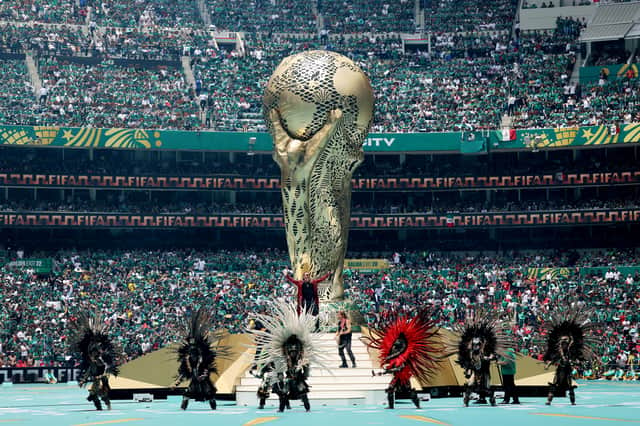

With a record 48 teams playing in a tournament staged across three countries for the first time, I said it remained to be seen if bigger equalled better.
Full disclosure. Deadlines meant this had to be written before Sunday’s final so it remained to be seen whether Spain managed to stop Argentina from defending their title.
While more teams gave an increased number of countries a chance of qualification, it did perhaps dilute the quality on show.
That isn’t taking anything away from Cape Verde, whose displays against Spain, Uruguay and Argentina meant their place was more than merited.
Uruguay, for their part, were arguably the main disappointment though in hindsight, it wasn’t that big a surprise given they barely reached England’s penalty area during March’s Wembley friendly.
In terms of referees, it looked like we’d have an overly officious tournament in store when three red cards were shown in the opening game.
After that, it was a pleasant change to watch matches with officials playing on rather than stopping proceedings every time a player hit the floor.
That laissez-faire approach might have gone too far when Paraguay met France, but it was a happy departure from the norm.
Now we get to VAR. Early on, the talk was how the Premier League could learn a lesson in terms of the decision making and the speed at which they happened.
Alas, it was too good to be true with the last of four disallowed goals between Portugal and Croatia particularly contentious.
Egypt could also feel hard done by with a goal ruled out against Argentina and as for the three-minute delay before Kylian Mbappe’s missed penalty when France met Morocco, that just took the proverbial.
There was also a top scorer battle for the ages with arguably the world’s four leading attackers - sorry Cristiano - in Mbappe, Lionel Messi, Erling Haaland and Harry Kane firing their teams into the latter stages.
As for Ronaldo, the tournament was one too many despite what his vociferous supporters might claim: is there really any doubt as to whether Messi is the better of the two?
OK, I can’t put it off any longer. Folarin Balogun’s red card and the subsequent furore.
Was he right to be sent off? It looked extremely harsh but the World Cup rules saying red cards cannot be appealed opened up Pandora’s Box.
Following some lobbying, FIFA invoked Article 27 which meant Balogun’s red card would be rescinded but he would serve a 12-month probationary period.
The same clause meant Ronaldo was able to play Portugal’s first two matches, having been given a three-game ban for a red card against the Republic of Ireland last November.
Nobody comes out of it well. Balogun for putting himself in the position to start with, the original refereeing decision, FIFA’s backdown or those busy behind the scenes.
Away from the experiences of England and Scotland, much of the UK focus was initially on the differing approaches taken by BBC and ITV with their coverage.
The Beeb attracted criticism for keeping presenters and pundits in the UK until the latter stages: a ‘work from home’ approach, as it was billed.
Suppose they had gone fully-staffed for the last month? In all probability, those criticising them for staying put would have been submitting freedom of information requests as to who they’d flown with, where they were staying and for how long.
A bit of maths later and we’d have a story estimating the cost to the licence fee payer and questioning whether it was a valid use of money. Damned if you do, damned if you don’t.
Speaking of which, the reminders about scanning QR codes to pay for a TV licence generated plenty of ire on social media.
Licence fee reminders aren’t new if we take a trip back to 1997.
Anyone watching the BBC last thing on a late summer’s evening would have seen, between programmes, a music video for a cover version of Perfect Day.
A corporate promotion of its musical output, the following message popped up on the outro: “Whatever your musical taste, it is catered for by BBC Radio and Television. This is only possible thanks to the unique way the BBC is paid for by you. BBC. You make it what it is.”
That none-too-subtle licence fee reminder didn’t attract anywhere near as much debate, but its future wasn’t a political hot potato back then.
As for ITV, their USA-based line-up might have had the stunning backdrop of New York but I don’t recall anyone asking how suitable a base that was given no matches were played there.
Again, keeping presenters and pundits at home isn’t something new either.
Go on YouTube and you’ll see how the BBC and ITV covered World Cups back in the day.
Mexico 1970 began what was described as the golden era of presenter and combative pundit, but where were Brian Moore, Jimmy Hill and their colleagues all based?
I’ll give you a clue. They were nearer to the North Circular than North America, an arrangement which continued for a number of World Cups to come on both networks.
All of which just goes to show that the more things change, in some cases, the more they stay the same…