
Local owner David Armstrong's racing column: The road to financial disaster
Peter Easterby was a gruff Yorkshireman with his heart in the right place but there was no better judge of a horse.
A figurehead of one of racing’s most famous families he was responsible for Sea Pigeon and Night Nurse, two of the sport’s biggest stars in the 1970s and early 1980s.

He was a gentleman who had a deep passion for the countryside, but Peter was as sharp as a tin of tacks when it came to business.
“Now, listen, lad,” he told me on my first visit to his yard.
“I’ve got a question for you, David.
“How do you make a million pounds from horse racing?”
Of course, I had no idea.
But quick as a flash, Peter added: “Start with five million pounds, and you will be lucky if you break even.”
I’ve always thought about those words because right now racing is on the road to disaster if things don’t change quickly.
Racing is in a terrible state financially.
They call it the sport of kings but there are plenty of smaller trainers getting pushed closer to the margins of survival every day.
It’s a mess, and many have simply packed up because they can’t make ends meet.
The rising cost of fuel, staff wages and the shocking state of prize money on offer, all contributors to racing’s growing crisis.
When I compare the prize money on offer to a couple of decades ago, there is barely any difference for the bread-and- butter midweek races staged today.
And the decision by Manchester bookie Fred Done – when he announced this month that his company would not be renewing their sponsorship of the five British classic races, the 2000 and 1,000 Guineas, The Derby, The Oaks and the St Leger – has come as a massive blow.
Future sponsors will not be wanting to put more money into a negative enterprise, because that’s what racing has become.
It just shouldn’t be like that because the public are not falling out of love with racing.
Quite the opposite, in fact.
Racing is one of the great days out and a bumper crowd of 32,000 flocked to Cheltenham for the first day of their November meeting, while the major Flat Turf fixtures continue to attract healthy attendances.
I have great admiration and respect for the new generation of jockeys who have emerged in the last few years.
Just look at what Billy Loughnane has achieved this term, crowned as the youngest British champion flat jockey since Charlie Elliot won the title in 1923.
His ride on the 2000 Guineas star Bow Echo, that gave him his first classic success, was one of the highlights of the season.
Now he has landed a plum job for Godolphin as one of their retained riders.
Billy’s a humble lad and what I admire most about him and others like Rob Hornby, Rossa Ryan and Hector Crouch, who rode Coppull to victory in the Hungerford Stakes in August, is their desire for hard work and application.
American trainer Wesley Ward knows plenty about sprinters and now he owns the fastest horse in the world.
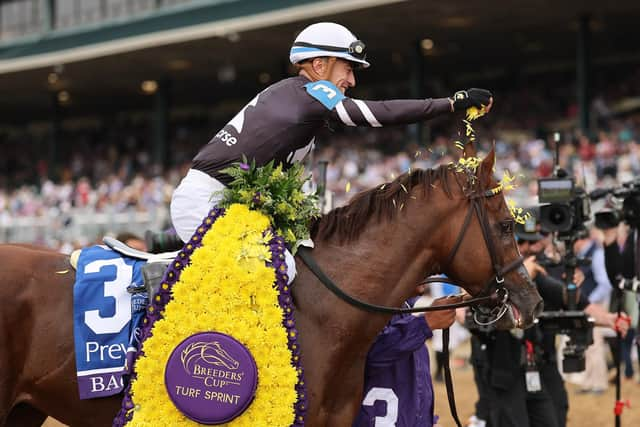
You could only marvel watching his globe-trotting superstar Bacio winning the Breeders’ Cup Turf Sprint at Keeneland in splendid isolation.
Remember, the three-year-old had also carried off the Palace of Holyroodhouse Stakes at Royal Ascot before obliterating the field in the Nunthorpe at York in August.
Bacio is an exceptional horse with speed to burn but what a training performance from Ward on his home track.
Bacio is not a big animal, but he is very quick and agile like a cat.
And once again he demonstrated electric early speed from the stalls to leave the field trailing in his wake.
You only have a small window with a sprinter so to keep Bacio sweet for so long is a testament to Ward’s deep understanding of this horse.
Shipping a horse to a different continent presents so many hurdles.
Coming from America to the UK, Bacio had to acclimatise to a fresh environment, including a period in quarantine, but he overcame every challenge.
There’s plenty of good horses, but there’s few true champions – and Bacio has joined racing’s elite.
David Armstrong was talking to Tony Dewhurst