
Why are deliveries of auto parts sometimes delayed? A look at the inner workings of e-commerce logistics


You ordered the exact brake pads your car needs and paid for expedited shipping. Now, you're refreshing the tracking page for the third time today. Sound familiar?
If you've ever bought car parts online in the UK, you've probably had to wait longer than expected for an essential component to arrive. The reality is that 52% of online auto parts buyers cite delivery delays as their primary concern, and this problem isn't going to go away anytime soon.
Delivery delays aren't the result of one retailer making a mistake. They're baked into the complex machinery of cross-border e-commerce logistics, especially in the automotive aftermarket. The European automotive parts e-commerce market is booming – growing from $23 billion in 2022 to an estimated $58.5 billion by 2028. That's more than double in just six years. This rapid growth puts enormous pressure on warehouses, carriers, and customs systems that weren't designed to handle such high volumes. Add Brexit into the mix and UK buyers are facing a perfect storm of logistical challenges that make delays not just possible, but probable.
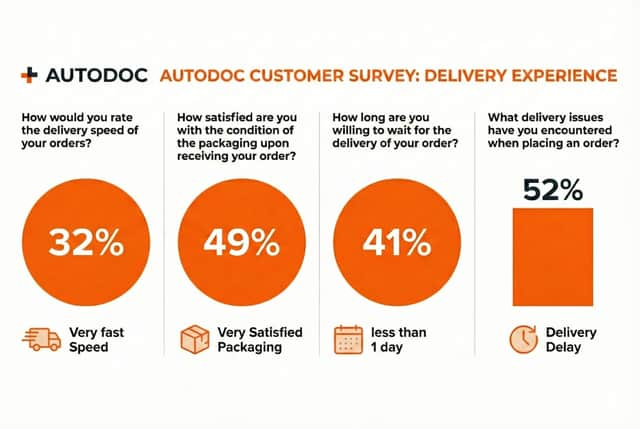
According to a recent industry survey conducted by the European parts retailer AUTODOC, customer expectations regarding delivery times are mixed. While 32% of respondents rated delivery speed as “very fast” and 37% as “satisfactory”, a significant 30% described their experience as “slow” or “very slow”.
When asked about problems encountered when ordering, 52% of customers cited delivery delays as the main issue – by far the most common complaint. Damaged packaging was the second most common issue at 21%, followed by a lack of order status updates at 22%. Issues with the wrong address were minimal at just 5%, suggesting that the problem is not human error in processing orders, but rather the complexity of getting parts from point A to point B.
Customer patience varies considerably. While 17% expect delivery in less than a day, the majority are more realistic: 41% are willing to wait one to three days, and another 29% will wait four to seven days. A patient 13% don't mind waiting more than a week. However, these expectations don't always align with the realities of cross-border logistics, especially for specialist parts that aren't in a local warehouse.
Where your parts actually come from
Most car owners don't realise that the replacement alternator or set of brake discs they ordered probably didn't begin its journey anywhere near the UK. Auto parts are sourced from specialist suppliers across Europe, particularly in France, Germany, Poland, and Spain. Each country has its manufacturing strengths, and online retailers aggregate inventory from multiple suppliers to offer the widest possible catalogue.
Large-scale operations like AUTODOC illustrate just how complex modern automotive logistics have become. The company operates four major warehouse hubs across Europe: Berlin, Szczecin (Poland), Cheb (Czech Republic) and Ghent (Belgium). The state-of-the-art Ghent warehouse opened in 2025, representing a significant investment in modernising European distribution capacity. Each facility handles tens of thousands of parts and processes thousands of orders daily.
While this multi-hub approach offers customers access to a vast range of parts, it also introduces complexity. Depending on stock availability, your order may be fulfilled from Berlin or Szczecin.
The Brexit bottleneck nobody talks about
For UK customers, there's an additional hurdle that didn't exist before 2021: Brexit. Now, every single package crossing from the EU into Great Britain faces mandatory customs clearance. This isn't a minor administrative step; it's a significant bottleneck that can add days to delivery times.
Customs clearance requires detailed paperwork, including commercial invoices, commodity codes and proof of origin. Even when everything is filed correctly, the sheer volume of packages moving through UK border checkpoints can cause unpredictable delays. For example, a part leaving a Belgian warehouse on Monday might clear customs by Wednesday, or it might sit in a holding facility until Friday.
This is why many UK customers experience a "black hole" in tracking information. The period between a package leaving an EU facility and appearing in the UK postal system can span several days with no updates whatsoever.
When the whole system gets overwhelmed
Significant seasonal fluctuations in the automotive aftermarket put a strain on the entire supply chain. In the months before winter, for example, there is a surge in orders for tyres and maintenance parts, as drivers prepare for harsh conditions. Holiday periods also see a spike in gift purchases and supplies for DIY projects. During these peak periods, carriers, fulfilment centres, and even customs facilities can become overwhelmed, resulting in delays across the industry that affect every retailer equally.
Carrier reliability can vary significantly. Premium courier services offer faster transit times and better tracking, but at a substantially higher cost. Budget carriers deliver acceptable results under normal conditions but struggle during peak periods. Retailers must balance cost, speed, and reliability for each market segment they serve.
Different e-commerce models produce different delivery outcomes. AUTODOC's approach of sourcing from multiple EU hubs provides extensive parts availability but introduces complexity in cross-border fulfilment. Amazon's model relies on dedicated UK and EU fulfilment centres, which often deliver faster results for common items. However, their automotive catalogue is more limited as they cannot economically stock tens of thousands of specialist parts.
Real-world examples highlight common frustrations, such as packages being delayed at Coventry or Heathrow customs for four to seven days without explanation, parts being shipped from Germany and reaching the UK within 48 hours only to spend another week in the domestic delivery network, and tracking numbers no longer updating once the package leaves the EU.
The lack of order status updates is a key source of customer frustration, as mentioned by 22% of respondents. In a cross-border scenario, this gap is often unavoidable. Once a package leaves an EU hub and enters UK customs, tracking typically becomes unavailable for 2–5 days.
Understanding the different stages of the tracking process can help. “Dispatched from warehouse” means that the package has left the EU facility but hasn't yet reached UK soil. “Cleared customs” is the key milestone – once this status appears, delivery is usually 1–3 days away. The absence of updates does not necessarily indicate a problem, but rather a gap in system integration.
On a positive note, when packages do arrive, they generally arrive in good condition: 49% of customers report being “very satisfied” with the quality of the packaging, and another 41% rate it as “satisfactory”.

AUTODOC Great Britain holds an "Excellent" Trustpilot rating of 4.3 based on over 15,000 reviews. This reflects the fact that, despite the inherent challenges of cross-border automotive logistics, the service remains reliable overall. Although customers may experience delays, they receive authentic parts in proper condition, backed by responsive customer service.
Plan ahead and save yourself the stress
Delays in the delivery of auto parts aren't the result of incompetence or cutting corners by individual retailers. Rather, they are the natural consequence of a complex system involving multiple countries, thousands of suppliers, post-Brexit customs regulations, and market growth that has outpaced infrastructure investment.
The smartest approach for UK car owners is simple: plan ahead. If you know your brake pads are wearing thin or your battery is showing signs of weakness, order them before they become urgent purchases. Allow yourself an extra week, especially if ordering specialist or less common parts.
Drivers looking to purchase auto parts online may be interested in AUTODOC's extensive catalogue, which offers competitive pricing. Readers in the UK can receive a 5% discount on purchases over £100 on the AUTODOC UK website using the promo code lepATD. This code is valid from 11 November 2025 until 15 January 2026. Whether you're planning a DIY repair or stocking up on maintenance supplies, understanding the logistical reality helps you to set realistic expectations, and ordering in advance ensures that you won't be left waiting when your car needs immediate attention.