
Preston’s role in the American Revolution and the man who lost America

Discover the intriguing story of General John Burgoyne, MP for Preston, whose actions during the American Revolutionary War led to significant outcomes in both the UK and the USA. Uncover how Preston's Great Election of 1768 and Burgoyne's military ventures shaped history.
As the United States of America celebrates the 250th anniversary of the Declaration of Independence, announced on July 4, 1776, during the American Revolutionary War (1775-1783), we in Preston can reflect on the part played by John Burgoyne, an MP for Preston, writes Keith Johnson.
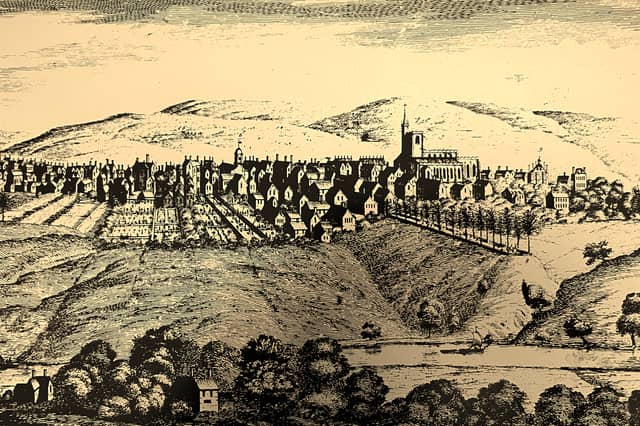
If we turn the clock back to the 18th century in Preston, the exploits of Burgoyne are brought to light. At the election of 1768, when Preston’s population was about 5,000, four contestants sought the two seats in the House of Commons. Sir Henry Hoghton and John Burgoyne stood for the Whig interest, with the backing of the Derby faction, while the two other candidates, Sir Frank Standish and Sir Peter Leicester, represented the Tory party and the interests of the Corporation of the Borough.
John Burgoyne, who was born in Sutton, Bedfordshire, in 1722, was no stranger to Preston, as he had been stationed in the town during the 1740s when he was a lieutenant in the 13th Light Dragoons. Whilst based in Preston, he had frequently visited Knowsley to share the company of his old school friend James Smith-Stanley, commonly known as Lord Strange, the eldest son of the eleventh Earl of Derby.
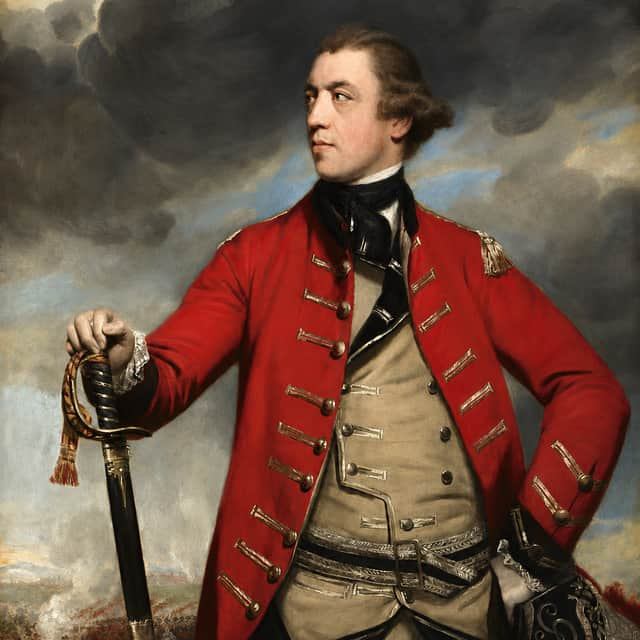
During his visits, he became acquainted with Lady Charlotte Stanley, his friend’s sister. Their meetings developed into a loving friendship and this led to their elopement in 1751. The relationship had brotherly approval, but was frowned upon by Lord Derby. His reaction was to sever the couple’s ties with the Stanley family. A number of years in London, and then France, followed for the couple before they eventually became reconciled with Lord Derby.
By the time of the election of 1768, the by-then General Burgoyne had the full backing of the Stanley household. He entered the contest with an impressive military background and as an experienced MP, having represented Midhurst in 1761.
The election contest that followed was to be eventually referred to in the local annals as the “Great Election”. For a period of 18 months, its influence was to be felt on the life of the town.
There were scenes of bloodshed and many brutal skirmishes between the contending parties, and it is on record that Burgoyne rode through the town with a pistol in each hand. One of the battle cries was “Leave not a Freeman alive”. Lawless bands of colliers from the neighbourhood of Chorley were in Preston in the interest of the Corporation candidates, while from Longridge and Ribchester came armed blackguards in support of the opposition.
For upwards of six months before the voting, the town was at the mercy of the hired bludgeon men. The inflamed mobs even went to the length of destroying places of worship, and the Roman Catholic church of St Mary’s on Friargate was sacked at this election. No one appeared safe, with even the Mayor, Robert Moss, being seized and soused under a pump. Dishonourable methods were employed and disturbances and destruction were the aim. Most of the windows in the town were broken and many buildings were barricaded against the mobs.
In March 1768, a letter appeared in the Gentleman’s Magazine, written by a local resident in late February. It read as follows: “The contest here is attended with imminent danger. I have just escaped with many friends. The country is now up in arms. As the town is now abandoned by our men, the cry is ‘Leave not a Freeman alive’. God knows where this will end. I think tonight or tomorrow may be fatal to many.”
A further letter, published in April, included the following: “The violence committed on account of the election in Preston exceeds belief; murdering, maiming, pulling down houses, destroying places of public worship and the burning of furniture, are amongst the acts of the inflamed mobs.”
The Mayor and Corporation maintained that only freemen, or in-burgesses, were entitled to vote, whilst the Whigs and the Derbyites strictly supported the claim that all the adult male population were eligible to cast a vote. The result of the election, held from March 21 until April 2, was that the Corporation nominees were returned, namely Sir Frank Standish and Sir Peter Leicester, despite receiving fewer votes. According to the Mayor, a freemen-only vote was the official outcome, with Leicester on 289 votes, Standish 276, Burgoyne 259 and Hoghton 230, Leicester and Standish being duly elected.
The defeated candidates promptly petitioned Parliament and the House of Commons ruled that other votes cast by the inhabitants at large must be included, leaving the state of the poll thus: Hoghton 558 votes, Burgoyne 589, Leicester 290 and Standish 277, meaning victory for the ruling Whig party under the leadership of the Duke of Grafton.
As a result of this, Preston afterwards enjoyed universal adult suffrage prior to the Reform Act of 1832. The Corporation keenly felt this rebuff to their ancient rights and privileges, and their power was never the same afterwards. The rioting was the subject of a trial in May 1769 and, as a result, Burgoyne was convicted of improper practices and ordered to pay a fine of £1,000, whilst a number of rioters were imprisoned for six months.
Whilst serving as Preston’s MP, General Burgoyne became involved in the American war. In 1777, he was in command of the British Expeditionary Force that went to Canada and, after a couple of small battles in which he was successful, he crossed the Hudson River to engage the Americans on their own soil. His army became engaged in a ferocious battle during which he lost many men.
The losses, plus sickness amongst his soldiers, forced him to camp at Saratoga in order to rally his troops for the final battle. Gradually, the enemy closed in on all sides and eventually Burgoyne’s army was surrounded. His orders had been to meet up with Lord Howe and his army at Albany, although Lord Howe, oblivious to the intentions of General Burgoyne, was marching his troops towards Philadelphia.
Reduced by desertions, sickness and lack of supplies, General Burgoyne was forced to surrender to General Gates of the American army. He and his troops were well treated by the colonists as they were marched to various encampments, the popular officer later paying tribute to their kindness and generosity in Parliament.
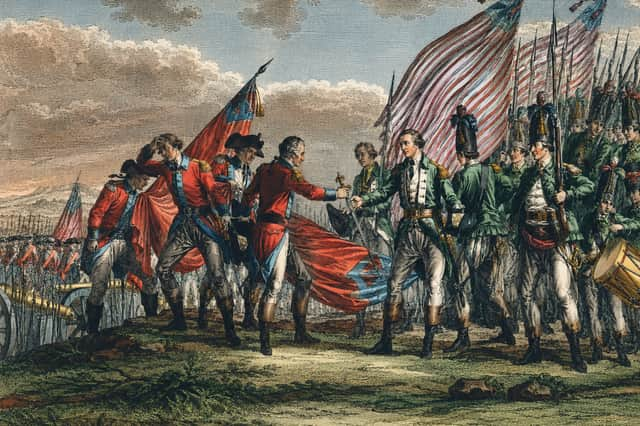
Burgoyne was allowed to return to England on parole, but later the Americans demanded his removal from the House of Commons. Fortunately, thanks to the intervention of Benjamin Franklin, one of the founding fathers of the USA, whom he is believed to have met in Preston, the claim was eventually waived.
He went on to play an active part in Parliament and often spoke on questions affecting the army, the improvement of the soldier’s lot and India. Certainly, his popularity in Preston increased and, in all, he and Sir Henry Hoghton were returned to Parliament to serve the town in 1774, 1780, 1784 and 1790.
In his later years, he devoted much of his time to the theatre and was, in fact, the author of several plays. A flamboyant character and great wit, he was in demand in the very best of society. He died in August 1792 and was buried in the cloisters of Westminster Abbey, near to his beloved wife Lady Charlotte. Sir Henry Hoghton also died within that Parliament, in the year 1795.
The exploits of General Burgoyne feature in my book A-Z of Preston, published by Amberley, and some modern-day scribes describe him as the man who lost America.