
Preston Guild Hall’s journey from civic glory to ruin, rebirth and uncertainty
The uncertain future of Preston Guild Hall echoes a long and chequered history of civic buildings, fires, demolitions and rebuilds linked to the city’s ancient Guild celebrations.
Perhaps we should not be surprised that the future of our glorious Guild Hall is uncertain. After all, its predecessors went through uncertain times and came to an inglorious end, writes Keith Johnson. Certainly, Preston and its Guild Halls have had a chequered history. Therefore, news of the current troubles at the Guild Hall on Lancaster Road should come as no surprise.
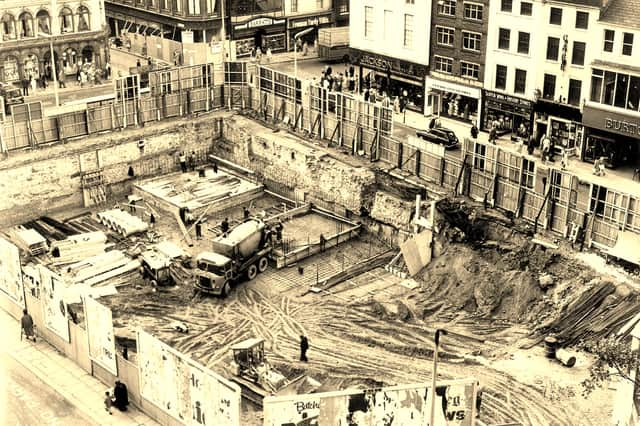

Our town halls, moot halls and guild halls have been interwoven from the earliest of days. As long ago as circa 1680, Dr Kuerden had this to say on his visit to the town: “In the middle of the borough is placed an ample ancient and yet well beautified guild or town hall, to which is annexed at the end thereof, a council chamber for the capital burgesses or jurors at their court days, to retire for consultations or to retire from public view.”
Kuerden was pointing out that it was the place where the Guild mayor and all officials connected to the event would gather every 20 years to celebrate the Guild Merchant.

In 1760, Preston Corporation decided to erect a purpose-built Guild Hall adjoining the existing Town Hall, and the new structure was ready for all the pomp and pageantry of the Guild of 1762. Alas, it was the structure’s one and only Guild, as a large proportion of it fell down into a heap of ruin in early June 1780. A ball had been held the previous evening, and the ladies and gentlemen in attendance had only departed a few hours before the catastrophe occurred.
Little time was lost in building another one on the same site, incorporating some of the old structure, and amazingly it was open in time for the Preston Guild of September 1782. By all accounts, it hosted a splendid Guild, including a masquerade ball attended by 300 genteel folk. The work had been entrusted to Messrs Bailey & Emett, who signed a contract for no more than £615 — around £96,000 in today’s money.

The new Town Hall was described thus by historian Peter Whittle 40 years later: “This handsome building stands in the centre of the borough near the Market-place, and fronts onto Fishergate, built of brick, it contains a news room, a council chamber, together with a court room. A Cupola was added in 1814 built of freestone with mouldings of Norman style and surmounted with a clock with four dials. Over the entrance to this Town Hall the arms of the town are carved along with the initials P.P. meaning Prince of Peace.”
The rear of the Town Hall is open to the Market-place, and is ragged, tasteless, smoky, and dirty
Things were gradually changing for the worse as time moved on and Preston was in the grip of the Industrial Revolution. Indeed, a reporter from The Builder magazine who toured the town in 1861 had this to say after journeying up Fishergate: “At last the Town Hall narrows the road, just where Cheapside leaves Fishergate at a right angle, and the Market-place opens out in view. The Town Hall is neither modern nor ancient: but is a dingy worn out mansion. The rear of the Town Hall is open to the Market-place, and is ragged, tasteless, smoky, and dirty. Shop shutters are leaning against the ruined walls, as are temporary wooden urinals: placards and posters are stuck upon every available space.”
By March 1862, the Town Council had resolved to improve matters and a gang of workmen was busily engaged in pulling down the Town and Guild Hall buildings. Soon they would make way for a structure said to be more in accordance with the wealth and importance of the borough, even though the “cotton famine” was in full swing and poverty abounded among the working classes. That year’s Preston Guild had to be ceremoniously opened in the hall of Preston Grammar School, as the Guild Hall site was a pile of rubble.
The new building was opened in early October 1867 amid much pomp and ceremony by the Duke of Cambridge. The contractors were local builders Messrs Cooper & Tullis and the architect was George Gilbert Scott, a future knight. Built with stone from the Longridge quarries, it was lofty and stately in appearance. Altogether it cost more than £69,000 to build, equivalent to almost £7m these days. It was a building at the heart of Guild celebrations in 1882, 1902 and 1922.
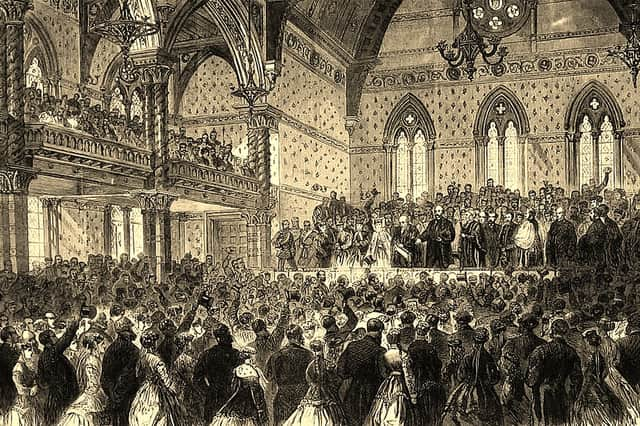
There was a change in emphasis in the decade that followed with the erection of new Municipal Buildings on Lancaster Road, opened in September 1933, with a purpose-built Council Chamber and Mayor’s Parlour for dealing with Town Hall matters. Designed by architects Messrs Briggs & Thornley of Liverpool, the £130,000 structure, built of Portland stone, was described as well balanced and elegant.
Nonetheless, the Guild Hall remained an essential place for civic ceremonies and events galore. Unfortunately, the Preston Guild of 1942 was cancelled due to the Second World War. Talk was that, once the war was over, the Guild Hall would play host to a Preston Guild in 1952.
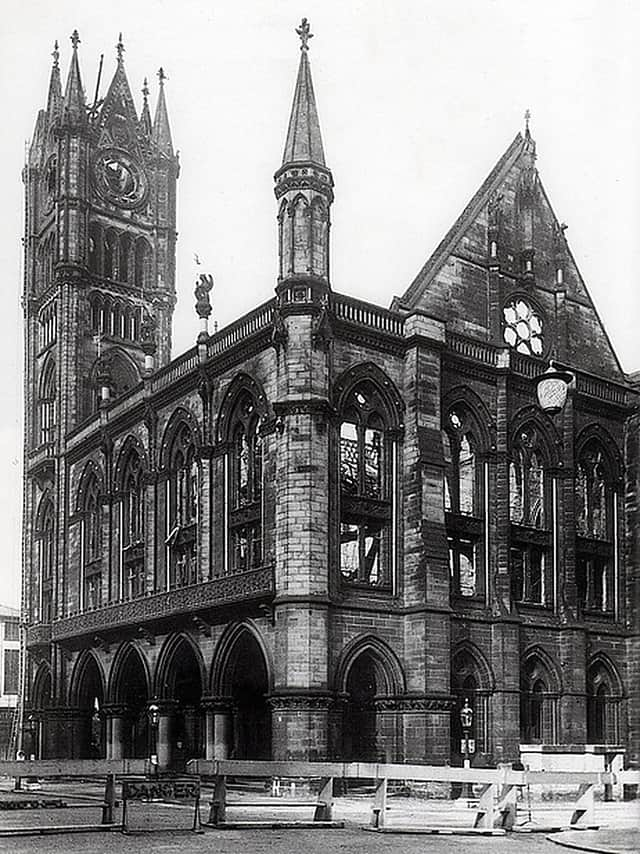
Sadly, those hopes were dashed in mid-March 1947 when the residents of Preston awoke from their slumbers to news that their stately Gothic-design Town Hall had been reduced to a smouldering ruin. Fire had raged for three hours from 3am and had swept through the entire building. The old Guild Hall had been completely gutted and the cherished clock tower, standing 180ft tall, was a haunting burnt-out ruin facing Fishergate.
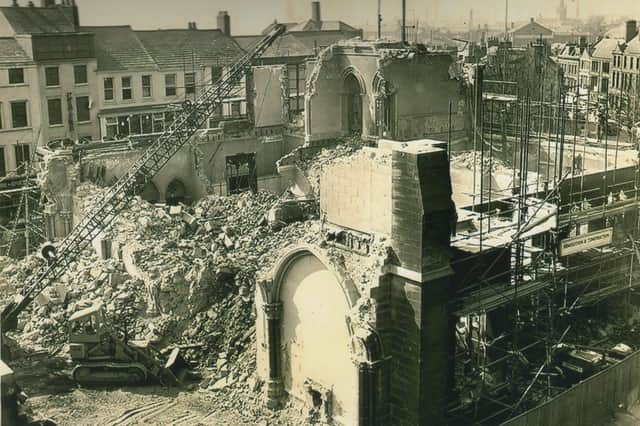
The day after the fire, workmen began demolishing the parts of the structure that were clearly unsafe, and the building was patched up to allow the ground floor to be used in a limited way. Nonetheless, it was in no fit state to stage the Guild of 1952, and the Public Hall became the focus of Guild activities that year. Initially, the clamour was for the structure to be rebuilt on the site and restored to its former glory. Eventually, the Town Council opted to knock it down, and in 1962 the demolition gangs moved in.
Soon after, work started on erecting Crystal House on the site, a 164ft-tall structure which cost £400,000 and had retail outlets and modern offices within its seven-storey tower. That structure, which never held a place in the affection of local folk, was renovated in 2008, being newly clad and incorporating penthouse apartments at a cost of more than £4m. It now stands over 200ft tall and is known as the Cubic.
There was great excitement when plans were unveiled for the building of the current Guild Hall in time for the Guild of 1972. The site chosen was where the old Ribble Bus Station had stood. The structure was basically a reinforced concrete building, with fair-faced concrete exposed in some parts, along with attractive dark red Accrington rustic bricks. Unfortunately, bad weather and strikes delayed the opening until November 1972, too late for the pomp and pageantry of Preston Guild. Once more, the Public Hall became the focal point for the Guild celebrations.
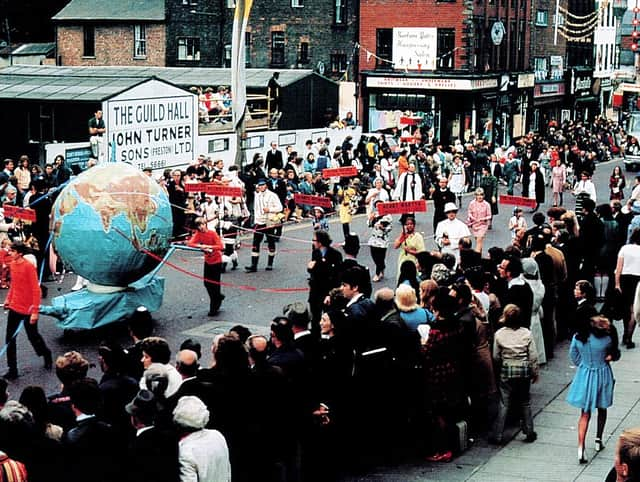
Happily, the Guild Hall played a significant role in the Guilds of 1992 and 2012, hosting many of the events associated with the ancient Guild Merchant.
Businessman Simon Rigby took over the Guild Hall in 2014, when things looked bleak for the building’s future. Ambitious plans for the entire site were drawn up and work started on transforming parts of the Guild Hall. Unfortunately, following Mr Rigby’s untimely death in 2020, the future prospects of the Guild Hall became uncertain. Let’s hope that by September 2032 we still have a Preston Guild and a building wherein it can be celebrated. After all, our Guild Hall of 1972 was dubbed the “Albert Hall of the North” a decade later, as the next feature will reveal.