
Garstang's fortunes reversed: from Victorian decline to thriving market town
A Victorian visitor feared for a town with a shrinking population, while decades later traders worried its markets were dying — yet both have endured.
Inevitably, as we go through life, we will follow routes taken by earlier generations. Always fascinated by the journeys that historian Anthony Hewitson made and recorded, I was particularly keen to visit Garstang, writes Keith Johnson.
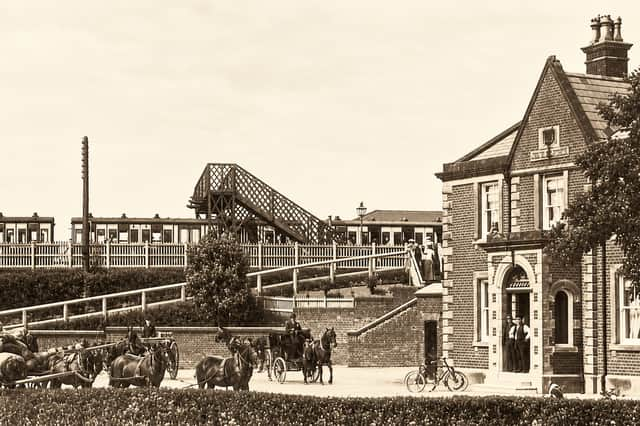

Back in 1872, when he made the journey on a Sunday morning, he travelled by train from Preston station, remarking thus – 'It was a dull autumn morning with only milkmen, dog fanciers muffled up and thirsty souls astir. Over a number of complicated railway points, with sharp, saucy engine whistles assailing one's ears every other moment; then a quickening of movement by dismal looking cottages, grim saw pits, and lofty sided mills; and then we had clear breathing space in the countryside, with green fields and cattle on each side, as the hills filled up beautifully the eastern horizon. Gentlemen's residences breaking in upon the view occasionally; sundry glimpses roundabout a now obsolete canal; tempting views of hares and rabbits, with a stately walking pheasant now and then on view; periodical sights of fish ponds, with broad yellow flowers, and quick witted little water hens floating among them; a swift penetration into a shadowy wood, whose branches and foliage seem to open out with a wild rustle for the flying train; a return of daylight and free breathing space; a whistle; and in a few moments afterwards a stoppage. This was the sum and substance of my journey from Preston to what is called Garstang station – an elevated exposed place, on the main line, about two miles from the town of Garstang, and recently connected with the said town by a poor little junction, which runs to Pilling, and winds up in a field there.'
He expected to be able to catch a connecting train on the Pilling line to reach the High Street of Garstang, but the station master informed him that not a single train ran upon that line on a Sunday. Not because it was sinful to run a train on the Sabbath, but because the line was kept quiet as it didn't pay to provide a Sunday service. So he had to walk.
My trip to Garstang, starting from Preston bus station, was less complicated, arriving by Stagecoach – not the horse-drawn variety, but the modern-day No. 40 double-decker bus with considerably more horse power. Once past Broughton, I was also able to admire the view of green pastures, although modern-day housing estates are now plentiful along the A6 route, and I had glimpses of the high-speed travellers on the M6 motorway and the railway along which Hewitson had travelled. No doubt he would have been amazed at the speed of travellers today and also happy that the canal, deemed obsolete in his day, is now a place enjoyed by those with barges and boats for pleasure.
Hewitson's visit gave him the opportunity to relate some relevant facts about Garstang at that time. His interesting notes included the following – 'The railway between Preston and Lancaster would have been run nearer to Garstang, if there had not been objections. Garstang is in many respects most irregular, rickety, tumble down, and antiquated; due to an aversion in the past towards what were conceived as improvements.'
He then referred to Baines' account of a progressing Garstang, written in 1824, describing the place as well paved and lighted, remarking thus – 'Either the town has been progressing backwards or the historian was mistaken. To be sure its streets are now paved, but unless you wear the thickest of shoe soles it is torture to walk down them, and as for the lighting it is simply ante-diluvian. There are about five ancient oil lamps dragged out of the old top loft of the Town Hall every Winter and put somewhere in the streets, for the joy and security of the inhabitants.'
Hewitson went on to inform us that for many years nobody could, by any possibility, buy either land or houses in Garstang and that only since 1867 had the old barriers been removed, with property then being bought. He then told us that Baines had stated all those years before that the accommodation at the inns was very good. It was a statement he agreed with, pointing out that there were, perhaps, more public houses in Garstang than in any other town of the same size in the north of England. Altogether, he counted eleven, including the Church Inn over the bridge in Bonds, just a stone's throw away.
The day I visited was a Thursday and market day, which, according to Hewitson, was a good time to visit, remarking thus – 'Garstang is only really alive one day a week – during Thursday's market – and much of the business is transacted in the public houses. The population is decreasing, in 1801 the township was home to 731 people and according to the 1871 census only 687 dwell within. The inhabitants are frugal, long lived, and primitive in their habits.'
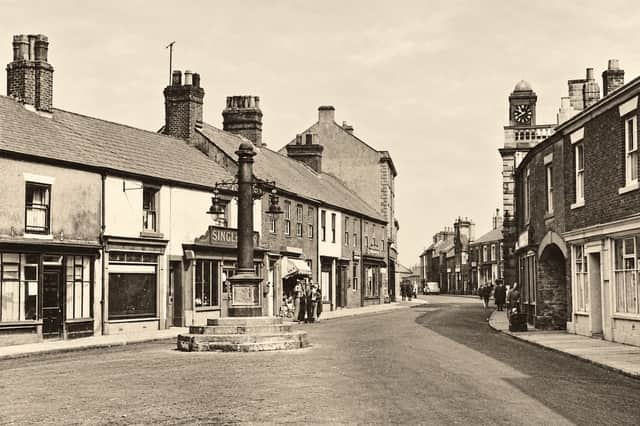
Hewitson's worries about a declining population for a place midway between the cities of Preston and Lancaster seem unfounded now, as a survey in 2021 credited Garstang with a population of almost 4,500, with many more in the outlying districts.
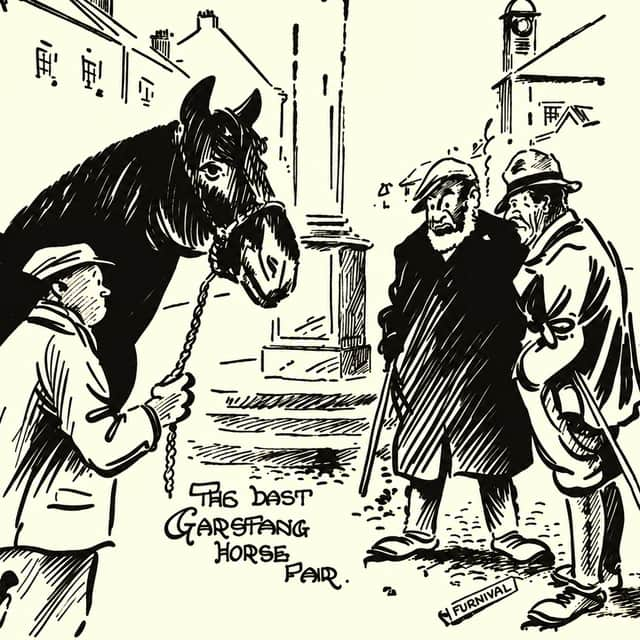
Post reporter Cyril Heywood, along with illustrator Furnival, had visited Garstang on a market day in 1935 and, back then, old traders were lamenting the glory of bygone market days. Days when farmers flocked to town and conversed about their cattle and crops and enjoyed a glass or two of ale. Talk was of the loss of the traditional Garstang Horse Fair and the dying street market, yet more than 90 years later the street market has survived.
Certainly, the Thursday I visited the High Street in Garstang, it was a lively place, with numerous market stalls lining the street. There were ancient alleyways off the main street, some leading to courtyards with cafes and shops selling gifts and curios. In these days when derelict shops are commonplace, Garstang High Street is flourishing, with a wide variety of goods on offer.
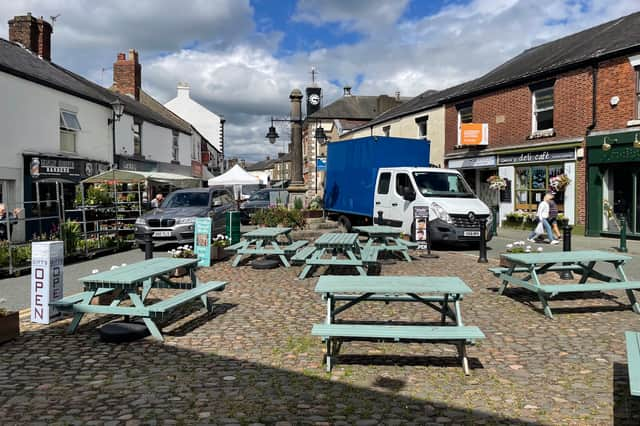
Just as when Cyril Heywood visited, the sun was shining, folk were standing about on the pavements, gossiping and bargaining and watching the world go by, and you could still admire the old Town Hall building, erected in 1755, and be well aware that you were in a very ancient market town.