
How a former Preston pub kept Doctor Syntax alive
Discover how the legacy of Doctor Syntax, the legendary racehorse, is preserved through a former Preston pub, celebrating its rich racing history.
The Derby Stakes will be contested at Epsom on the first Saturday of June 2026, continuing an annual tradition begun in 1780. A highlight of the racing calendar, it is named after Edward Smith-Stanley, the 12th Earl of Derby, a familiar figure in these parts, writes Keith Johnson.
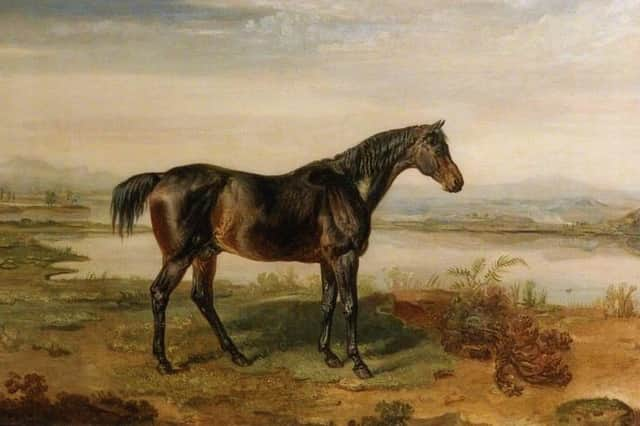

From as long ago as 1726, horse racing took place upon Preston Moor, and it is recorded that in July 1727 a horse named Milkmaid won the Preston 40 Guineas Plate. The races continued there periodically until 1791, enjoying the patronage of Preston Corporation in their later years.
From 1786, rival meetings were held on Fulwood Moor, enjoying the patronage of the 12th Earl of Derby. His enthusiasm for horse racing was displayed at Fulwood, where he often offered a purse of 50 guineas to attract the best thoroughbreds to compete. The races were highly competitive and Preston Races attracted horses from far afield, with the Preston Gold Cup being a much sought-after prize.

On Fylde Road, in Preston, until recent times stood a public house named Doctor Syntax, a survivor of the nineteenth century, when at one stage the town had no fewer than 460 inns or beer houses dotted around its terraced streets.
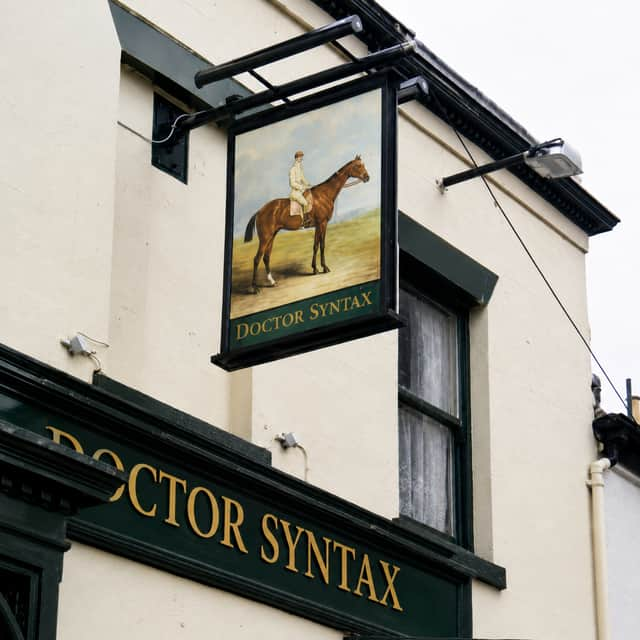
Down the years, this public house displayed numerous attractive signs depicting, on one side, the fictional Dr Syntax, a medical man whose name it carried, and, on the other, the racehorse named in his honour.

The horse was to earn legendary status in its lifetime, with outstanding feats on the racecourses of northern England, particularly the one on Preston Moor. The years that would make Doctor Syntax, a brown horse foaled in 1811 and bred by Mr Knapton of Huntington, near York, a racing favourite began in July 1814.
The horse’s first outings had been in April, at Catterick, where he took a tumble, and four days later at Middleton, where he finished second. In July, the horse, owned by Mr Ralph Riddell of Felton Park, Northumberland, was brought to Preston to take part in a two-mile race on Preston Moor and swept all before him to claim the purse of £70 — almost £5,000 in today’s money. By October, when the season drew to a close, Doctor Syntax had claimed five victories from eight outings.
As a four-year-old, the horse emerged as a top racer, winning the Middleham Gold Cup in April, the Lancaster Gold Cup in late June and a third 100 Guineas prize purse with a Preston Gold Cup victory in mid-July. In all, seven outings brought six victories and great credit to his jockey, R Johnson.
The subsequent years were equally successful as the horse took on the best the aristocracy could muster, with the horses of Lord Derby, Lord Queensberry and the Duke of Leeds unable to stop his gathering of Gold Cups, usually with jockey Johnson in the saddle.
The annual visit to Preston Moor in 1818 was seen as a stern challenge, with 21 runners in the field. Once again, however, the three-mile course seemed to be to Doctor Syntax’s liking and, despite carrying almost nine stone, the horse saw off the challenge of Lord Grosvenor’s fancied horse Tagus. More Gold Cup victories followed at Richmond, Pontefract and Lancaster, besides the annual visit to claim the Preston trophy and the 100 Guineas that went with it.
Not until 1821 did the remarkable record of Doctor Syntax at Preston look under threat. Early that year, Reveller beat him at Lancaster to claim the Gold Cup there, and consequently the crowds that gathered for the return encounter on Preston Moor were well above the norm, with country folk attracted from far and near.
Eighteen horses took to the field, but Doctor Syntax was in front from the start and never wavered, earning a three-length victory over Reveller at more attractive odds than usual of 7-4. Seven successive Preston Gold Cups had been won, a marvellous achievement considering the competitiveness of the annual event.
Sadly, in Guild Year 1822, the remarkable run came to an end, with the Gold Cup contested in September as part of the Guild celebrations. The great and the good all put their thoroughbreds in the field, most of them four to six years old, including the classy rival Reveller.
Alas, the 11-year-old Doctor Syntax could not hold back time and had to settle for second place behind Reveller. The seven-times winner was watched by Guild Mayor Nicholas Grimshaw and other local dignitaries in his brave, but failed, attempt to add an eighth Gold Cup.
Although Doctor Syntax was not rewarded so lavishly, he was certainly worth his weight in gold.
It was the last Preston would see of this amazing horse, which collected another couple of Gold Cups before his retirement in 1823. The horse’s record was indeed impressive: 49 races, 36 victories, including 20 Gold Cups — seven at Preston and five each at Lancaster and Richmond.
It had been a glittering career and we should not be surprised that, when the horse retired, he sired another winner in Beeswing, who had a liking for the Newcastle Gold Cup, winning it six times.
Racing continued on Preston Moor until 1833, after which the Corporation enclosed the area. Eventually, some 100 acres of the land was used to create present-day Moor Park, which was officially opened in 1867 at a cost of £10,826.
Racing on Penwortham Holme came to the fore in early Victorian days, with the Preston Guild of 1842 staging two days of horse racing with significant prize money on offer, despite the nobility choosing not to patronise the events.
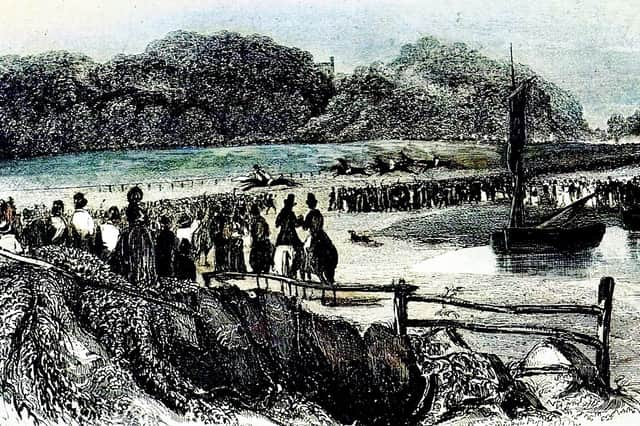
The fun for spectators was plentiful, with horses bolting, throwing their riders and even turning tail. Mr James Owen had cause to celebrate on both days, with his horse Collina winning the Guild Handicap and then the Guild Cup, and prize money of 250 sovereigns, with a horse named Champagne finishing second both times.
Further race meetings were held at Penwortham Holme from 1845 to 1848, in which year a confrontation between soldiers and the Preston Constabulary led to their discontinuation.
Certainly, in the days of nobility, Preston had its fair share of horse racing excitement, and many a regular at the old Doctor Syntax inn on Fylde Road — nowadays The Tang Chinese restaurant — would no doubt have been happy to raise a glass or two in honour of Preston’s glorious Gold Cup-winning horse.
This year, the total prize pot for the Betfred Derby will be £2m. Although Doctor Syntax was not rewarded so lavishly, he was certainly worth his weight in gold.