
Chorley Market through the years from Victorian stalls to today's bustling Market Quarter
The Chorley Market's 'Flat-Iron' market area has undergone significant changes over the years, evolving from a grassy hollow to a bustling hub of activity, with itinerant traders and colourful characters drawing in the crowds.
Just over 90 years ago, in 1935, Post reporter Cyril Heywood and illustrator Furnival continued their visits to market towns within the old Lancashire county boundaries with a trip to Chorley on its traditional street market day, writes Keith Johnson.
Heywood reminded readers that Chorley was once a bigger borough than Bolton, a fact dating back to at least 1287. He also suggested that Chorley might have grown into a town as large as Preston had local landowners not been reluctant to allow industry to invade their territory during the later Georgian era.
A direct railway link between Chorley and Preston was one of the later connections made with our neighbouring towns. For some time, Preston had enjoyed direct lines to places including Wigan, Liverpool, Manchester, Lancaster, Fleetwood and even Longridge. There was therefore much celebration in late June 1843 when the new North Union line connecting Preston with Bolton opened, including a stop at Chorley. Before its opening, a trip to Bolton involved catching a stagecoach from the Red Lion on Church Street to meet trains departing from Chorley.
On a market day in early July 1843, a reporter from the Preston Chronicle was tasked with taking advantage of the new railway link by visiting Chorley. Train travel was still something of a novelty in those days, and he wrote of his journey from Preston with a companion:
'When we got started I was surprised by the rapidity with which we were borne along. Indeed, in crossing the valley of the Ribble, we would have preferred a less rapid flight, that we might have more fully and leisurely enjoyed the charming views spread out before us. On one side the beautiful country of Walton-le-Dale, with its church crowning the precipitous hill that rises above the valley of the Ribble; further on, Hoghton Tower, famed in ancient story.
'We had scarcely time to note half the beauties that lie in the other direction, including Penwortham Hall and Church, and the river, sweeping onwards in its course towards the sea. Borne rapidly onwards, we quickly reached Farington, in which village, not far from the railway line, has been erected a handsome new church.
'Messrs. Bashall's extensive works were next passed, and shortly after we reached Leyland station, that beautiful village of Leyland, situated in what is appropriately called the "Garden Of Lancashire", was lying to our left, its locality pointed out by the tower of its ancient church.
'We had now reached a level district, over which we had a most extensive view of a most lovely countryside. At Euxton, a little further on, we left the North Union line, and proceeded along the newly cut portion of the Bolton and Preston railway.
'The town of Chorley soon appeared to view, presenting that smoky appearance common to all manufacturing towns. The final cuttings of the railroad to Chorley had been challenging and expensive and crowds welcomed the approach of the train in which we were journeying, being gazed upon by groups in lanes, fields and on bridges.
'Prior to reaching the station we noted a very handsome church and at the station there was much hustle and bustle and a feeling of rejoicing among passengers who alighted from the train having experienced a delightful journey with a chance to view Chorley, which had until recently been near yet so far away.'
The Chorley Market that greeted those early rail travellers was situated at the end of Fazackerley Street, off Market Street, having transferred there in 1826. The original market had been held on Town Green, which was developed into St Thomas's Square, where the Town Hall and County Police Station would later be erected.
In 1838, visitors would have seen a horse trough and fish stones surrounded by stalls, with vendors of fents and pots on the north side of the square. On the south side, greengrocers and produce dealers had their pitches. Farm carts brought produce to market and were also used as selling stands.
It was also a place where farmers brought cattle and sheep for auction. With a shooting gallery, an eating shed and even an area designated as an amusement park, the market catered for all classes.
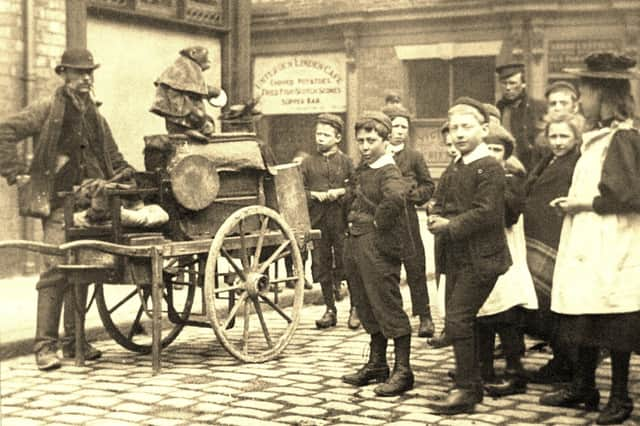

Cyril Heywood discovered that the passage of time had changed market day considerably, writing in 1935:
'Not as much produce comes as once upon a time. Drapery merchants have extensive pitches and there are a multitude of other dealers. The most remarkable portion of the market is the cindered expansion of Union Street, which presumably, after the Salford tradition, has become known as the "Flat-Iron" market.
'The area, once a grassy hollow, has been levelled, and now itinerant traders of all descriptions are to be seen each Tuesday plying their vigorous business. The place is entertaining and folk go there to buy and you can witness unusual transactions taking place.
'The folk who come to sell on the "Flat-Iron" have their own way of attracting and holding the crowds. You will see colourfully garbed figures, speaking broken English – which is robust should the situation demand it. You will hear voices compelling attention, while the mysteries and virtues of cures for all the ailments that mankind suffers are on offer.
'The crowds slowly milling round the stalls watching as the salesmen joke and raise laughs before they get down to the business of selling – but as they seek the shillings the crowds disperse – happy to have been entertained.'
In conclusion, Cyril Heywood declared that Chorley Market was a Lancashire market with a lively character of its own, a distinctive place where people bought and sold.
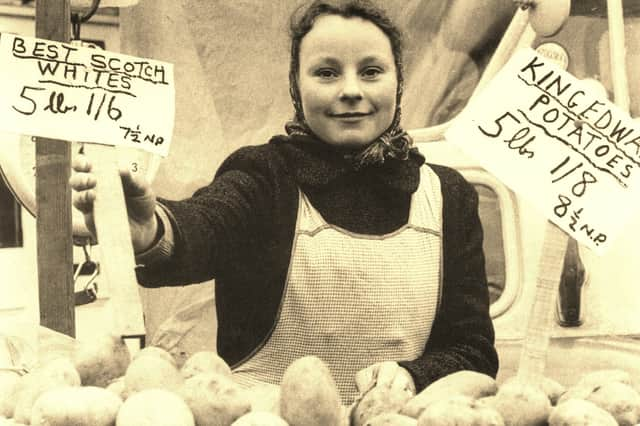
Curious as to the situation today, I chose an October Tuesday to visit the market myself. I caught a Northern-operated Class 323 electric multiple unit at Preston station, heading for Manchester Airport, and after stops at Leyland and Buckshaw Parkway, we arrived at Chorley within 15 minutes.
Just like those early rail travellers, I enjoyed the views of the landmarks and countryside, although there has been much more industrial and housing development since their day. Likewise, my train made rapid progress, at a speed which would have astonished them.
Before travelling to Chorley, I was aware that there had been considerable development of the town centre in modern times, not least in the market areas.
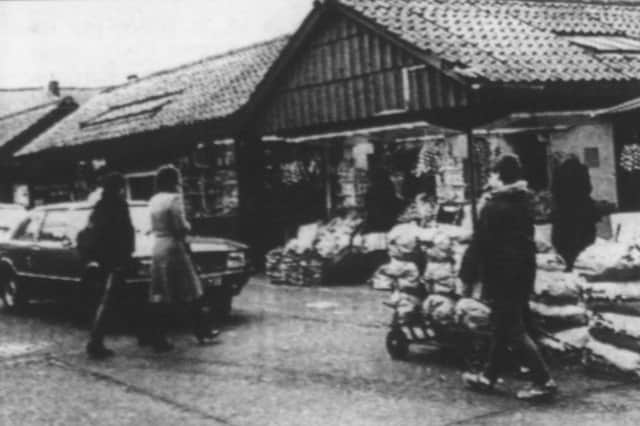
By 1995, the Flat-Iron market could boast 100 stalls every Tuesday and, combined with the bustling Covered Market, open four days a week, the town enjoyed a prosperous market trade.
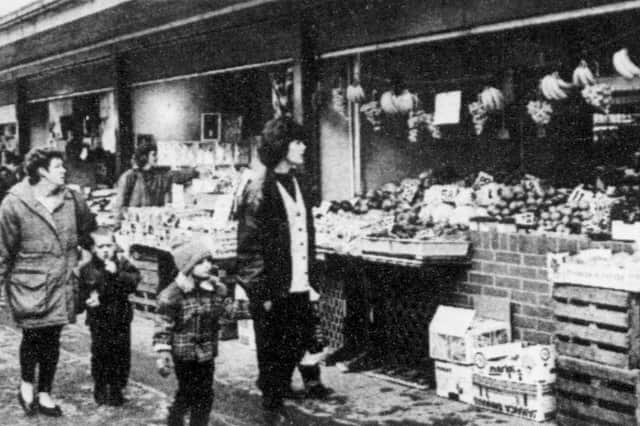
As recently as 2017, further developments saw the Tuesday markets moved from the Flat-Iron to the town centre streets as work on the Market Walk extension got underway.
A short walk from the railway station took me into the Market Quarter where, flanked by a delightful variety of shops, lines of market stalls stood beneath gazebo-style shelters, displaying a wide range of goods just like the street markets of old.
Merchandise was plentiful, from flowers to fruit, curtains to cushions, sweaters to socks, trinkets to toys, and jackets to jumpers on offer for a fiver.
It was a similar story in the Market Hall, where bargains galore were on offer. You could even dine in the aptly named '1498' café area, a reminder of the time when the lords of the manor were summoned by the Crown to claim their right to hold a market, in the days when Henry VII ruled the land.
And you could, as many did, enjoy a cup of tea, a Chorley cake and a good old natter while taking a break from shopping.
Like Cyril Heywood before me, I thoroughly enjoyed my visit to Chorley Market. Today, it remains a busy, bustling and quite enchanting place, retaining a touch of the old-fashioned market days we love to remember, with stallholders who are delighted to serve you.