
Thousand of miles - and thousands of pounds - for Poppy Express pair
Denis and Barbara Scaife are travelling over 1,000 miles in two days to raise money for the Royal British Legion - and yesterday stopped off in Preston to say hello.
It was only a small stop in Preston for Denis and Barbara Scaife yesterday - but that doesn’t mean they’re not trying to make a big difference along the way.
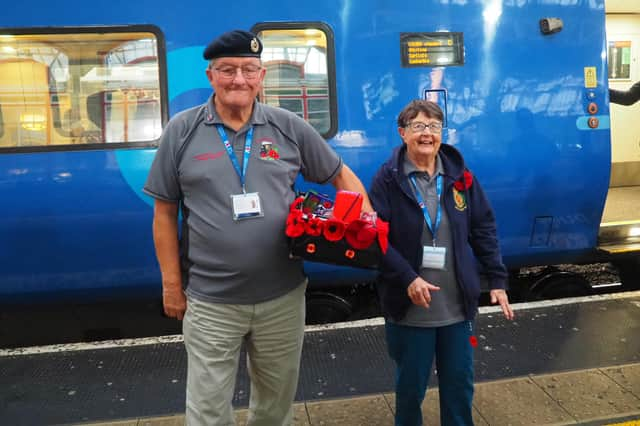

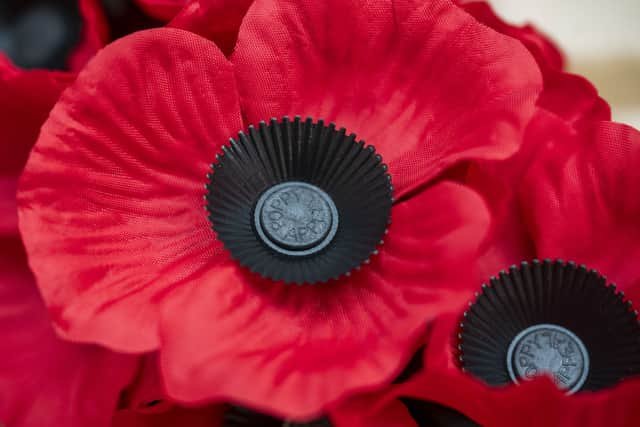
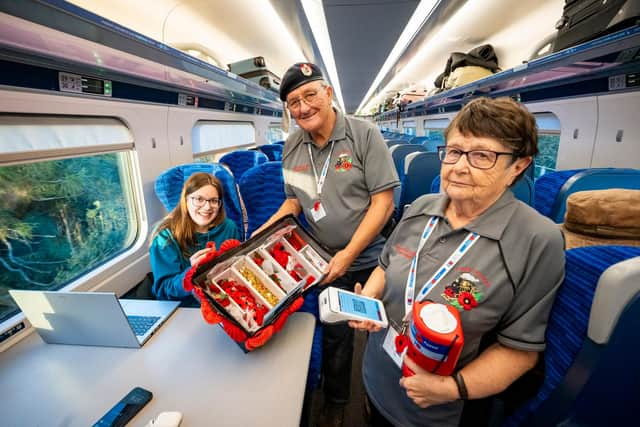
It’s been over a decade since the couple first set out on the ‘Poppy Express’, which saw them embark on a 48-hour round trip along the east coast main line selling poppies for the Royal British Legion.
But the two of them never could have expected to still be chugging along 11 years later, having raised thousands to support veterans across the UK.
Yesterday morning, Denis, 74, and Barbara, 75, set off from their home in Hull for their latest journey, which would also be the first time they fundraised on the west coast as well as the east.
“It was the 8:26 from Hull, right down to London, and then we got a full train on there, so we did very, very well,” Denis told the Lancashire Post.
“I used to be the chairman of our Royal British Legion branch, and I sued to sit in my blazer and tie, and people just ignored us. I thought there must be a better way of doing this and getting more money in.
“So, I wrote to the chief executives of Lumo in Hull, and they were very receptive and more than happy to help us, and have done ever since. It’s been absolutely superb.”
In the 1970s, Denis worked as a sapper with the Corps of Royal Engineers, where he was stationed in Northern Ireland.
“We do the building work. We can make runways, we can build buildings, we can build bridges, and we can demolish bridges to deny the enemy any access. We do an amount of tasks to assist the infantry and ensure they can advance in safety by clearing the mines and laying the bridges.
“I went to Northern Ireland in 1971 and 1974. It was just kicking off then, in 1971; it was a really bad time in Northern Ireland, but we got through it.
“In the Royal Engineers, we only lost somebody in an accident. One guy was shot by an accidental discharge - one of his mates blew his head off.
“Another one had his head cut off by the helicopter rotor, when he made a mistake by going to the rear and not the front.
“You can imagine that the wives at home often worried about what was happening to you, and I’d just been newly married a couple of months before I went off to Northern Ireland. So, she made sure I got insured.”

It was upon his return home from Northern Ireland that Denis made the decision to become a police officer.
He would spend more than two decades in the force, and eventually retire as a sergeant - though it was six years before the typical 30 year retirement mark.
“I had to come out on an injury pension, before I finished my 30 years, after 24 years,” Denis said. “Somebody attempted to murder me off-duty outside my home address.
“The guy crashed his car outside my home, and I went to see what was going on. He was walking about the back of his car, looking for his wallet, and he didn’t like the fact I was a police officer. He got his hand around my neck.
“In the meantime, my wife came out with a shillelagh, which I bought in Northern Ireland when I was a soldier. She cracked him with that, and he cracked her back and took the shillelagh off her and put that around my neck.
“She pulled his hair, she hit him with a shoe, and being a good Yorkshire lass, she grabbed him by the nether regions, and that got him off me. As I rolled over, he was just going to hit me with the shillelagh because he’d knocked my wife to the floor for a second time.
“She got off the floor and pushed him in the back. It was absolutely pouring down at the time, and I lost my grip on him. He ran up the road just as the blue lights appeared, and he disappeared into the wilderness.”
Though the man was apprehended within days, he only got charged with common assault, and not attempted murder.
Denis now lives with post traumatic stress disorder - a condition which is estimated to affect 4 per cent of people in the UK.
Over-55s are the only people where more men than women are diagnosed with PTSD, with women aged 16 to 24 most likely to be diagnosed overall.
“I just started bawling my eyes out,” Denis said. “It was awful. I don’t know how I’d take it now. I’m out of it, but I do have to be careful with my moods.”
Last year, Denis and Barbara together raised a whopping £37,000 for the Royal British Legion through selling poppies on the railway.
The rest of their journey will see them travel from Edinburgh, to London, and finally back home later tonight, where they’ll enjoy a well-earned rest after their 1,200-mile journey.
“It’s been a long day, that’s for sure,” Denis said. “But we’ve loved every minute of it.”