
Spectacular aerial view of Preston's St Walburge's Church - and it's fascinating history
As part of the Lancashire Post’s 140th anniversary celebrations, we’re exploring some of Preston’s most iconic landmarks. Today we look at it’s tallest structure - from a completely different angle.
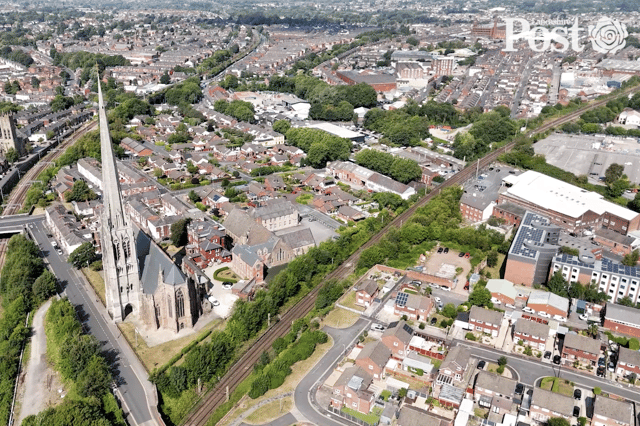
It dominates the Preston skyline, and 160 years after it was completed, is still the tallest structure in the city.
Now, take a look at St Walburge’s Roman Catholic Church as you’ve never seen it before - from the air.
Iconic
A masterpiece of Gothix Revival architecture, St Walburge's is famous for having the tallest parish church spire in England. In actual fact, its spire - which rises to a height of 309 feet (94m) - is the third tallest in the United Kingdom, after Salisbury and Norwich Cathedrals.
It was constructed from limestone sleepers that originally carried the nearby Preston and Longridge Railway, giving it a unique red tint during sunset.
But you’d be mistaken for thinking the spire is all the church is about.

What’s the story?
The church stands in the Maudlands district of Preston, a name corrupted from "Magdalen's Lands," which once held a 13th-century leprosy hospital dedicated to St. Mary Magdalene.
The Jesuits acquired the land, and in 1847, commissioned the building of the church during the Catholic revival in England and during the industrial era, when Preston was flourishing due to its textile mills. Unortunately, they did not obtain the freehold, which delayed the consecration of the church for nearly a hundred years. It was not until 1933 that the owners - descendants of the Fleetwood family of Penwortham - finally agreed to sell the freehold, and three years later the church was finally consecrated.
The architect chosen for the ambitious project was Joseph Hansom, who is also known for inventing the hansom cab -a two-wheeled, horse-drawn carriage for hire, and forerunner of the modern day taxi.
Construction began in May 1850, and the church was officially opened on August 3, 1854. The soaring spire was a later addition, completed in 1866, and the weather vane - the famous Maudland Cock - was added a year later, surviving atop the spire until 1931. The church was further extended in 1873 by the addition of a polygonal sanctuary with a central window 35 feet (11 m) high.
It was named after Saint Walburga (an 8th-century English missionary and nun) following a reported miracle where "St. Walburge's Oil" healed the broken kneecap of a local St Wilfred’s housemaid, Alice Holderness.
The features
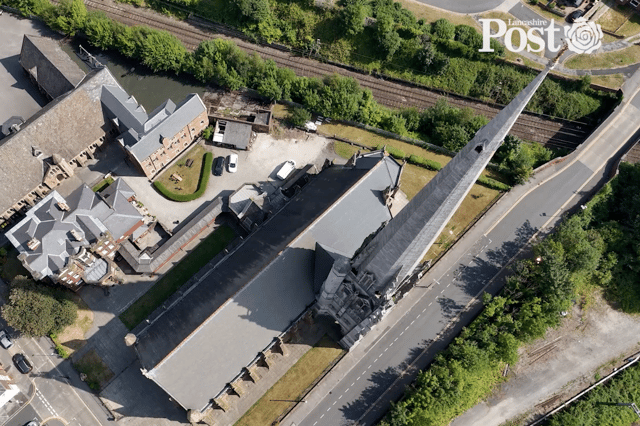
The exterior of the church has a New Red Sandstone facade which is divided into two zones - the upper zone is dominated by a 22ft wide rose window, which occupies almost the full width of the nave.
The church is 165 feet (50 meters) long and 55 feet (17 meters) wide and can seat about 1,000 people. It has an open wooden roof supported by 14 hammerbeams - each hammerbeam is adorned with life-sized carved figures of saints.
The hammerbeam roof was noted in its 1950 designation as a Grade I-lised building, as well as its 19th-century French Gothic style.
The church boasts an impressive organ by William Hill of London, installed in 1855 and the tower contains a single 15 tonne bell cast by Mears and Stainbank of Whitechapel, which is believed to be the heaviest swinging bell in Lancashire The use of the bell is restricted, due to protected birds nesting in the belfry, meaning it can only be rung in winter months.
According to The history of St Walburge’s by Peter Smith, during the Second World War, most parks and churches had their iron railings taken away to make weapons. In 1942 those of St Walburge’s were also removed but left to rust on a nearby waste ground. It was another nine years before they were replaced and the new ones painted by voluntary parish labour.

Recent history
In 2007 St Walburge's, along with several other churches in Preston, was threatened with closure by the Catholic Diocese of Lancaster. The quality of its architecture, its significance to the parish and its landmark status in Preston led to great interest in its fate, and the closure was given a stay of seven years from August 2008 while local fund-raising drives sought to supplement grants for the restoration of the building.
In 2014 Michael Campbell, Roman Catholic Bishop of Lancaster, entrusted the church to the Institute of Christ the King Sovereign Priest as a shrine for Eucharistic Devotion.
In 2020, the group launched a £3.5m restoration appeal, focused on roof repair, stained glass and stained glass protectors repair, a heating system renewal, a new extension to provide toilets for men, women and the disabled, repair to the parish hall and Talbot Library, conversion of the convent building and a new lighting system.
Church leaders set about making grant applications and running their own fundraisers, including The Spire Beer fest, and guided tours to the top of the spire.
Restoration
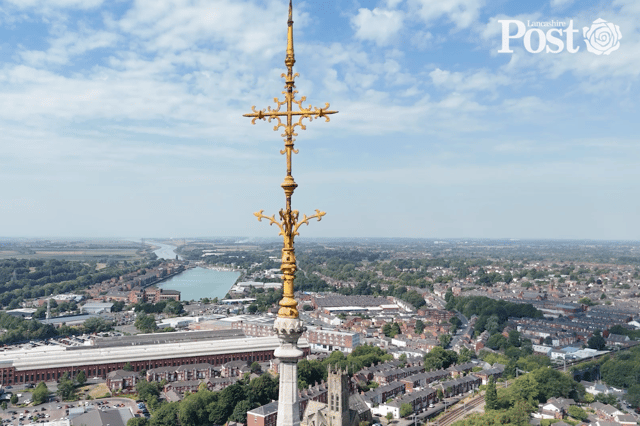
In 2025, St Walburge’s was awarded another £250,000 to fund urgent repairs and restoration work by the National Lottery Heritage Fund. The money was for repairing the south roofs, preventing further water ingress and protecting the landmark's interior. It was also to fund conservation skills through workshops with the University of Lancashire's school of engineering and its specialist roofing contractor, HCR.
Fundraising work continues.