
Revealed: The secret operation to defend the UK from smart fridge cyber-attacks
A secret cyber-operation has helped protect the UK from cyber-attacks after a major flaw was found in supermarket smart fridges.
Tens of thousands of smart fridges have been taken offline as part of a secret cyber-security operation, after they were found to be vulnerable to hackers.
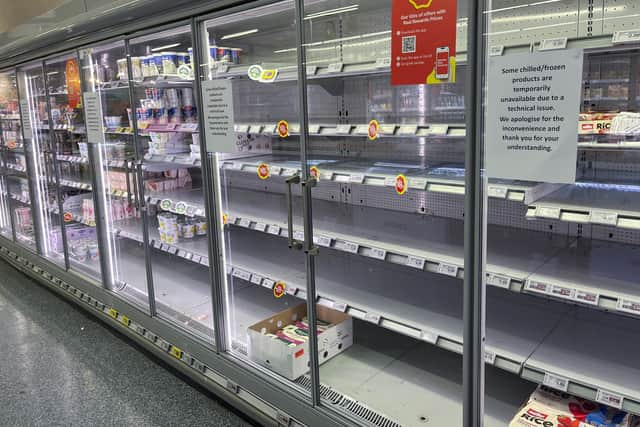

The National Cyber Security Centre - which coordinates with the National Cyber Force in Samlesbury, Preston - spent weeks secretly working with the Department for Environment, Food & Rural Affairs and the Food Standards Agency, after a vulnerability was found in the nation’s networks of smart fridges and freezers.
It comes as millions of euros’ worth of food was destroyed across Europe in October when hackers shut down hundreds of supermarkets’ fridges and freezers.
At the time, the UK was thought to be immune to such cyber-attacks, as smart fridges in this country rely on different devices, mostly made by British company Resource Data Management.
That was until late October, when staff at refrigeration consultants Omega Solutions spotted a potential security flaw in the system.

Cyber-attacks on fridges and freezers are not likely to affect at-home appliances, though this is largely because they would have little to gain from doing so.
Any device connected to the internet can potentially be targeted by hackers to steal data. However, it’s WiFi routers - not appliances - that make up three quarters of at-home hacking targets.
A whole year of the Lancashire Post for £12 (usually £49.99)
That said, household cyber-attacks are exceedingly rare. As was seen in Europe last month, hackers have much more to gain by hacking big businesses.
France was one of seven countries to be affected by cyber-attacks in the past few weeks, alongside Belgium; Luxembourg; Sweden; Ireland; the Netherlands; Estonia; and Finland.
On October 11, hundreds of French supermarkets were left scrambling after hackers targeted their fridge and freezer networks, causing them to heat up as high as 50°C .
The attack caused millions of euros’ worth of fresh and frozen food to be spoiled.

French authorities blamed the cyber-attack on Iran’s Islamic Revolutionary Guard Corps. In a post on X, European Food Commissioner Christophe Hansen described the attack as the “weaponisation of food”.
The Iranian foreign ministry described the claims as “baseless and hostile”.
Back in the UK, after staff from Omega Solutions discovered the vulnerability, all at-risk firms were contacted and told to take their devices offline.
As well as supermarkets, these firms also included petrol stations, fast food chains, food processing plants, and other parts of the food and beverage industry.
Thousands of remote controllers connected to tens of thousands of refrigeration devices were removed from the internet - in some cases manually, with staff ordered to physically remove internet cables and monitor temperatures by hand.
Speaking to the BBC, Ken Munro - a worker at cyber-security firm Pen Test Partners - said it was “only a matter of time” before hackers found the vulnerability and potentially targeted the UK.
"These popular controllers had a similar weak password problem to the Danfoss and other controllers that were attacked so successfully in previous hacks so we had to get the message out as soon as possible and keep it secret.
"There is so much extra attention on these ubiquitous bits of kit now that it was likely a matter of days until criminals or nation state hackers figured it out.”
But Resource Data Management, who make many of the refrigeration devices used in the UK, have disputed the seriousness of the vulnerability in their remote controllers.

They said the threat of their devices being hacked couldn’t be compared to the cyber-attacks in Europe, because hacking them would require a physical piece of hardware.
However, some ethical hackers - who are hired by companies to flag vulnerabilities in their systems - have said this hardware can be found online for cheap.
Ged Evans, the CEO of Resource Data Management, said that the vulnerability had been found in a “test environment”, and that the test “went beyond” what such exercises normally involved.
He told the BBC: "In any event we have acted at pace to address this issue and have already deployed first patch releases and have been in proactive contact with our customers to flag any issues and recommend mitigatory steps.”
They have now confirmed they will be working with the National Cyber Security Centre and other authorities to remain on top of the situation.