
Last chance to have your say on Lancashire council mergers in major shake-up
Lancashire residents have until midnight on Thursday to tell the government what they think of the options for the biggest overhaul of the council system in the county for more than 50 years.
A seven-week consultation into the shake-up – which will see all 15 main local authorities scrapped – is coming to a close.
The government-ordered revamp will result in the creation of a much smaller number of new councils covering large parts of the county – and responsible for delivering all services in their patch.
It will bring an end to the current ‘two-tier’ split between the county council and district authorities which currently exists across most of Lancashire – and the establishment of standalone ‘unitary’ councils, like those already operating in Blackpool and Blackburn with Darwen, but over a much bigger area. The number of councillors will also be slashed from the almost 700 that currently serve the county at all principal levels of local government to anywhere between 200 and around 350.
The change will involve Lancashire’s 14 boroughs merging, to varying degrees, depending on how many new authorities are created. The existing councils have put forward proposals for between two and five new unitary authorities to replace them.
Collectively, the documents run to more than 800 pages, but the Local Democracy Reporting Service (LDRS) has compiled a guide summarising the cases being made for each option ahead of the consultation closing (see below).
To have your say, visit lancashirelgr.co.uk/say-1 and follow the link to answer the survey questions by 11.59pm on 26th March. The government is expected to make a decision on the number and shape of Lancashire’s new councils this summer.
TWO COUNCILS


Council 1: Blackpool, Fylde, Lancaster, Preston, Ribble Valley and Wyre (722,045 residents and up to 99 councillors)
Council 2: Blackburn with Darwen, Burnley, Chorley, Hyndburn, Pendle, Rossendale, South Ribble and West Lancashire (879,510 residents and up to 99 councillors)
Promoted by: Lancashire County Council
Business case highlights:
***A two-unitary model avoids concentrating local disparities within its boundaries, but balances and connects places together, ensuring that all areas have a fair deal through Lancashire’s collective resources – connecting need to opportunity. [It] offers a financially sustainable model for local government in Lancashire. By consolidating structures and removing duplication, it creates economies of scale and frees up resources to reinvest in prevention, innovation and growth. With the scale and stability to align social care, housing, health and community services, we can provide more joined-up, preventative support that helps residents live healthier, more independent lives. At the same time, the model creates the capacity to innovate – harnessing digital transformation, data and insights-led decision-making and new models of meaningful community engagement and voluntary sector partnership – better connecting need to opportunity.
***The two unitary model minimises the disruption of implementation and reduces complexity, which is essential to ensure effective service delivery and value for money. Moving from the current three upper tier councils to two unitaries maximises the opportunity for continuity of service provision. Moving to two new unitaries and adopting best practice from the existing upper tier councils will maximise outcomes as early as possible.
***We anticipate there will be around 20 neighbourhood boards in each new authority area, representing populations of around 20-40,000 people on average. This will ensure that every neighbourhood has representation, clear accountability and a strong voice.
***[The proposal] delivers the most balanced socioeconomic unitary authorities (UAs) of all options, creating a robust platform for effective service design and positioning each authority for long-term success.
***The total council tax base is reasonably split, but with a four percentage point difference between the two UAs. In terms of how this taxbase works for the population the rate of tax band D equivalents per 1,000 residents is 12 percent higher in the North [council area] than the South – this is the lowest disparity in rates of all the UA options.
***[The two-council proposal] also provides the most financially resilient option. Financial resilience analysis of public data leads us to conclude that the 2UA model is the only compliant option without a unitary deemed significantly “at risk” in terms of financial resilience.
*** £391m net savings over five years from [launch] – the fastest payback of Lancashire proposals – and £140m annual recurring savings by 2032/33.
***Council tax harmonisation estimate [the amount by which rates paid by households in the existing local authority areas could shift in either direction under the new council] – no estimate given.
THREE COUNCILS
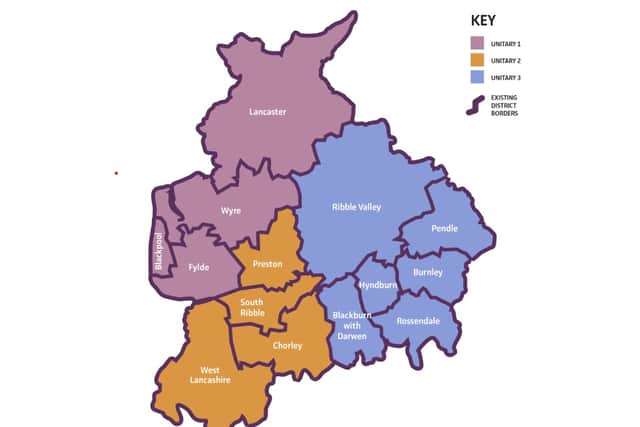
Council 1: Blackpool, Fylde, Lancaster and Wyre (493,387 residents and 85 councillors)
Council 2: Chorley, Preston, South Ribble and West Lancashire (521,811 residents and 85 councillors)
Council 3: Blackburn with Darwen, Burnley, Hyndburn, Pendle, Ribble Valley and Rossendale (586,357 residents and 85 councillors)
Promoted by: Blackburn with Darwen, Fylde, Hyndburn, Rossendale and Wyre councils
Business case highlights:
***Each new authority combines scale with identity, creating councils that are large enough to deliver complex services sustainably and local enough to stay connected to the places people recognise as home.
***The three-unitary option strikes the right balance between strategic scale and local accessibility. Each authority will have the critical mass needed to lead transformation and attract investment, while still being compact enough to maintain visible leadership and meaningful local accountability.
***The three-unitary proposal also deepens accountability beyond town halls. Local leadership will be strengthened through new, co-designed neighbourhood-level governance arrangements, which could include locality boards or community partnerships, ensuring decision-making is informed by lived experience and local priorities. Rather than setting a fixed structure at this stage, our ambition is to create formal mechanisms that connect the new unitary councils to the places residents most strongly identify with. These mechanisms will give local people, partners and elected representatives a meaningful voice in shaping priorities, overseeing delivery and building shared responsibility for outcomes.
***Creating councils with balanced and sustainable tax bases – the even distribution of businesses and population across the three-unitary option provides the most balanced split between unitaries in terms of retained business rates and council tax bases. This distribution spreads financial risk, avoids concentrating deprivation within a single authority and provides the capacity to plan for the long-term. Crucially, the inclusion of Ribble Valley within [the] Pennine Lancashire [council area] means that all three of the authorities put forward have as balanced a profile as possible – none of the alternative options being considered can distribute resources and demand in as balanced a way.
***The three-unitary option provides the conditions for long-term financial stewardship, ensuring that Lancashire’s councils can withstand external shocks, sustain balanced budgets and reinvest in the services and communities that need it most. This will deliver a system that is simpler, more stable and more capable of managing future pressures.
***The three-unitary proposal offers the most balanced distribution of jobs and businesses, and by balancing out areas of deprivation, offers a stable platform from which to deliver…inclusive growth. The preservation of strong local place-based identities will also facilitate…opportunities for culture-led growth.
***Total cumulative benefit [savings] after transition and transformation – £188.4m by 2032/33; and annual recurring net benefit – £99.8m (from 2031/32).
***Council tax harmonisation estimate [the amount by which rates paid by households in the existing local authority areas could shift in either direction under the new council] – ranges from a 0.3 percent to 10.3 percent change.
FOUR COUNCILS (version 1)
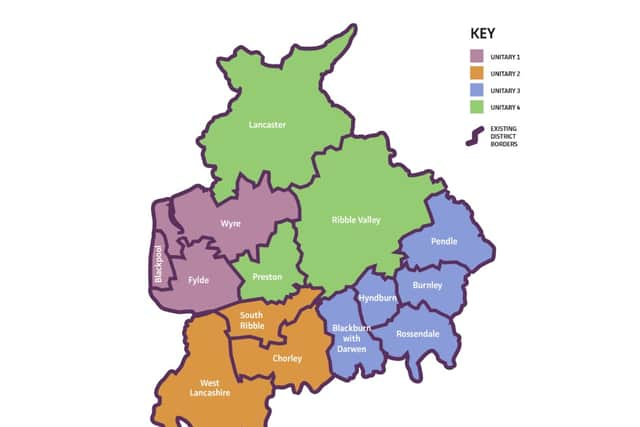
Council 1: Blackpool, Fylde and Wyre (348,381 residents and 72 councillors)
Council 2: Chorley, South Ribble and West Lancashire (358,947 residents and 72 councillors)
Council 3: Blackburn with Darwen, Burnley, Hyndburn, Pendle and Rossendale (520,563 residents and 80 councillors)
Council 4: Lancaster, Preston and Ribble Valley (373,664 residents and 72 councillors)
Promoted by: Chorley, Lancaster, Preston, Ribble Valley, South Ribble and West Lancashire councils
Business case highlights:
***Four unitary councils will create the conditions to accelerate inclusive and sustainable economic growth by working on social care, local services, business support, innovation, skills, infrastructure, and investment at the level that makes sense. At its heart is a commitment that public services will be closely connected to communities providing the foundation for a more preventative local government and the long-term sustainability of essential public services.
***The four unitary model provides the scale and opportunity to deliver bold reforms in the way local government and wider public services are run. It avoids the concentration risk in the creation of larger authorities that then have reduced flexibility to respond to challenges in specific areas. At our proposed scale and by investing in prevention and early intervention – particularly in adults’ and children’s social care – we will ensure that services are safe, effective, and more accessible.
***Each unitary would be large enough to be financially secure and stable but small enough to remain responsive to local needs and ensure fair access to democracy. Regardless of the size of the unitary models, the east of Lancashire sees a more challenging financial position, due to structural funding challenges – but the four-unitary authority model means this financial challenge is distributed appropriately.
***The transformation ambitions of the four-model approach will reduce demand on statutory services, cutting service costs and helping to address deficits across Lancashire. The impact will be greatest in Pennine Lancashire, where demand is highest. Services will be reshaped with communities at their core, enabling a local, community-led approach that empowers professionals to work alongside residents to understand and meet their needs more quickly and effectively. This preventative approach will ease pressure on statutory services, reduce costs and create a strong, sustainable model for the future. Crucially, by creating four unitaries, this option spreads financial risk more evenly across the county, allows for tailored strategies in each sub-region, and avoids overconcentration of challenges in fewer organisations.
***We will create the space for communities to be active partners in service delivery. We will empower the creation of at least 42 local community hubs. [By] bringing together community groups, neighbourhood forums, town and parish councils, the new authorities can unlock additional capacity and energy, enabling communities themselves to play a direct role in improving their areas.
***Even with a cautious approach, we can expect to achieve a cumulative net benefit [savings] of £194.9m, with recurring annual benefits of £81.9m from 2032/33. These benefits include additional resources ringfenced for managing the transition and ensuring safe, improved social care provision during reorganisation. This is not simply about reducing costs – it is about creating sustainable services that improve lives and outcomes for residents.
******Council tax harmonisation estimate [the amount by which rates paid by households in the existing local authority areas could shift in either direction under the new council] – ranges from a 1.0 percent to 10.9 percent change.
FOUR COUNCILS (version 2)
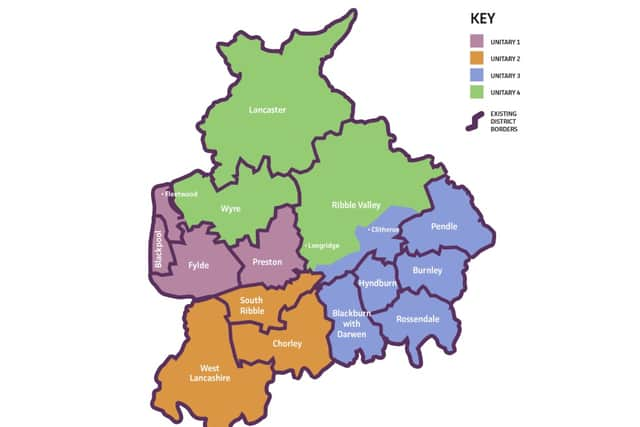
Note – the only proposal to suggest splitting up existing districts as part of the changes.
Council 1: Blackpool, Fylde, Preston and western Wyre (475,222 residents and, up to 70 councillors)
Council 2: Chorley, South Ribble and West Lancashire (358,947 residents and up to 52 councillors)
Council 3: Blackburn with Darwen, Burnley, Hyndburn, Pendle, southernmost Ribble Valley and Rossendale (565,968 residents and up to 84 councillors)
Council 4: Lancaster, most of Ribble Valley [excluding Clitheroe and southernmost areas] and eastern and northern Wyre (201,508 residents and up to 47 councillors)
Promoted by: Blackpool Council
Business case highlights:
***Council boundaries currently exist for administrative convenience. Where these impede rather than expedite quality services, it follows that they should be redesigned to best fit with people’s lives.
***By putting Fylde at the heart of the new borough, the geography recognises the association of parts of St Annes northward to Blackpool, and Lytham, Warton, Kirkham and Freckleton eastward to Preston, and allows for further development of a complimentary economic and tourism offer in a co-ordinated way. It also offers opportunity for both St Annes and Kirkham to benefit from their geographic locations. However, this serves to further emphasise the Wyre anomaly, with both Fleetwood and Poulton-le-Fylde key parts of the travel-to-work flows southward into Blackpool, and Thornton-Cleveleys inseparable from the urban form of Blackpool. For this reason, this option requires a request to modify the boundary of the proposed new authority.
***Deprivation is concentrated in key localities, namely Blackpool, Fleetwood and Preston, with these areas subject to systemic inequalities and interlocking disadvantages across health, education, employment, housing, and access to services. Incorporating these into a larger council area allows for innovation. It also enables an approach to deprivation taken in the round, one which considers how targeted, place-based interventions that address these interconnected challenges can be scaled up in a coordinated and impactful way.
***The Preston Model, an approach to delivering Community Wealth Building together with anchor institutions, is similar to Blackpool’s own model of Municipal Entrepreneurialism exercised through the council’s seven wholly-owned companies.
***Each new unitary will hold capacity to lead on a diverse range of socio-economic priorities, unlocking innovation and inclusive growth across Lancashire. This approach plays a vital role in reducing structural inequalities by aligning services and leadership with the real needs and identities of local communities. It reduces the risks of financial shocks, enhances resilience, strengthens community identity, and improves service delivery.
***The four councils will be best positioned to champion community-led innovation, neighbourhood empowerment, drive sustainable growth and ensure the long-term resilience of public services. Value for money will not solely be achieved through efficiencies from reorganisation, but also through sustainable investment and service quality improvements.
***Cumulative savings of £147.7m by 2032/33 with ongoing annual savings of £66.3m a year.
******Council tax harmonisation estimate [the amount by which rates paid by households in the existing local authority areas could shift in either direction under the new council] – ranges from a 3.3 percent reduction to a 5.0 percent increase.
FIVE COUNCILS
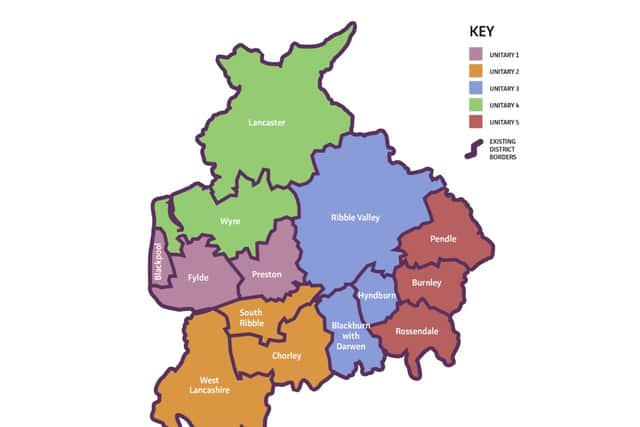
Note – suggested 55-80 councillors per council
Council 1: Blackpool, Fylde and Preston (348,381 residents)
Council 2: Chorley, South Ribble and West Lancashire (358,947 residents)
Council 3: Blackburn with Darwen, Hyndburn, Ribble Valley (314,302 residents)
Council 4: Lancaster and Wyre (263,749 residents)
Council 5: Burnley, Rossendale and Pendle (272,055 residents)
Promoted by: Burnley and Pendle councils
Business case highlights:
***Historically and recently, deprived communities and the authorities that serve them have been left behind in Lancashire decision-making, with decisions made centrally by a county authority that does not understand local needs and issues. This has been particularly experienced in the East of the county which is the most deprived area in Lancashire where over 30 percent of neighbourhoods in Burnley, Blackburn with Darwen, Pendle and Hyndburn are amongst the top 10 percent most deprived nationally. Enfranchising these communities is critical.
***This is why we propose two authorities to better serve and advocate for the East as part of [any future] Lancashire mayoral strategic authority to give them a stronger voice in devolution rather than dilute their representation as seen in the competing proposals. We have learned from the multitude of case studies that suggests that larger authorities do not work, due to being further away from their communities, distracted by multiple issues and challenges and too large to be responsive and agile. Our neighbours in Greater Manchester demonstrate a similar model that is nationally recognised as well-functioning, with small local authorities (smaller than those proposed here).
***The 5UA model envisages the establishment of a network of neighbourhood area committees being established within each new authority. The number of these committees will be determined by these new UAs as part of their new governance model.
***Savings are needed, and consolidation is required and the risk of a simplistic alignment of these drivers is clear. Challenging economic conditions cannot be ignored and efficiency should always be a priority, but it is profoundly damaging to base a programme for fundamental change on a platform of unrealistic savings. The notion of savings in local government reorganisation has become intrinsically, and erroneously, linked to the size of the population, the number of areas and the staffing of authority administrative centre(s).
***The statutory need that underpins and drives 70-80 percent of [a] council’s expenditure is not altered one bit by stripping posts and structures out of the local delivery system. That underlying need must still be met, and will be harder to understand, manage and monitor with fewer staff and with decisions made further away from the local expertise.
***Council tax harmonisation estimate [the amount by which rates paid by households in the existing local authority areas could shift in either direction under the new council] – ranges from a 2.1 percent to 8.8 percent change.