
Finney House update after Preston Reform councillor shares rumours about 'asylum hotel'

Preston’s Finney House will reopen as a care home and will not be used as housing for asylum seekers.
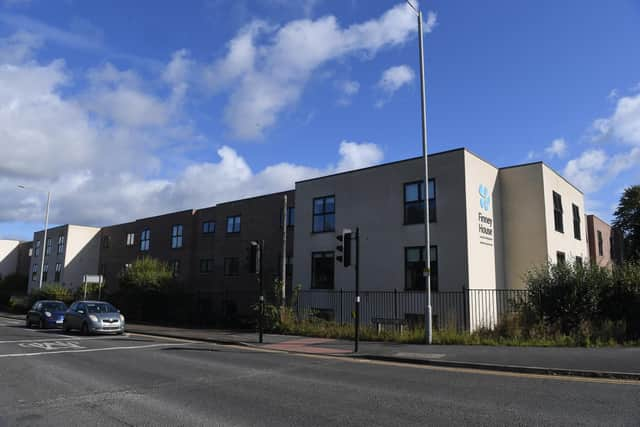
The luxury care home in Flintoff Way stands empty after its last remaining permanent residents were moved out of the facility last month.
The 64-bed facility is currently leased to Lancashire Teaching Hospitals and was used to accommodate those elderly and vulnerable patients who were ready to be discharged, but had nowhere else to go.


The arrangement helped free up beds at Royal Preston Hospital by reducing the number of patients stuck on its wards, but the service was scrapped after the hospital trust revealed it faced a £5m funding shortfall.
Finney House is now closed, leaving the building vacant with two years remaining on its lease before the site is handed back to landlords L&M Healthcare.
There was some speculation the site might be used to house asylum seekers. The rumour gained traction after Luke Parker, at that time a Reform UK candidate for Preston East in the Lancashire County Council elections, voiced concern over the alleged plans.
He said he was sharing ‘unconfirmed reports’ about the facility to ‘raise awareness and promote transparency’. Lancashire Teaching Hospitals described his claims as ‘unfounded and misleading’.
Last month, the Post approached Lancashire Teaching Hospitals and was able to confirm there were no such plans in place. The trust acknowledged it was aware of the speculation but stated “categorically” that Finney House “will not be used for this purpose.”
Restrictions on its lease stipulate the facility must only be used for rehabilitation purposes, such as supporting those who are unwell, vulnerable and/or elderly.
With two years left on the lease, Lancashire Teaching Hospitals said it was eager to find a new use for the facility and a number of options are being considered.

What happens when the lease is up?
Lancashire Teaching Hospitals will hand the keys to Finney House back to L&M Healthcare in 2027.
L&M, the owner of the site and former operator of Finney House nursing home, have also stated their intention to reopen the site as a care home when the Lancashire Teaching Hospitals lease expires.
A spokesperson said: “We can confirm that on completion of the lease period with Lancashire Hospitals Trust, L&M Healthcare will apply for registration with the CQC for the purpose of re-opening the care home facility.”
L&M Healthcare added that there has “never been any conversation whatsoever” about housing asylum seekers at Finney House.

Why did Finney House close?
In February, both Lancashire Teaching Hospitals NHS Foundation Trust (LTH), which runs the service, and the Lancashire and South Cumbria Integrated Care Board (ICB), which plans and commissions healthcare in the region, were placed on an intensive financial recovery programme by NHS England.
LTH had a £58m savings target for the 2024/25 financial year – much of which had to be delivered in the latter part of that timeframe – while the ICB was trying to save £530m over the same period.
Finney House was relaunched in November 2022 and was heralded as an innovative way of better integrating health and social care.
The idea was to improve the flow of patients through the Royal Preston by preventing delays in the discharge process having a knock-on effect in accident and emergency – and even on the ambulance service – when people could not be transferred into wards because of a lack of space.

L&M Healthcare’s previous management of Finney House was deemed ‘inadequate’, despite the costs for single rooms starting at a basic £900 a week.
An inspection in August 2021 by the CQC found that the service was inadequate even when the exceptional circumstances of the pandemic were taken into account. There were breaches in relation to keeping people safe from preventable harm and the care home was placed into special measures.
Those special measures were lifted after an inspection in June 2022 when its rating was upgraded to ‘requires improvement’ and the CQC found that improvements had been made, although there were still some areas of concerns.