
'Council's rampaging plant has ruined my backyard - but they've said that's MY problem'
A resident of a street in Preston says he was horrified to be told it is his responsibility to rectify damage caused to his property by an invasive plant growing on council land – and that he could face legal action if he fails to do so.
Almost two dozen households on St. George’s Road in Deepdale received a letter from Preston City Council late last month, warning them that they needed to meet their “repair obligations”.
It comes after the wall at the rear of their backyards started to collapse in some places and buckle in others, because of what they believe is a buddleia plant growing on rough ground just beyond the borders of their homes.


The narrow strip of land, only a few metres wide, lies between the houses and the city council’s waste depot – and is owned by the local authority.
It is currently a mass of foliage, but the problem facing residents is that nature does not respect property boundaries – and the roots of the rapacious plant, nicknamed the ‘butterfly bush’, have burrowed between the gaps in the bricks of their back wall. They have even got into some of the dividing walls between the individual backyards, running all the way up to the houses themselves.

Farook Selant says he has long been aware of a problem with the section of the partition that runs along the rear of his property and was intending to have it fixed.
However, it was only when he recently removed a shed that was shielding much of the wall from view that he discovered what was, literally, the root cause of the issue.
“At first, I didn’t realise the extent of the damage, to be truthful. I just thought, well, it’s my wall, I’ll repair it [when] I can afford to pay for it.
“It’s only four months ago…when I took the shed out, that [I realised] the damage is caused by Preston City Council’s neglect,” Farook said.
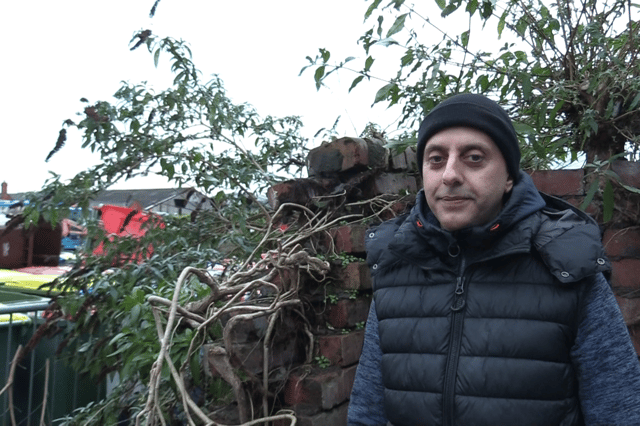
He told the Lancashire Post that having lived in his home for 30 years, he has never been aware of any maintenance of the scrub land at the back of his property.
Farook was advised by the city council that he is responsible for the half of the two-brick-deep wall closest to his house, while the local authority is liable for the part that adjoins their land.
However, he says that when a city council surveyor visited the property to discuss the matter, he was told that the authority would rebuild the wall in full – because of the source of the damage – and also clean up the land from where the problem stemmed.
But Farook says he then heard little else until the week before last when a letter – also sent to around 20 of his neighbours – arrived giving him 14 days to “confirm in writing…how you will comply with your repair obligations”.
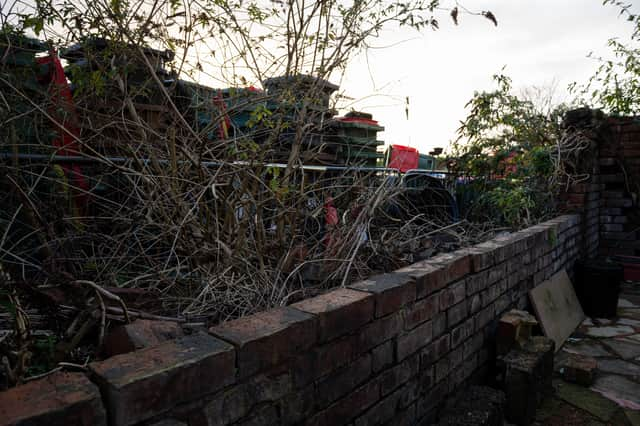
The houses on the affected stretch of St. George’s Road are built on land for which Preston City Council is the freeholder, making the people who live in the properties leaseholders.
The authority has told the Post that the leaseholders are liable for repairs to the entirety of their rear walls if the plant is growing within the structure.

The correspondence sent to householders says they must “conduct a review of the condition of the party wall” abutting the city council's strip of rough land and advise the local authority of the results within seven days of the assessment being undertaken. The residents are told that they must also co-operate with each other in commissioning any necessary work.
The missive ends with a warning that “if the lease obligations are not complied with, the council reserves the right to issue any relevant enforcement action, which may include legal proceedings for breach of lease, with associated costs being recoverable from you”.
Farook said he was stunned to receive the letter – not least because of the futility of carrying out any repair work unless and until the city council commits to clearing the problem plant. That is a promise that he says was made to him in person, but on which the authority has now fallen silent.
“Even if I put the wall back up, [unless they have] cleared this vegetation, it’s irrelevant really – [because] within two years, I’d be facing the same problem again,” he explained.
“I was more than happy to rebuild the wall, if it was my responsibility – in the sense that there was no neglect [on the part of anyone else].
“I want Preston City Council first to acknowledge that [the problem originated from] their part of the land and [then] clear all the vegetation, which they actually agreed to do four months ago.
“I hold [them] responsible because of their neglect for 30 years [in] letting this buddleia grow,” Farook added.

He said he also believed the city council should repair the walls between neighbouring backyards, even though they are on the leaseholders’ land. He has removed one layer of bricks from each of the partitions running down the sides of his yard in order to expose the extent to which the buddleia roots have permeated between the pointing.
His next door neighbour‘s back wall – along the border with the scrub land – is showing signs of the same problem, bearing bulges that suggest that it could be close to going the same way as the section at the rear of Farook’s property.
Lancashire county councillor Michael Lavallette, who represents the Preston Central East division in which the affected homes stand, said he was “completely shocked” by the damage done to the residents’ walls – and the city authority’s response.
“It just seems astonishing that Preston City Council won’t take responsibility. When you look at where the buddleia trees are rooted, they’re clearly on [their] land.
“When this was brought to their attention, rather than dealing with it in a neighbourly way…they have immediately upped the ante. I can’t believe the letters that they’ve sent out to people and the threatening tone that they’ve invoked telling people to rebuild their walls and [that] it’s their responsibility in the lease,” County Cllr Lavalette said.

He also contrasted the way in which Preston Bus had looked after the same strip of land – part of which they own, further along St. George’s Road – where there is “no problem” with rampant vegetation.
County Cllr Lavalette added that it was common decency for the city council to rectify the mess which he said they had caused – in a way that any good neighbour would.
“If there was any [resident that] neglected their property and the consequence was it led to your foundations, your walls, your property being…destroyed, would you expect them to offer you some compensation for that?
“I think most reasonable people would say that is the responsibility of Preston City Council [in this case],” he said.
A spokesperson for Preston City Council said: “If the growth is in the wall, then the responsibility falls with the tenant/owner to remove the plant and make good the wall.”

WHAT IS BUDDLEIA?
The Royal Horticultural Society says buddleia boast “fragrant flowers” and are “a favourite nectar source for butterflies”.
“These undemanding, mainly deciduous shrubs, deserve a place in every garden with their spectacular displays of blooms and honey scent,” the organisation’s website suggests.

However, the Property Care Association warns that the plant can “spread rapidly via seed dispersal” – and is not deterred by the kind of conditions that may stop other shrubbery in its tracks.
“It grows well on brownfield sites and on masonry due to its tolerance of lime mortars and concrete.
“In severe cases, buddleia roots can colonise masonry walls making them somewhat unstable and a potential danger as well as blocking gutters and causing rainwater to penetrate walls, “ the PCA website says.
...