
Vision for ‘very different’ Lancashire in massive shake-up completely changing political map
People’s lives in Lancashire can be improved if councils and other bodies support new co-operatives and mutual organisations, so more money stays locally, Preston City Council’s leader told a Lancaster University event.
Matthew Brown, giving a local government lecture, said reorganisation of Lancashire councils in 2028 could be an opportunity for community wealth building, ‘democratic economies’ and doing things ‘very differently, if it’s done right’.
These changes could make individuals and communities less-vulnerable to unexpected political and economic changes – whether by big businesses, national governments or international events. And it could bring better work, pay, housing, energy costs and other benefits for thousands of people.
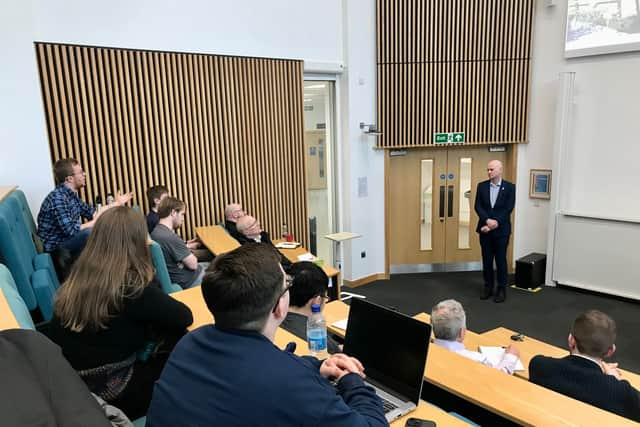

Coun Brown spoke as part of the ‘Lancashire Voices’ lecture series organised by Lancaster University’s School of Global Affairs. It was hosted by Professor Christopher MacLeod and Dr Martin Steven with an audience including students, the public and some Lancaster city councillors.
Matthew Brown said Preston was encouraging new co-operatives to address many needs in response to globalisation, the legacy of the late 2000s financial crisis and the collapse of retail-led regeneration, including Preston’s former £700million Tithebarn project. That plan centred on John Lewis becoming an anchor store for redevelopment around Preston Bus Station. Various organisations were involved but it failed to progress, following the financial crisis.
However, Mr Brown said new examples of council-linked, community or employee-owned enterprises in Preston include the Animate cinema and leisure complex, Mandala Yoga Centre, Community Energy Preston, Preston Cooperative Education Centre. Preston Digital Co-op, Brookfield Retrofit. which works on buildings; Lady Boss food co-op, Leighton Street housing co-op and The Ferret music venue.
He emphasised: “Preston is not perfect. We have many issues including empty shops. But 35 per cent of our council’s spending is local, which is higher than many other councils.”
FUTURE COUNCILS
Looking ahead, he said: “Under the 2028 council changes, we want Preston to join with Lancaster and the Ribble Valley. That would create an area with a number of universities and hospitals, and a big cyber-technology sector. A big powerhouse.
“But it would also be an opportunity to address inadequacies. Distribution of wealth must be addressed. We want community wealth building – an exciting, radical system to do local politics and economics very differently rather than money being extracted from communities.
“We want fair work, locally-rooted finance, a regional mutual bank and credit unions. Banks are still failing us. But a North West Mutual Bank is being established. We also want the fair use of property and land, community-owned housing and renewable energy.
“Nobody had heard of community wealth building 10 or 20 years ago. But it’s a growing movement. We don’t always have to work for large supermarkets paying the minimum wage. People can work for co-operatives.”
OTHER APPROACHES
He added: “For years, councils traditionally worked with big retailers on town regeneration schemes. Preston persisted with that for years and this included competing with Blackburn.
“But Preston’s Tithebarn Regeneration Partnership was abandoned in 2011. And I wanted to see things done differently and started looking at community wealthbuilding ideas.”
He said there were other examples in Britain and around the world of co-operatives, mutual societies and credit unions. A key aim is to get big ‘anchor institutions’ such as councils, hospitals, colleges and universities to support local co-operatives, for example with food, local energy or building services.
In Preston, he said major institutions spend millions every year on suppliers. On a larger scale, Lancashire has a huge public sector pension fund in investments. However, no Lancashire pension fund money is currently invested in Preston, he said. There were many ideas to consider but action was vital.
He said there was plenty of economic research by think tanks and universities on all these topics. But ideas needed to be turned into action at all levels, from big organisations to residents and workplaces.
He added: “The biggest barrier we face is people who just want to do things the same way.”
Speaking after, Christopher MacLeod from Lancaster University’s School of Global Affairs said: “We are running a series of lectures including on Lancashire and regional issues which the public can attend. We’ve had a couple of talks on devolution and an upcoming talk will be about history, monuments and memorials.
“Registration to attend the talks is encouraged, so we know how many people to expect. But members of the public are very welcome – and we’ll offer them a cup of coffee too.”