
Verdict in on future of Burnley church at the centre of bitter dispute over migrant housing rumours
Plans to use a former Burnley church and upholstery factory at the centre of a bitter dispute last year over false rumours it would be used to house migrants as student flats has been refused by councillors.
In August, the borough’s Labour MP Oliver Ryan and Reform UK’s Burnley Central West Lancashire County Councillor Liam Thomson became locked in a fierce social media row over the possible use of the premises at the corner of Claremont Street and Tabor Street for housing asylum seekers.
It followed a small fire in the yard of the building originally home to the 19th-century Claremont Street United Free Methodist Church, which was then occupied by Wrights Upholstery.
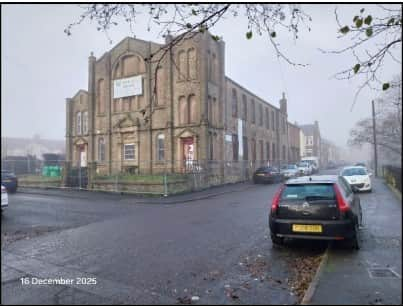

Now this month’s meeting of Burnley Council’s development control committee has rejected Khalid Mahmood’s proposal to convert the property into 24 studio flats for students.
This decision was made despite a legal warning over the possible consequences of the decision overturning an officer’s recommendation to grant planning permission.
The committee’s legal advisor told the meeting: “Any decision taken in this matter must be based on, and only on, proper planning grounds.
“Your officers have advised fully in relation to the relevant material considerations and policy background and you should consider that advice carefully.
“Whilst you are not bound to follow that advice, in any appeal proceedings arising out of the decision you make, the council will be expected to produce evidence to substantiate each reason for refusal, by reference to the Development Plan and all other material considerations.
“If the council fails to, or cannot do so, then costs may be awarded against it.”
The grounds for refusal were:
- the proposal fails to demonstrate that the development would provide sufficient communal student facilities and outdoor amenity space to meet future occupants needs;
- the proposal would introduce a student use into a residential area and is a use which has the potential to generate noise at antisocial times which would be unacceptably detrimental to neighbouring residential amenity;
- the layout and design of the proposal would not accommodate any disabled parking and therefore fails to meet the need of disabled road users; and
- the application site is located in an area which is known to suffer from significant on-street parking problems and the lack of parking provision would exacerbate on on-street parking problems.
The original plan for 48 rooms generated 162 public objections while the scaled-back scheme for 24 flats sparked another 23 public objections.
A planning officer’s report recommending approval with 12 conditions said: “Numerous comments received refer to the proposal as being a scheme to house migrants.
“The submitted scheme makes no reference to housing migrants, and approval is sought for student accommodation.”