
Police called in as rare hen harrier disappears from Lancashire in suspicious circumstances
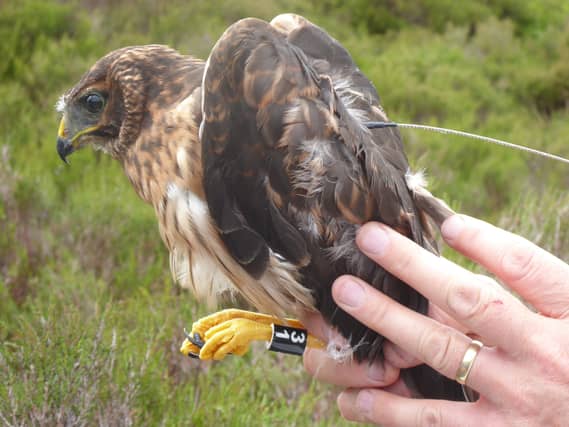

A rare bird of prey has disappeared in suspicious circumstances raising fears of illegal persecution.
The young female hen harrier, named Helius, hatched last summer in Bowland, Lancashire.
While still in her nest, Helius was fitted with a satellite tag which allowed the RSPB to monitor her movements after fledging.
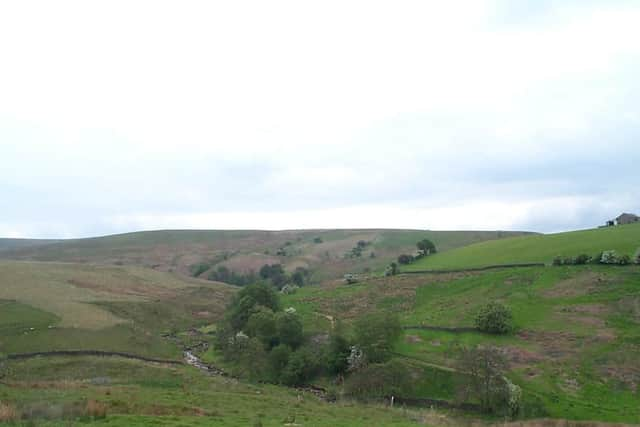
Her tag showed her to be exploring the wider Bowland area, spending time on the United Utilities estate and neighbouring moorland.
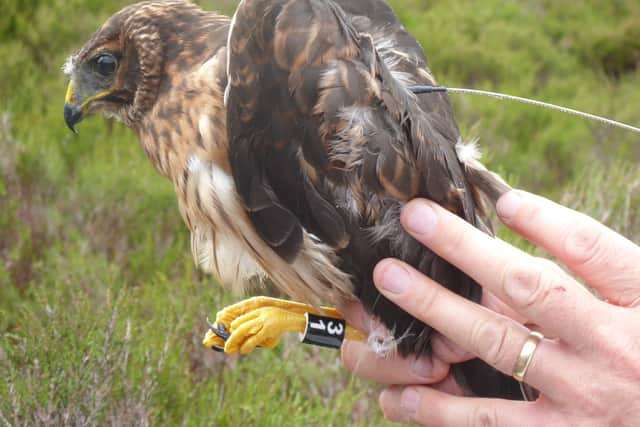
She even went on to have chicks of her own, producing a brood of five chicks this summer on United Utilities land, three of which fledged.
Her chicks having left, on July 31 this year, Helius was at a location on the boundary of a United Utilities Estate between Brennand Fell and Tarnbrook Fell.
The next day, her tag, which had been performing reliably, failed to transmit. It has been silent ever since.
The National Wildlife Crime Unit (NWCU) and Lancashire Police were informed and a search was conducted, but they found no trace of Helius or her tag.
Illegal persecution
Hen harriers are rare breeding birds in the UK, known for their acrobatic ‘skydancing’ courtship display.
Illegal persecution over recent decades has reduced the population of this species to a fraction of what it ought to be.
In England, there were 25 successful nests in 2024, down from 36 in 2023. A Government scientific study estimates there is capacity in the English uplands for over 300 pairs.
The RSPB has been tagging Hen Harriers for over a decade to help with conservation efforts for this elusive and heavily-persecuted species.
In 2023, 34 tagged birds were either killed or disappeared in suspicious circumstances, many of them in connection with land managed for driven grouse shooting. This is more than in any other year to date.
A scientific study published in the journal Biological Conservation found that survival rates of Hen Harriers were ‘unusually low’, and illegal killing was identified as a major cause.
Using data from the largest GPS tracking programme for hen harriers globally, the authors discovered that individuals tracked by the project were typically living just 121 days after fledging.
The risk of dying as a result of illegal killing increased significantly as hen harriers spent more time on areas managed for grouse shooting. Previously, a 2019 Government study concluded that Hen Harriers suffer elevated levels of mortality on grouse moors, most likely as a result of illegal killing.
What they say
Howard Jones, RSPB Senior Investigations Officer, said: “Satellite tags continue to transmit even after a bird dies, allowing us to locate the bird’s body. But when a tag suddenly stops transmitting, with no sign of malfunction, and then cannot be located, this is deemed highly suspicious. We suspect human interference in this case.
“Helius’ fate is by no means a one-off. Too many of these birds are disappearing in suspicious circumstances, and it is having a heavy impact on the species as a whole.”
Earlier this year, it became law in Scotland for all grouse shoots to require a licence to operate. If criminal activity – such as raptor persecution – is detected on an estate, then this licence can be removed. The RSPB is calling on Westminster to introduce licensing in England for all gamebird shooting, to afford birds of prey greater protection.
Mark Harrison, Detective Inspector at the NWCU, said: “Bird of prey crime is a UK National Wildlife Crime Priority, and crimes involving Hen Harriers and other birds of prey has no place in modern society. We will continue to work with the RSPB and our other partners to develop crime prevention techniques and thoroughly pursue all investigations into these crimes. The public also play an important role in reporting intelligence and suspected crimes to the police.”
If you notice a dead or injured bird of prey in suspicious circumstances, call the police on 101 and fill in the RSPB’s online reporting form: www.rspb.org.uk/report-crimes.
If you have information about anyone killing birds of prey which you wish to report anonymously, call the RSPB’s confidential Raptor Crime Hotline on 0300 999 0101.