
'Both people & animals need support'- Uni of Lancashire Vet Dean supports search & rescue efforts in Venezuela

“Both people and animals need ongoing support” says University of Lancashire professor deployed to help search dogs over in Venezuela.
A senior staff member at Preston’s University of Lancashire has been using her expertise to help with search and rescue efforts in Venezuela following last month’s earthquakes.
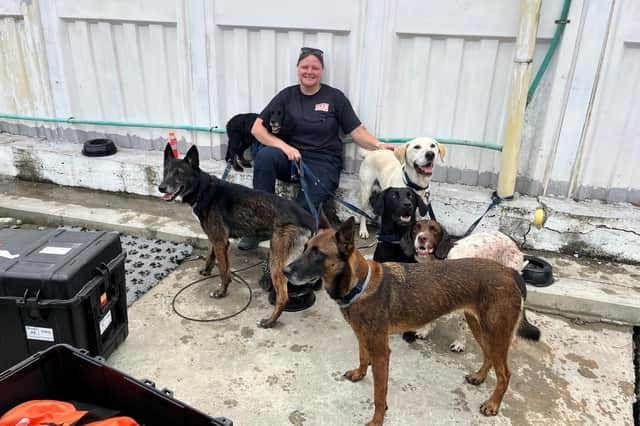

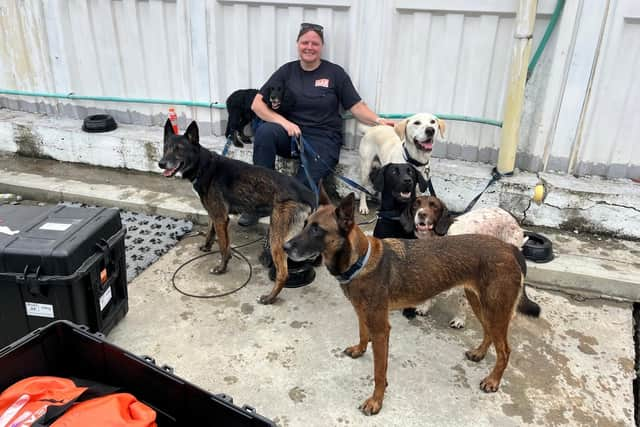
The Dean of the University of Lancashire’s School of Veterinary Medicine has been overseeing the welfare of specialist search dogs in the disaster struck South American country.
Professor Heather Bacon OBE , who lives in Preston, was deployed as part of the UK International Search and Rescue (UK ISAR) team, supported and funded by the Foreign, Commonwealth and Development Office, alongside experts from 14 UK fire and rescue services.
The team spent eight days working in La Gauira, the region most severely affected by the twin quakes, which hit on June 24.
Operating in difficult conditions of over 30 degree heat and 85% humidity, Heather oversaw safeguarding the health and welfare of six live person search dogs as they worked day and night with rescue teams to recover people trapped in the rubble.
The highly trained search dogs helped locate potential survivors by detecting signs of life in collapsed structures and unstable environments.
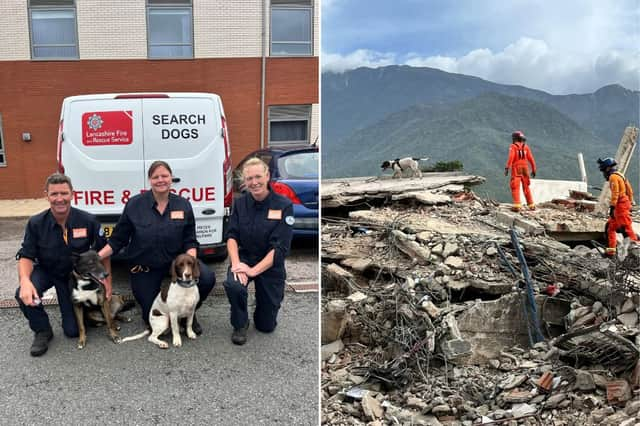
Heather, who looked after specialist search dogs Davey, Scout, Fozzie, Luna, Millie and Bailey, said: “In a disaster situation like this, the dogs are the most effective tool we have for detecting people. They are specifically trained to search out the odour of live people only, a unique mix of breath and pheromones, and can access areas of collapsed structures that are impossible for human rescuers. The dogs are trained to give an active indication of a loud series of barks when they locate the strongest source of live human odour and this helps the rescue team to locate and plan access to human survivors.
“The situation is La Guardia is devastating, but it was inspiring to see the international community working together to help. My role was to keep the dogs fit and safe, prevent heat stress, and treat any illnesses or injuries so that they could continue their important work in extremely harsh conditions. I was also able to help the search dog from the Peru rescue team and some local pets too.
“Whilst our deployment there focuses on live recovery of people, it is important to remember that the humanitarian crisis in the aftermath of this disaster will continue, and both people and animals need ongoing support.”
Heather, who has led the University of Lancashire’s School of Veterinary Medicine since it was established in 2021, is a passionate advocate for animal welfare and has worked extensively with animal welfare charities overseas.
The Preston professor was out in Venezuela with Lancashire Fire and Rescue dog handlers as well - they were among 70 UK fire and rescue service personnel deployed after the offer of help from the Foreign, Commonwealth and Development Office was accepted by Venezuela late last month.
The death toll from the quakes has now risen to 3535 and thousands more remain displaced.
The Disasters Emergency Committee (DEC), a group of UK charities, that launched an appeal to help the people affected in Venezuela on Sunday revealed they had raised more thean £10 million so far.