
'I want to change how care is perceived in Preston': Preston man opens care service in parents' honour
Ejaz Riaz was inspired to open his own care service after both of his parents were diagnosed with dementia.
A Preston man has told of how his parents’ diagnoses of dementia led to him pursuing a career in care.

44-year-old Ejaz Riaz had spent years working in an airport, and had later spent many more working in insurance until his mid-30s.
His father Mohammed had been “very loving and caring for others”, and though he had started to become unwell, Ejaz said his family had felt completely unprepared when the council said he would need to be moved into care.
“He was in hospital for a number of weeks, and they were planning to discharge him to the more end-of-life side, which was quite a shock,” Ejaz told the Lancashire Evening Post.
“He was walking and stuff, so it was all quite sudden. The nurses were arranging for him to come home, and then a day later the doctors called me and my mum into a side room and said he’s not well enough to go home, and that he could pass away at any time.
“My care knowledge at the time wasn’t great. Even basic things like shaving my dad, I’d never done that before, and it was just a bit upsetting that my dad would soil himself and I’d have no idea what to do. He got unwell quite quickly.
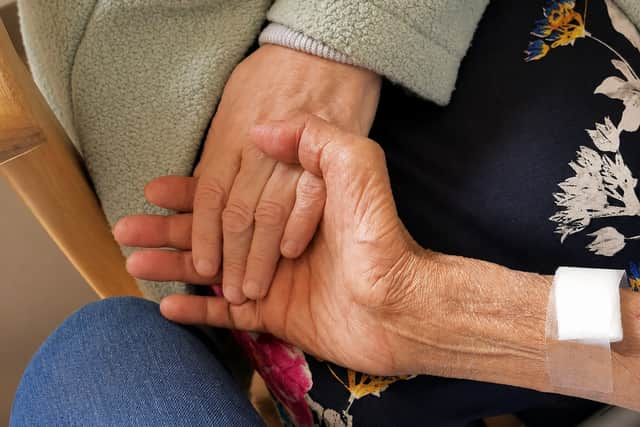
“I remember an image of him and my mum, holding hands. He passed away in my arms the next day.”
After Mohammed passed away, Ejaz’ mother Hannah had not been able to face returning to an empty home, and instead moved in with her son.
For three months, the pair had lived together and kept each other busy through their grief.
But after moving back home, Ejaz was once again plunged into uncertainty as Hannah - who had always been “active and healthy” - was also diagnosed with dementia.
“Literally within a couple of weeks, she forgot how to do everything,” he said.
“She forgot how to wash herself, how to eat, how to do everything, basically.”
For more than six months, Hannah remained bedbound at home as a result of her illness, and the family had been forced to rely heavily on agency care workers to come and assist her treatment.
However, while he had met several good carers over the years, Ejaz said he’d been “shocked” to see the level of poor and impersonal treatment his mother received from “rushed” carers.
“I’d be there when the carers came, and they were so rushed. In and out. There was no person-centred care, and they were sending males in to attend to a female, which we were totally against.
“She had numerous falls out of bed, because the carers would forget to put the side up. They left her uncomfortable and in a really bad way.
“At stages, I had to attend to her personal care, which was quite thing for me and my mum. But it was something I had to do.”
Some of the biggest issues that face patients, according to the Care Quality Commission, included “intrusive” assessment processes, poor understanding from carers about specific conditions, and the uncertainty faced by patients at having strangers come into their homes.
In the UK, the proportion of older adults who receive local authority-funded social care has dropped from 8.2 per cent to just 3.6 per cent over the past 20 years, even as demand has continued to rise.
It was during this time that Ejaz began working in care full-time, in the hope that he would be able to offer her more help than he had been able to with his father.
”I wasn’t able to help my dad,” Ejaz said. “When you’re not from that background, you might be caring, but if you’ve never physically shaved someone before, or if they’re struggling to go to the bathroom and you don’t know how to move them, it’s a difficult position to be in.
“I didn’t want to go through that with my mum as well. There’s things I wish I could have done differently with my dad to help him more, but I was blind to it. I wanted to gain more knowledge and have that wake up call.”
After months of treatment, Hannah would slowly start to recover from the worst of her illness - a “miracle” Ejaz attributes to her drinking Zam Zam water, which is considered holy in the Islamic faith.
“I was constantly there for her doing physio with her, helping her, and just giving her food and cups hand-to-mouth, and she came a lot more to life, which was a huge miracle. The doctors said they’d never seen it before.
“She lives in the same place now, and she’s able to walk, she’s able to talk, eat, drink... It’s a miracle that she’s back on her feet, just doing her own thing and enjoying life now.
“But I’ve worked at quite a few care agencies, and everyone’s all about business. On morning calls, they put like six, seven people on you, which you just can’t do properly.
“There has to be a different way to do things, a more person-centred way for people with dementia and the elderly. They had a life before this, and that should still be honoured by carers, the family, and by everyone involved.”
A decade on from his father’s diagnosis, Ejaz is now preparing to open his very own care service in the heart of Preston.
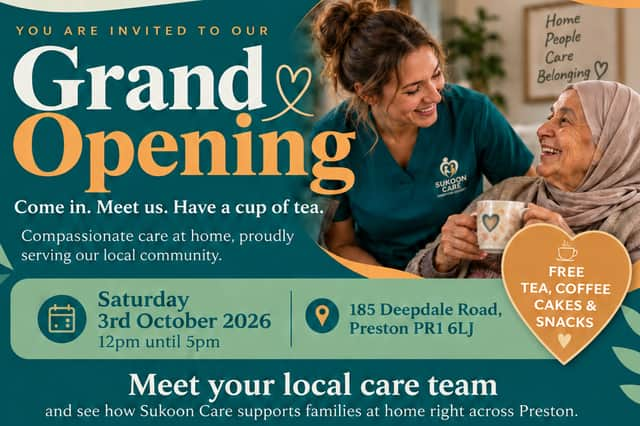
Sukoon Care - which means “rest”, or “stillness” in Arabic - is set to launch on October 3, and will offer a more personalised service to families in the city who need at-home carers.
“My parents always said that if you help somebody, people will help you, and that life is more peaceful and satisfying that way,” Ejaz said.
“The best thing about care is seeing people smile. It gives you a huge sense of achievement at the end of it. It’s always sad when people pass away, but being asked by a family member, ‘Would you mind carrying the coffin?’ just goes to show what impact you had on their lives.
“I want to change the mindset of how care is perceived in Preston,” he said.
“When people talk about care, I want them to have positive words about it, and I want to look after people how I would expect me to look after my own parents.”
Further information about Sukoon Care is available on their website.