
Boyhood PNE fan Patrick Watts recalls the moment he was held at gunpoint during Falklands conflict


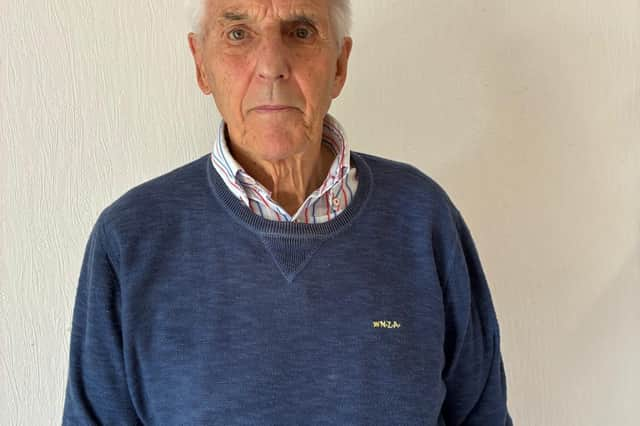
Falkland Islands native Patrick Watts is a boyhood Preston North End supporter. In part one of the Big Interview, he talks to Craig Salmon about the harrowing experience he endured during the Falklands War when Argentina invaded the British Overseas Territory in 1982
Maybe it was the thought of watching his beloved Preston North End play once again on the hallowed turf of Deepdale which caused Patrick Watts to remain remarkably calm and collected despite being plunged into a life or death situation.
The radio presenter - affectionately known during his career as the voice of the Falkland Islands - was broadcasting live on air when he felt the full force of an Argentinian soldier’s gun pressed into his back.
Ordered to keep broadcasting by Governor Rex Hunt to keep the islanders informed of Argentina’s imminent invasion on Friday, April 2, 1982, Watts maintained his composure as the Argentinians stormed the studio to take over the radio station.
Recordings of the incident make for vivid listening as Watts, who was born and bred on the island, asks the invaders to ‘take the gun out of my back’ and ‘I’m not speaking with a gun in my back’.
Courageously, he informs the Argentinians that guns are not allowed inside the broadcast station which prompts an officer to order the soldiers to remove their arms.
Watts remained - and continued to work - throughout Argentina’s occupation until the British Army liberated the Falkland Islands 72 days later.
Nearly 35 years on from the conflict, father-of-two Watts - who turns 82 this month - tries not to reflect too much of the horrors he witnessed.
And talks modestly of the bravery he displayed as he continued to broadcast in such horrific circumstances.
“It’s very difficult to describe what that time was like because you kind of don’t want to make it feel more traumatic than it was,” said Watts, who is the father of two grown up daughters Amara and Lucinda, and grandfather to Imogen.
“But I had two young daughters who were then aged 10 and 12-years-old and that was my main concern.
“I carried on doing what I was asked to do at the radio station by the governor which was to keep broadcasting until the Argentines eventually took over the radio station.
“I did what I was requested to do.”
Driven by a sense of duty to the British flag, Watts refused to yield to the Island invaders.
His initial defiance from the first moment the Argentinians set foot in the radio station bearing arms was mirrored over the course of the ensuing weeks.
He continued to broadcast throughout the occupation and challenged the Argentinian commanders on a daily basis.
It is one of the reasons why he believes he has not been troubled too much from post-traumatic stress over the course of the rest of his life.
He said: “The Argentinians sent people over from Buenos Aires to work with me in the radio station and so we were broadcasting in Spanish and English for the 10 weeks of occupation.
“That was quite a challenge, but well...I just stayed there because you want to keep the British flag flying if you can.
“You don’t want it to become an all-Spanish radio station so I went in every day and did what I could in English, they did what they did in Spanish.
“I suppose I have been quite fortunate compared to some people after the war ended. I have had experiences where I sort of see these Argentine planes coming over the island.
“Thankfully, that has been very minimal - I do wonder if the fact that I was going into work every day and challenging the Argentines has something to do with it.
“There were four or five civilians sent over from Argentina to work with me, but of course the military officers were coming in every single day just to show their authority.
“Some of them were okay and were supportive, but one or two wanted to throw their weight around a bit.
“Maybe because I had that challenge to go into work every day and take them on a bit if you like, I have not been too badly affected.
“My boss was a colonel so if anything went wrong, I had to report to him and I would get a little ticking off; be told to be careful and to watch my step.
“I think it made me more determined to carry on, instead of just retreating and staying at home.
“I think that is the worst thing you can do - if you sit at home just worrying about what might happen, at least I could go out and do something.”
While Watts has been able to come to terms with what happened and get on with his life, the memory of the truly devastating events which occurred on his homeland during the conflict will never leave him.
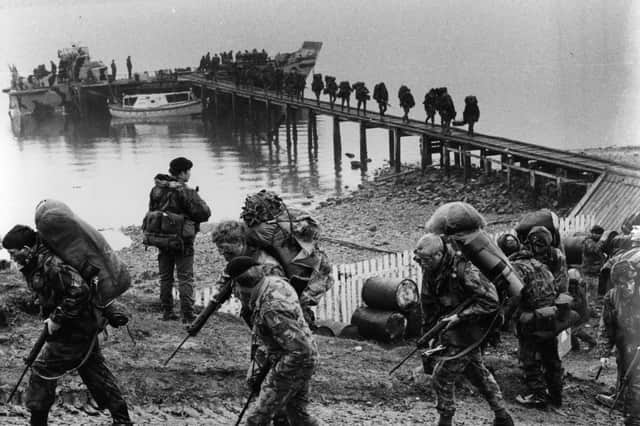
Three civilians were killed - Susan Whitley, who was a 30-year-old British citizen, and local islanders Doreen Bonner (36) and Mary Goodwin (82) - in a friendly fire incident when a British Royal Navy shell targeting Argentine positions accidentally struck the house where they were sheltering in Port Stanley.
The tragic loss of them is personally felt by Watts as he knew all three ladies. The war also claimed the lives of 255 British military personnel and 649 Argentine military personnel.
“The shells were falling short and landing in the front of the garden,” Watts recalls.
“So they all moved into the back, into the kitchen. Unfortunately, the next shell landed in the back of the garden and the shrapnel killed them.
“Two of the ladies were locals and the younger lady was a schoolteacher from the UK. She was married.
Subscribe now and catch every minute of our North End coverage this season - from pre-season to the final whistle. Click here
“It was sad. I knew all three ladies - in those days everybody knew everybody in the Falklands.”
Watts recalls having to black out his windows during the war and there was also a dusk to dawn curfew every day - something which he often fell foul of.
In the last three days of the conflict, he opted not to go into work and stayed at home to be with his daughters as the conflict intensified.
He added: “The last three days were pretty horrific because the British were trying to take out the Argentine positions on the edge of town and some of the bombs were falling in the wrong places.
“Quite a lot of buildings were hit and were on fire. All you could do is stay indoors and hope for the best. The last three days I didn’t go to work - they’re the only days I didn’t work.
“I felt obliged to stay home and look after my family.
“We had refugees if you like coming from over the hill in the outskirts of the the town. We all took in people, like for instance my sister and brother-in-law all came to stay with us.
“I was in the centre of town, in a stone house with a wooden roof - we just had to hope for the best.”
The Falklands have been a British Overseas Territory since 1833 and Britain supports the right of self-determination of the islanders.
Despite Britain repelling the Argentine invasion in 1982, the Falkland Islands remain the subject of much political tension between the two countries.
In 2013, a referendum was held amongst islanders with 99.8% of the population voting in favour of remaining as an overseas territory of the United Kingdom.
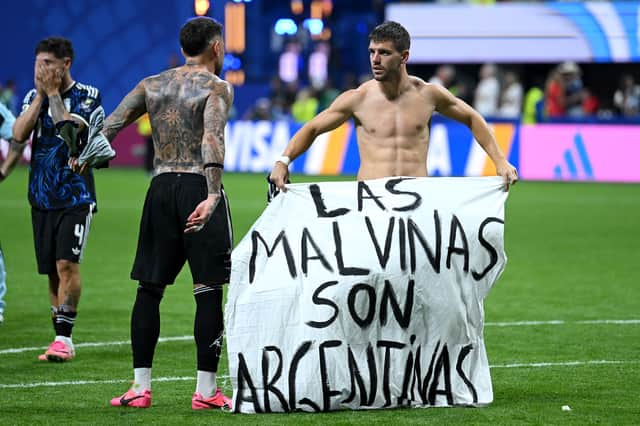
During the recent football World Cup semi-final when Argentina defeated England 2-1, the victorious players afterwards unveiled a banner laying claim to the Islands.
It read “Las Malvinas son Argentinas”, which translates as the “Falkland Islands are Argentine”.
Even as recently as this week, Argentina's president Javier Milei delivered a televised address to the nation during which he repeatedly asserted the country's claim over the Falkland Islands.
Milei also announced plans to sanction oil companies working off the islands
The islands are "under British occupation", Milei said, as he issued a rallying cry to the people of Argentina to "stand together" and "show a united front to the world".
However, several leading British politicians have provided statements in response to the president’s address, including foreign secretary Ed Miliband.
He said the UK's position on the islands was "unwavering".
"The islands are British and will remain so because that is the overwhelming position of the Islanders," Miliband wrote on X.
"Their right of self-determination is paramount, grounded in international law and we will resolutely uphold it."
Watts admits the islanders have always lived under a cloud of concern due to Argentina’s incessant claims to them.
“The political aspects haven’t changed, but militarily, we have no worries as we have a deterrent which we never had in 1982,” Watts said.
“We just had 45 British Royal Marines and a little ship with a four-inch gun and nothing else.
“Now we have got the Euro-fighters, the Typhoons, a military infantry and surface to air missiles - and radars so that we can track any Argentine aircraft movement.
“There is probably a submarine around - we feel safe.
“People say, ‘Why can’t you be friendly with the Argentines? Britain and Germany made friends after the Second World War’.
“The difference is Germany is not maintaining its position that it wanted to take over Britain and the rest of Europe.
“Whereas Argentina hasn’t changed - it’s still laying claim to the Falklands. It still brings the subject up every year at the United Nations.
“Every opportunity they get, they are reminding that the islands, as far as they are concerned, are called the Las Malvinas.
“They make up stories - a bit like they do at football. They kick people off the field but then they lie down and pretend it’s them who are being hurt.
“They make up stories that it was Britain who expelled them from the Falklands.
“I am fed up of telling people that there was never any indigenous population in the Falklands. When Britain colonised the Falklands, there was no Argentine population that they expelled at all.
“An Argentine military came over illegally and the British told them that they had to leave which they did voluntarily.
“We voted more than 10 years ago, 99.8% wanted to stay British. Every British Government since 1982 and Margaret Thatcher have given their support to the Falkland Islands.”