
'I've overpaid my council tax since 1995' - Penwortham pensioner claims he's £15,000 out of pocket
A Penwortham man claims to have overpaid his council tax to the tune of £15,000 over 30 years - and isn’t prepared to give up after fighting for six years.
A Penwortham man claims that he's overpaid his council tax for more than 30 years - and is £42,000 out of pocket.
Michael Fielding, 83, said he discovered the issue by accident six years ago, and has been fighting the Valuation Office Agency (VOA) ever since - with no joy. They have rejected his appeal three times on grounds that the banding is correct, and he’s had a Valuations Tribunal dismissed.
To add to the retired accountant’s claimed injury, he’s even been labelled as a nuisance customer, and told his letters will not be responded to.
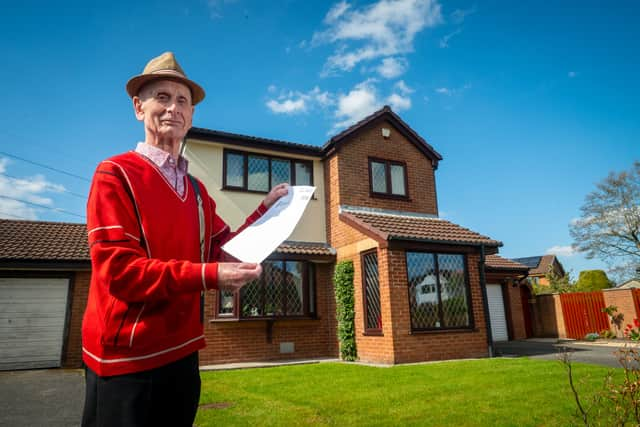

As well as claiming he has made around £15,000 in overpayments, Mr Fielding says he has lost out on tens of thousands due to lost interest on the money, the cost of preparing for a tribunal, recorded deliveries, gaining copies of sales invoices and missing out on a council tax rebate during the pandemic, available to houses in Band A-D.
What's the background?
Mr Fielding and his wife Sandra bought their detached house in Appletree Close in December 1987 for £55,995. While the house was originally designed as a four-bedroomed property, the couple chose to make a range of modifications at the building stage, one of which was making the fourth bedroom into a dressing room, accessed only from the master bedroom and thus making it a three-bed property.
The property was assessed as being in Band D for Council Tax purposes, until 1995, when Mr and Mrs Fielding received a "total surprise" letter saying it had been wrongly banded and it had been reclassified as Band E. They didn't question the change, which also affected a number of neighbouring properties, until they saw a Martin Lewis segment on TV about checking council tax and a relative mentioned the Government council tax band check website.
The problem
Mr Fielding says that he discovered that other 'identical' properties on the estate were still in Band D, paying around £500 less per year since 1995. The current 2026/7 Council Tax charge for a Band E house in Penwortham is £3,011.90 - £547.62 more than a Band D property at £2,464.28.
Mr Fielding said: "Its made me really angry, this whole situation. It's now in it's sixth year, but I’m not going to give up.”
Mrs Fielding said: “I’ve got to the stage where I feel defeated by it”.
Of all 40 houses on the Blackberry Way and Appletree Close estate in Penwortham, 13 are in Band E, but all apart from Mr Fielding's property have four bedrooms - something he says would make it worth less. Mr Fielding also wants to know why a neighbouring property of the same design and floorspace is classified as Band D, when it has four bedrooms. "It's completely illogical", he said.
The neighbouring house has a slightly smaller garden and has one garage instead of Mr Fielding’s double, but according to the VOA’s website, attached and integral garages are excluded from Reduced Covered Area (RCA) calculations - which is how houses are measured - unless they are accessed from within the main house and finished to a similar standard.
How is Council Tax worked out?
Council Tax is a applied to domestic properties (owned or rented) to fund local services like rubbish collection, policing, libraries, and social care. Typically, one bill is paid per household, and each home is assigned a valuation band (A-H in England) based on its value as of April 1 1991, with higher bands paying higher taxes.
The price range for a band D house would fall between £68,001 and £88,000 on April 1, 1991 and to be in band D, it would fall between £88,001 to £120,000.
The VOA hold Property Attribute Data (PAD) about the the physical features of a property, which goes towards determining your Council Tax band.

Mr Fielding’s calculations
As Mr Fielding’s house was four years old on April 1, 1991, he said he is confident he can determine that it would have fallen within the Band D bracket of between £68,001 and £88,000.
He said: “My house was newish in 1991, so I can dig my heels in. People who have a newbuild now won’t be able to figure out what the value would have been in 1991. That’s why it’s important that people like me fight - so other people are also treated fairly.”
He said he has used sales prices of the same house types and known local price inflation data to show his house would have been worth £79,002 in 1991. He has also calculated that as the identical neighbouring house mentioned earlier (sold for £2,000 less in 1987) sold for £82,000 in January 1992, his house would have been worth just over £85,000 at the same time - still within the Band D bracket.
He also says that the PAD for his house is incorrect - as it shows it as four bedrooms, not three. He said: "It might have been a mistake a first, but it's not a mistake when I've left them know many times since 2021 that this house has three bedrooms. I've offered for someone to come out and inspect it three times, and three times they haven't. This house is unique on this estate."
Because of this, he claims that the department is failing to adhere to the Local Government Finance Act 1992, which requires the VOA to maintain accurate valuation lists.
The VOA
The VOA say they have looked at Mr Fielding’s argument three times, and every time have concluded that his house is accurately banded. In one letter seen by The Post, they argue that in March 1991 an ‘identical’ property in Appletree Close sold for greater than £95,000 and in August 1991, a smaller property in Blackberry Way sold for in excess of £92,00 - both well into Band E range.
But Mr Fielding says this can't be correct because they are four bedroomed properties.
The VOA has been contacted by the Post over the issue - and they say the number of bedrooms is not an issue.
A HMRC spokesperson said: “We have engaged with Mr Fielding extensively over a number of years and, based on thorough consideration of the evidence, we’ve concluded the Band E classification is correct.
“Comparable properties in the area with three bedrooms are valued well within Band E, so the bedroom count does not affect the banding outcome.”
They said the VOA has engaged with Mr Fielding through multiple channels since at least 2018, including correspondence involving several MPs, two referrals to the Adjudicator's Office, numerous FOI requests, and Valuation Tribunal proceedings. The Tribunal struck out Mr Fielding's case on procedural grounds, as he did not have standing to bring it. The case has also been reviewed by the VOA Complaints Investigation Team and formally closed.