
Everything you need to know on Solar Eclipse day in Lancashire: including how & where to watch

Take a look at our full guide to Solar Eclipse day in Lancashire...
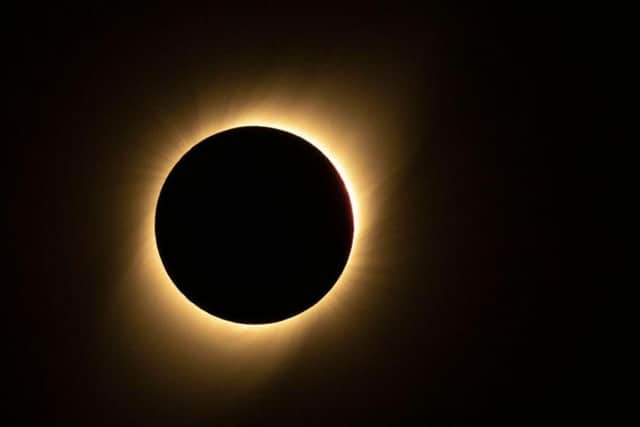
Today (Wednesday, August 12), Lancashire and the entirety of the British Isles will experience a rare celestial event- a deep solar eclipse.
Up to 96% of the Sun will be covered by the Moon, in what will be the deepest solar eclipse the British Isles have seen since 2015.
Fortunately for anyone hoping to catch the event, the weather forecast is also on our side tonight, with clear and dry skies promised.
During the eclipse, the forecast for clear skies will be joined by temperatures of up to 29C in Lancashire too as a heatwave sweeps across the county.

What is the safesty way to watch the solar eclipse?
Experts warn that you should never look directly at the sun during an eclipse with the naked eye, sunglasses, a camera, binoculars or a telescope.
The reduced brightness of the Sun during an eclipse can override the body's natural reflex to look away - allowing intense sunlight to reach and damage the retina.
The damage happens without causing pain so you may not realise it’s occurring until too late.
Poonam Patel, Eye Health Information Service Manager for RNIB (Royal National Institute of Blind People) explained that looking directly at the sun during an eclipse can cause solar retinopathy, a type of retinal injury that may lead to permanent blind spots, distorted vision or reduced central vision.
Instead, special solar filters designed for eclipse viewing are required, with Ms Patel advising that only eclipse viewers that comply with the international safety standard ISO 12312-2 should be used for direct viewing of a solar eclipse.
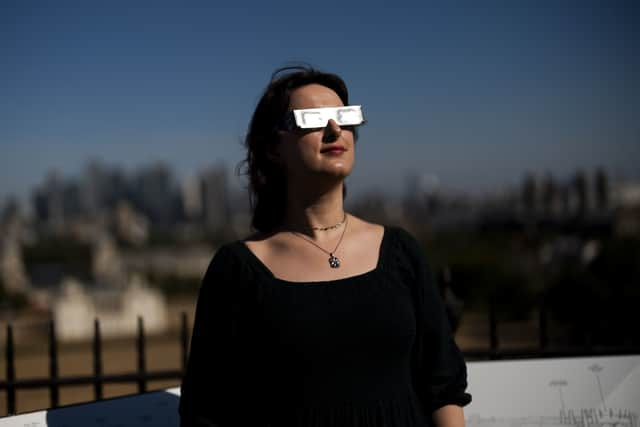
Glasses should also be checked for scratches, tears or other damage before use and discarded if damaged.
Reusing old eclipse glasses should be done with extreme caution in case damage to the lenses has compromised their filtering properties.
What can I do if I don’t have solar glasses?
Ordinary sunglasses - no matter how dark - don’t provide adequate protection for watching a solar eclipse.
Sunglasses reduce glare, making it feel more comfortable to look at the Sun for longer, while still allowing harmful solar radiation to reach the retina.
The safest ways to observe an eclipse are indirect methods, such as projecting the image through a pinhole,using a colander to cast the sun's image onto a surface or through tree leaves.
DO NOT look directly at the sun through the pinhole or colander.
To use the pinhole method, you should make a small hole in one piece of paper and hold it above another piece of paper to see the shadow being cast on the Sun replicated in miniature.
To use a colander, hold it up and look at its shadow.
With the tree leaves method, the gaps between leaves are natural pinhole projectors - look at the shadows cast by leaves on the ground.

When is the best time to see the solar eclipse in Lancashire?
In Lancashire, the partial eclipse is excpected to begin around 6.15pm and finish around 8.00pm.
Where are the best places to watch the solar eclipse in Lancashire?
Moor Park, Preston
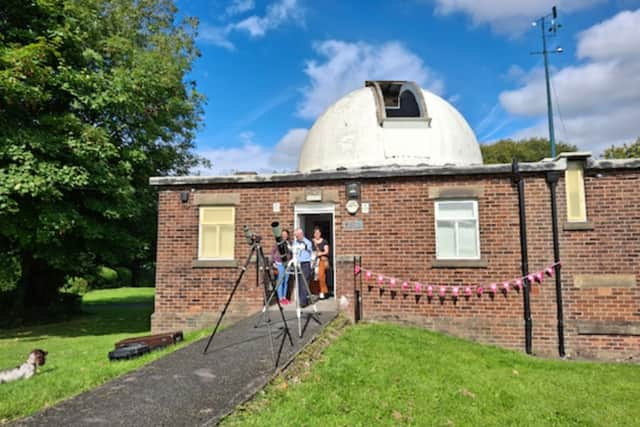
Astronomers from the University of Lancashire and Preston and District Astronomical Society are hosting a free public event at Moor Park, to help people experience the UK’s first deep solar eclipse in over a decade.
If the weather is clear, the team will set up solar scopes and projection facilities in the Park across from Deepdale Stadium and provide eclipse glasses for people to safely view the event.
If the weather proves to be unsuitable, the team will instead base themselves at the Moor Park Observatory to live stream the eclipse from other clear locations and discuss eclipse science.
The free event will start at 5.45pm and finish at 8pm. People are asked to meet at Moor Park near to the car park across from Deepdale Stadium.
For poor weather, the revised location will be the Jeremiah Horrocks Institute Observatory and people are advised to follow https://www.instagram.com/unilancashire_engineering/ and https://www.facebook.com/UniLancashire.Engineering/ for updates in the build up to ensure they have the most up-to-date information in case of changes due to the weather forecast.
Fairhaven Lake, St Annes
A free Community Solar Eclipse Picnic, organised by Blackpool and South Fylde Methodist Circuit, is due to take place between 5pm and 8pm at Fairhaven Lake, near the Spitfire Memorial. Solar eclipse glasses will be provided.
Rossall Promenade, Thornton-Cleveleys
Stargazers are invited to join Blackpool & District Astronomical Society on Rossall Beach Promenade from 5pm until 8.15pm. Safety-filtered solar-viewing equipment will be on hand.
Blackpool Pleasure Beach
The theme park has announced a solar eclipse viewing event, with extended viewing hours and free protective glasses between 6pm and 8pm. Visitors will be able to watch the spectacle from the park’s overpass, adjacent to the ‘Wallace & Gromit’s Thrill-O-Matic’ ride.
Join our new WhatsApp community - Get the latest news and top stories from across Lancashire direct to your phone
And if I can’t watch it tonight, when is the next one?
The next full solar eclipse in the UK isn't expected for another 64 years, on 23 September 2090, according to the Royal Museums Greenwich.
The Royal Observatory Greenwich will also be live-streaming the partial solar eclipse from 6.10pm on Wednesday, August 12 and has lots more information about when and where to see the eclipse on its website.
Watch the Lancashire Post’s solar eclipse video explainer in the player above, detailing what a solar eclipse is, where to see it and how to view it safely.