
Essential maintainence work to be carried out at this prominent landmark
Essential maintainence work will soon be carried out on a prominent landmark.
Ormskirk Clock Tower is a Grade II listed building, which was built in 1876 in typical Victorian Gothic style. The tower stands in the Centre of Ormskirk at the junction of Church Street, Aughton Street, Burscough Street and Moor Street.
In order to ensure its longevity and safety, West Lancashire Borough Council applied to it’s own planning officers for Listed Building Consent to carry out “essential structural and aesthetic improvements”.
A surveyor’s report states that the tower is “structurally robust with no obvious signs of progressive structural movement”, but it points out poor previous repairs, vegetation growth which has likely caused a slight movement of parapet blocks, natural erosion of sandstone and missing and loose pointing.
What work will be done?
The council states that no extensions or significant alterations to the original structure will be made. Proposed works include:
• Scaffolding and temporary fencing/hoarding;
• Cleaning of the tower
• Removal of vegetation and resetting sandstone blocks
• Replacing damaged sandstone
• Re-pointing sandstone blocks
• Repainting door and benches
• Replacement of floor light glass lenses and minor paving/ mortar repairs.
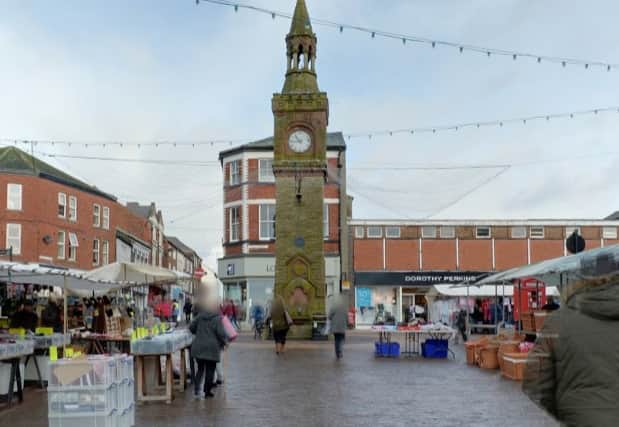

Officers recommended that NHL lime mortar be used for the repointing as previous work with OPC mortar has caused damage to the stonework. They also said that any repair work to the masonry should be colour matched/completed with matching stone in order for the proposed work undertaken to appear seamless across the tower.
History of the Clock Tower
The tower plan was first announced in October 1875, the offer from Lathom-born stonemasons Charles and John Wells to build it was accepted at a meeting of the town’s Court Leet, assisted by contributions from the town and neighbourhood.
The architect was announced as Peter Balmer of Aughton, and the cost of building the tower was estimated at £300, not counting the clock mechanism itself.
The building consists of four sections: Base, Column, Clock Chamber and Spire. The exterior of the tower, which is square on plan, except for the spire, which is octagonal, is built in a mixture of contrasting red and buff stand stone. The internal construction is brick.
Within just a few years, the gleaming Yorkstone was blackened with soot and grime from smoking chimneys. In the 1970s, when it was cleaned and restored to its former state. In August 1972, the 96-year-old Clock Tower was given Grade II-listed status as a building of historical interest.