
Windfarm plans will cut 'motorway-wide' crater through the Lancashire countryside
Lancashire County Council will tell the government that “urgent action” is needed to prevent two offshore windfarms wreaking huge on-shore damage across the Fylde – in the form of an 18-mile trench that would be “the width of the M55”.
The authority’s intervention comes after councillors united in a cross-party effort to secure an alternative route for the cables that will have to be laid in order to transfer the energy generated by planned turbines in the Irish Sea to the national grid.
A meeting of the full council backed a motion calling for the county council’s chief executive to write to the Energy Secretary, Ed Miliband, encouraging the government and the developer to work with local officials to help plot a different path for the infrastructure required.
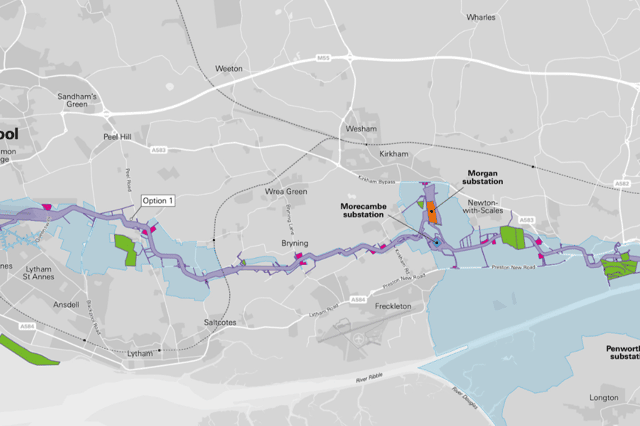
Under the current blueprint for the so-called Morgan and Morecambe scheme, the cables would come ashore at St. Annes beach and run across the district through the excavated trench to two substations, south of Kirkham and west of Newton-with-Scales. They would then continue onwards, beneath the River Ribble, to their final grid-connection destination at Penwortham.

Bringing the motion on the subject, St. Annes division county councillor Peter Buckley stressed that he supported offshore wind and the transition to renewable energy – but said that neither residents nor businesses could countenance the carnage that the suggested route would cause.
The Conservative member said that it would “carve out a 100 metre-wide corridor for 30km across the Fylde countryside…through protected sand dunes, under playing fields [and] cutting through prime agricultural land”.
“This is not a minor inconvenience, it is a multi-year construction project that will severely disrupt residents, businesses and local tourism, damage sensitive coastal and rural environments, [all while] threatening wildlife habitats, bringing massive heavy construction traffic rumbling along narrow residential roads and permanently alter[ing] the character of rural Fylde,” County Cllr Buckley warned.
Reform UK cabinet member for rural affairs, environment and communities Joshua Roberts – who represents the Fylde East division in which the proposed substations would stand – said he was fully ”aligned” with County Cllr Buckley’s concerns, particularly in relation to the impact of the trench on farmland.
He added: “The width is the size of the M55, it’s going to destroy 600 acres of greenbelt and 90 acres [as a result of the] two substations.
“There are much better alternatives which [campaign group] Fylde Against Cable Transmission and Substations have looked at – and this is something, no matter what party, we can get behind and look at a better alternative route,” said County Cllr Roberts, adding that his sentiment was shared by fellow cabinet member – and Fylde South representative – David Dwyer.
County Cllr Buckley accepted a requested change from County Cllr Roberts to the wording of his original proposal, which had called for the chief executive to raise “objections” with the Secretary of State.
Instead, the authority’s boss has now been instructed to write Mr. Miliband to “set out our willingness to work with [the government] and the developer to deliver the urgent action needed to avoid the adverse impacts and realise the opportunities that proper assessment of the alternative routing options could deliver and also to facilitate these discussions for the benefit of all”.
The correspondence will be sent in addition to formal concerns raised by the county council last month through the formal planning process.
That followed a six-month examination of the windfarm proposal by the Planning Inspectorate, which is now considering whether or not to recommend the government gives the go-ahead to the project The deadline for that recommendation is 29th January, from which point ministers will then have three months to make a final decision.
In a 106-page submission, Lancashire County Council said that as the inspectorate had to be satisfied that there was “no satisfactory alternative location or design solution with a reduced ecological impact”, it would be “appropriate for the applicant to provide details of other options explored and why they were not feasible”.
Meanwhile, in its formal response following the examination process, Fylde Council suggested that a grid connection at Stanah and the Hillhouse Technology Energy Enterprise Park - east of Thornton-Cleveleys - “offers a better economic, social and environmental solution which would be cheaper and quicker to deliver, as well as providing a significant economic boost and power to the sub region, reduc[ing] significant environmental harms and would have the wider support of local communities”.
A spokesperson for Lancashire County Council told the Local Democracy Reporting Service (LDRS): “As a consultee, we wrote on 29th October to the Planning Inspectorate, who are the planning authority for this Nationally Significant Infrastructure Project, in order to highlight a number of concerns or issues in relation to the potential impact of the proposal on the local area.
“These include the impact of the proposed substations on the green belt and countryside, the ecology within the area, some archaeology issues arising from a lack of survey data, and flooding and highways matters.”
Meanwhile, a spokesperson for the Morgan and Morecambe Offshore Wind Farms Transmission Assets project said in response to the issues raised in this report: “We recognise that projects of this scale and importance have an effect on local communities. We remain committed to minimising these effects where possible, and it is important that concerns, such as those raised by Lancashire County Council, have been considered thoroughly and independently by the examining authority as part of the ongoing DCO [development consent order] process.
“The Morgan and Morecambe offshore wind farms could generate enough electricity to power the equivalent of around two million UK homes every year and make an important contribution to the UK’s renewable energy targets.”
This article was update on 25th November after a response was received from the Morgan and Morecambe project team.