
'Childhood is too precious' - Preston mum takes under-16 social media petition to Parliament
“Enough is enough”: Thousands of Lancashire parents call for social media age to be raised to 16
More than 1,100 people In Lancashire have signed a petition calling on the Prime Minister to raise the age of social media to 16.
It came as the government’s consultation on children and social media drew to a close on Tuesday evening. The consultation examined measures including a ban on social media for under-16s – and the government is expected to announce a policy within weeks.
The petition gathered over 110,000 signatures across the UK. It was delivered to 10 Downing Street by members of the Smartphone Free Childhood (SFC) movement including Jenna Madden SFC Regional Leader for Lancashire.
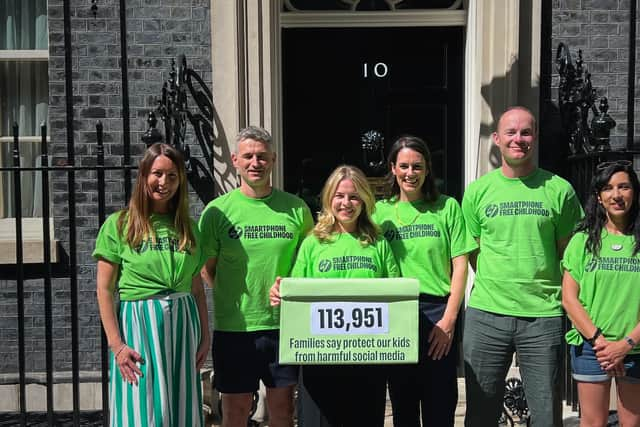

“Families across Lancashire are concerned about the growing impact social media is having on children’s wellbeing, safety, and development,” said Jenna, a mum-of-two from Preston. “For too long, regulation has failed to keep pace with the speed and scale of online platforms, leaving young people exposed while tech companies continue to profit. Parents are calling for meaningful action, and the government must step in with strong, effective measures that put children’s safety first.”
What do they want?
The petition calls for a simple, common sense reset: If social media companies want access to under-16s, they must prove their platforms are safe and age-appropriate first.
Alongside the petition, families in Lancashire are also taking action in their own communities. More than 2,400 local parents have now signed a Parent Pact, agreeing to delay smartphones until at least 14 and social media until 16. The idea is that these pacts help parents act together – reducing peer pressure and making it easier to hold boundaries at home.
Click here to see how you can sign the Parent Pact
“Parents are coming together to delay smartphones and social media in their school communities, which makes it so much easier and means that your child isn’t left the only one without,” said Jenna. “The Pact helps level the playing field, but ultimately we need more support from the government, because not every parent has the time or tech knowledge to protect their child.”
Jenna said the work of SFC has been supported by numerous local councils, MPs, headteachers and the police. She said: “The general feeling in Lancashire is definitely building. The number of people signing the pact is growing every month and it tells us that there’s a big community of parents who are ready for change.
“The more we spread the message, the more parents know there is an alternative. Parents are in an impossible position. Do you put a device designed to be addicting in your child’s hands, or risk alienating them from their peers? We want to give this alternative because childhoods are too precious to give away to an addictive device.”
She added: “It’s not about judging parents -10 years ago people didn’t know - it’s more about educating people that there is another way. You can go in with knowledge of the harm that social media and having a smartphone can do.”
SFC believe that if 25 per cent of a community agree to the pact, that is a tipping point where not having a phone until the age of 14 becomes a ‘new norm’. Currently around five schools in Lancashire are at that figure.
Jenna said research shows the average age to get a smartphone is now nine, with 90 per cent of children owing one by the time they’re in high school. She said: “There is definitely a generational change. Whereas people my age were playing out in parks and being taught about ‘stranger danger’, thesedays, children are more often in their own homes being exposed to strangers and seeing things not designed for young eyes.
“And very often the parents don’t know - this stuff is served to their children without it necessarily being looked for. It’s not about being anti-technology, it’s about realising you’re carrying a supercomputer round in your pocket and there is harm attached to that.
“Someone once said to me, ‘It’s not giving your child access to the internet, it’s giving the internet access to your child’.
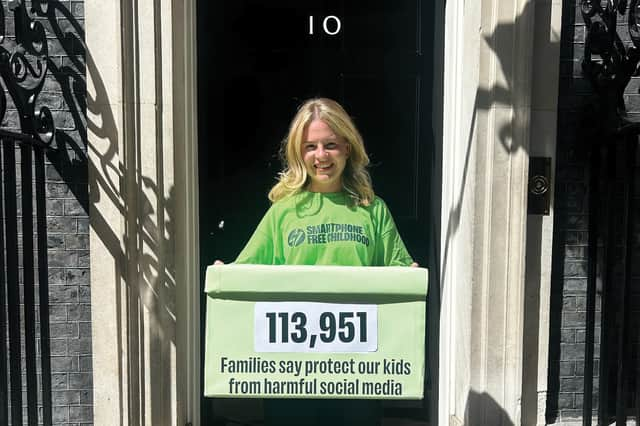
The Lancashire figures are part of a wider wave of parent-led action across the UK. A quarter of a million parents wrote to their MP in January, asking them to raise the age of social media, which resulted in the government launching a consultation into the issue.
The petition delivery comes as a major new UK-wide survey of parents has revealed the depth of despair many families now feel about childhood in the age of social media, with overwhelming numbers saying parenting has become harder, family life more conflict-ridden, and childhood fundamentally worse than their own.