
"Too many decision makers" Lancashire Constabulary amongst forces facing radical change

“Most significant change to policing across the UK for a generation”.
The National Police Chiefs’ Council has called for “fewer, bigger forces” in the “most significant change to policing across the UK for a generation”.
NPCC chairman Chief Constable Gavin Stephens said policing is not “national enough to cope with local threats”, adding that “serious and organised crime often sits behind the problems that communities see every day”.
A review, led by former Metropolitan Police commissioner Lord Bernard Hogan-Howe, will make recommendations later this year on how to restructure policing across England and Wales into fewer, larger forces. There are currently 43 regional forces in England and Wales, in a structure established in the 1960s.
It means Lancashire Constabulary is facing a major national restructuring as the government moves to consolidate forces and abolish Police and Crime Commissioners. The Constabulary, as it exists now, could be absorbed or replaced into a larger national body.
Founded in 1839, Lancashire Constabulary covers an area of 1,189 square miles. The county has a population of nearly 1.5 million people and the constabulary is split into three divisions, West, South and East. It’s headquarters is based in Hutton, Preston, with dogs and mounted section nearby. Each division is run by a Chief Superintendent. The workforce made up of over 3,000 police officers and 2,500 police staff – of which 290 are PCSOs and 460 Special Constabulary officers, police cadets and community volunteers. (Source of data: Lancashire Constabulary.)
Meanwhile, Lancashire leaders and the Lancashire Police and Crime Commission have expressed concerns larger regional bodies must not disconnect police work from local communities.
Earlier this year, speaking to the Local Democracy Reporting Service (LDRS) , Lancashire Police and Crime Commission Clive Grunshaw said: “The overriding aim of police reform must be to raise standards and strengthen public trust. I welcome the white paper’s focus on neighbourhood policing and the potential for a National Police Service to improve consistency and performance. However, policing must remain rooted in the communities it serves. In Lancashire, strong local relationships and accountability are key to what works, and that must not be lost through larger structures that risk adding cost or complexity. Any consideration of merging police forces must be driven by clear evidence that it will improve outcomes for the public.
“Policing also needs sustained investment in technology and data to tackle modern crime, alongside properly resourced neighbourhood teams. It is vital that locally commissioned services for victims, prevention and offender management are protected.”
Mr Stephens said the reforms would be the “most significant change to policing across the UK for a generation”, adding that funding was “not fairly distributed” in the current system. He told a media briefing that the current set-up is “not financially viable” and police forces are “struggling with about half a billion pounds worth of savings”.
The NPCC chairman said: “Having fewer, bigger forces with really defined local policing areas, giving a much stronger guarantee to the public about what they get in their local policing area, would make it much easier for us to join up our intelligence, our effort against organised crime, our co-operation across force boundaries.”
He added: “Local policing is not about the location of your headquarters or your accessibility to the chief constable and the number of forces. It’s about local sergeants, inspectors, neighbourhood officers knowing their communities.”
Greater Manchester Police Chief Constable Sir Stephen Watson said there are “too many forces who cannot sustain effective neighbourhood policing”, adding “the system at the moment just has too many entities, too many decision makers”. He added that some small forces “lack the capability and the capacity even to turn the stone over” with regard to “strands of serious and organised crime”.
Sir Stephen said savings would come from regional reform, “because we are paying for 43 chief constables, 43 deputy chief constables, 43 headquarters, 43 IT departments, 43 means of procurement”.
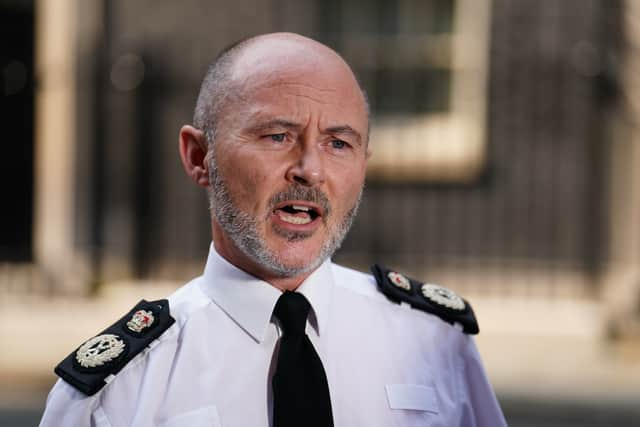

He added: “There is no planet in which policing will have been designed this way. Reform holds out the prospect of releasing that equity into the local, and it’s the local where the power of policing is best expressed.”
Wiltshire Police Chief Constable Catherine Roper said rural crime is linked to “money laundering, human trafficking, large-scale plant theft”, adding that these are “really tricky to deal with and to tackle on a large scale when you’re in a small force”.
The NPCC said a new report, commissioned by the Office of the Police Chief Scientific Adviser, found that a 10% increase in community policing “could generate approximately £13 billion in net economic benefits for businesses over three years”.
The report suggested that “every £1 invested in policing generates around £10.70 in economic value for businesses” and a “10% increase in neighbourhood crime is associated with approximately a 1% reduction in business output”. The NPCC is the national co-ordination and representative body for senior police officers across the UK.