
Preston's red phone box revamp gets the green light
Preston’s famous row of red phone boxes is set for a long-awaited refurbishment designed to secure the future of a piece of the city’s – and the country’s – telecommunications history.
Eight of the nine kiosks, on Market Street in the city centre, form what is the longest line of the iconic scarlet-coloured calling facilities anywhere in the UK – with the ninth standing on its own, a short distance from its record-breaking neighbours.
They have all fallen into an increasing state of disrepair – and been subject to vandalism – since being disconnected around a decade ago.
However, as Grade-II listed structures, they have been spared the scrapheap fate of many of their less significant counterparts nationwide – and Preston City Council planning officials have now given the green light to the restoration of the local landmarks.
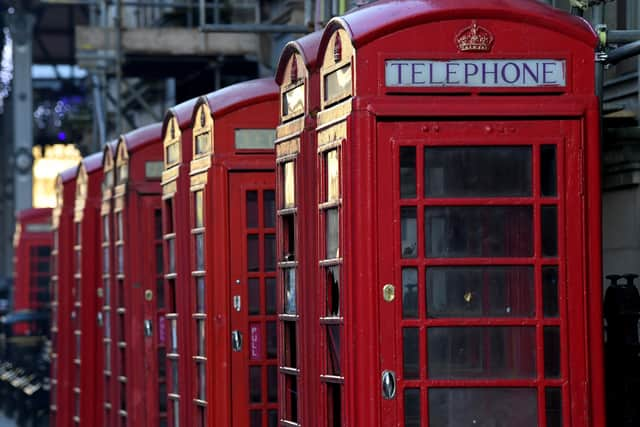

As the Lancashire Post revealed when an application for permission to carry out listed work was submitted last December, the phone boxes could be removed from their home – alongside the former main post office building – while their restoration is carried out.
The authority, which acquired the kiosks in 2021, said it was also considering engaging ways in which they could be put to use once they were back in situ – potentially by working with local artists to create audio-visual installations within the once well-used facilities.
The works now approved by town hall planning officers – acting independently of the branch of the council wanting to carry out the restoration – will see the boxes stripped out, sandblasted and have new toughened windowpanes installed, along with coloured lights and power sockets to facilitate any future displays within the tiny spaces.
While the intention is to restore the kiosks to their former visual glory – albeit with a different purpose – the authority has not been too hung up on recreating their exact look from when they were installed between the mid-1930s and late 1960s.
The lone box nearest the market is likely to have been the first to be put in place, with the other eight – arranged in pairs and securing Preston the crown of having the longest continuous row of phone kiosks in the UK – following at various points over the next three decades.
Rather than being repainted in their original shade, they will be given a lick of “currant red”, which was the colour of later versions of the phone kiosk from 1968 onwards. Crucially, however, that shade has also been used since then whenever earlier phone boxes have been redecorated – including those on Market Street. For that reason, planning officials concluded there would be “no discernible consequence” to not reverting to the original colour.
The crowns on the boxes will also be painted in gold – as some of them already are – when they would all have been red originally. A report by planning officers noted that the discrepancy was the result of an “inconsistent approach to…restoration” taken in the 1990s and 2000s – before the council gained control of the call boxes – and that the use of gold in the latest refurbishment would signify that the kiosks had all undergone the same revamp.
It was also acknowledged that the use of colour-changing lights “would not be in-keeping” with the boxes in their original form – but that they would initially have been lit at night and, from the 1970s, during the day as well, following the introduction of fluorescent lights.
A condition has been attached to the permission to ensure that the renovated kiosks will be “well maintained in their new condition”.
The report concludes that the works will “preserve” the listed structures – as required under legislation – and will not harm their significance.
The eight are all of the “K6” design by Sir Giles Gilbert Scott, who was also responsible for the Cenotaph war memorial on Market Place, while his father, George Gilbert Scott, designed Preston Town Hall.
The phone box nearest the market was originally a forerunner to the K6 – and so was painted cream – but was replaced with a K6 at a later date.