
Where all of Lancashire's hospitals rank in new NHS league table
Two Lancashire hospital trusts have been judged to be amongst the 10 worst performing in England according to a new NHS ‘league table’.
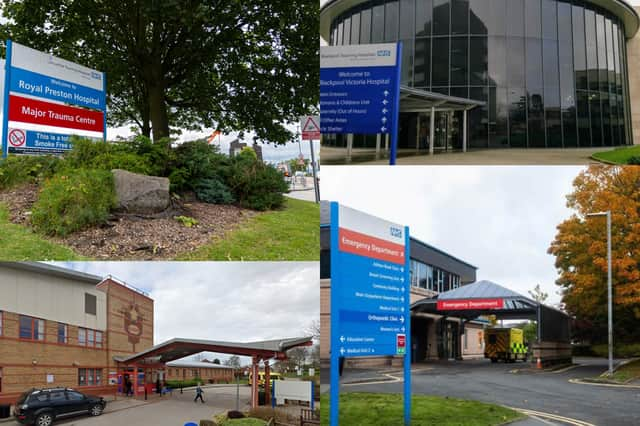
Lancashire Teaching Hospitals NHS Foundation Trust (LTH) which operates the Royal Preston and Chorley and South Ribble hospitals, was placed 127th in the ranking of 134 acute hospital providers nationwide.
Meanwhile, Blackpool Teaching Hospitals NHS Foundation Trust (BTH) found itself two places higher at 125.
LTH says its lowly position is largely the result of the financial challenges it is facing - and has moved to reassure patients that it remains committed to “delivering excellent care with compassion”.
It is understood that providers with a financial deficit are unable to be ranked any higher than the third of four possible ‘segments’ - where 1 is the best and 4 the worst.
Both LTH and BTH - which also has a deficit - have been placed in segment 4.
BTH said of its rating that it acknowledges “the scale of improvement required” at the trust.

Elsewhere in Lancashire, Mersey and West Lancashire Teaching Hospitals NHS Trust - which operates Ormskirk Hospital, as well as facilities beyond the Lancashire county border - was the highest-ranked acute, non-specialist trust in the North West, in 56th place. However, even that position still placed it in segment 3.
University Hospitals of Morecambe Bay NHS Foundation Trust (UHMBT) - which runs the Royal Lancaster Infirmary - came 84th and East Lancashire Hospitals NHS Trust (ELHT), operator of the Royal Blackburn Hospital and Burnley General, was 89th. Both organisations were also put in segment 3.
The so-called “aggregated metric rankings” are the first to be published under a new assessment regime introduced in June - and are derived from judging a range of different factors, such as waiting times.
NHS England, which compiled the data, says the league tables can be a “helpful indicator” of variations in performance across different trusts, but warns that direct comparisons should be made “cautiously”.
In a statement accompanying the table, it adds: “NHS trusts do many different things and serve very different communities. So, just because one trust ranks higher than another doesn’t mean it’s ‘better’”.
Under the previous assessment framework, LTH was put into the equivalent of financial special measures back in February - along with BTH, ELTH and the wider Lancashire and South Cumbria NHS system under the region’s Integrated Care Board (ICB) - as a result of its deficit.
Trusts and ICBs in that position were then given intensive support in order to help them recover their position. The Local Democracy Reporting Service (LDRS) understands that today’s new rankings do nothing to change that ongoing arrangement.
LTH is attempting to achieve a £60m “efficiency” savings target during the 2025/26 financial year. An update at a meeting of the organisation's board last month revealed that £10.2m of that figure had so far been delivered.
The trust has a “planned” deficit of £7m this year, but was overshooting that by £5.5m as of the end of June - because of a year-to-date shortfall in its efficiency programme.
In a statement on its place in the new league table, a spokesperson for LTH said: “"Both the segmentation and ranking are primarily a reflection of our long-standing financial deficit and our strategic decision to prioritise financial recovery efforts in 2025/26.
"We understand that this ranking will be a concern, but we remain committed to delivering excellent care with compassion whilst being supported by NHS England’s (NHSE) most intensive scrutiny and performance management.
"The new metrics will allow for more targeted help for Trusts, and we welcome the support being provided by NHSE and other partners to help us focus on the areas we must improve.
"Whilst Trust finances also play a significant part in our league ranking, we have also been gradually recovering from a range of performance challenges, which stems back to the Covid-19 pandemic.
"LTH Board has prioritised delivering improvements in key areas through our Single Improvement Plan (SIP) to improve patient safety and staff engagement. We are also streamlining our operational processes, implementing advanced technologies to improve patient care and service delivery, and investing in staff training and development.
"We are committed to continuous improvement and are confident of receiving an improved ranking in the Q2 publication (late November). However, we do not underestimate the task at hand and are focusing on making these important improvements and on what matters most to our patients."
Meanwhile, BTH forecast in July that its deficit for 2025/26 could range anywhere between £7m and £13.4m. At that point, it had identified £37.4m in “waste reduction programme savings” - but the target for the year is £44.7m.
Speaking more broadly about its league table ranking, a spokesperson for the trust said: “We welcome the transparency that comes with the publication of the NHS Oversight Framework and the additional support available to trusts facing the greatest challenges.
“We acknowledge the scale of improvement required at Blackpool Teaching Hospitals NHS Foundation Trust and are committed to a relentless pursuit of improvement.
“With the support of NHS England and our partners, we will continue to work together with the communities we serve to deliver the improvements they deserve.”
The LDRS approached all of the acute trusts in Lancashire, which were highlighted in this report, for comment.