
Charity funds "vein finder" equipment for radiotherapy staff
Needle-phobic patients and those with “difficult veins” or whose veins have been affected by chemotherapy should now find their radiotherapy planning scan less stressful.
That's thanks to the Rosemere Cancer Foundation charity, which stepped in to equip the radiotherapy team at Rosemere Cancer Centre with their own vein finder device.
Between 30 to 40 per cent of all patients needing radiotherapy will have to undergo a contrast medium CT scan at treatment planning stage.
This is where a dye — the contrast medium — is injected into a vein via a thin tube called a cannula. The dye helps internal organs show up more clearly in the scan images.
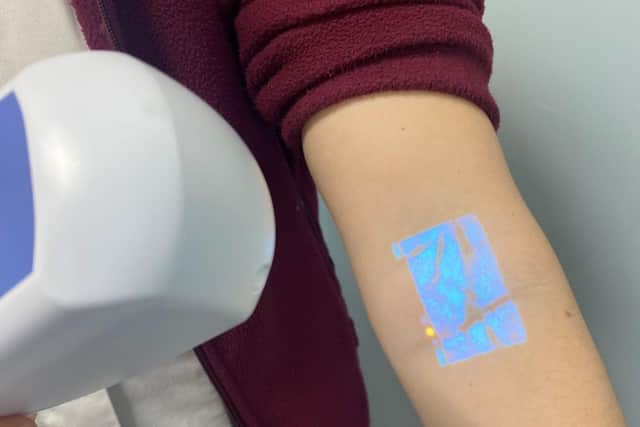

Sometimes, staff trying to cannulate patients, who have been on chemotherapy or who have “difficult veins” that are less easy to see, may have to have multiple attempts at inserting the cannula into the patient’s hand or arm. This can make the procedure more painful for the patient and stressful, especially if the patient already has a fear of needles.
The vein finder, which is a hand-held device that is hovered over the patient’s hand or arm, uses infrared technology to show staff where the veins are under the skin. It can help identify a “good vein” to make cannulation easier.
Radiotherapy pre-treatment leader Olivia Kneale, who asked Rosemere Cancer Foundation for the £3,520 for the device and a stand to hold it, explained: “We cannulate approximately 36 patients a week. Based off our own data, a quarter or 25 per cent of these patients were needing multiple cannulation attempts.
“In some cases, radiographers were having to request the loan of a vein finder from another department or ask for help from the acute oncology chemo team, who cannulate more frequently and therefore have more experience.”
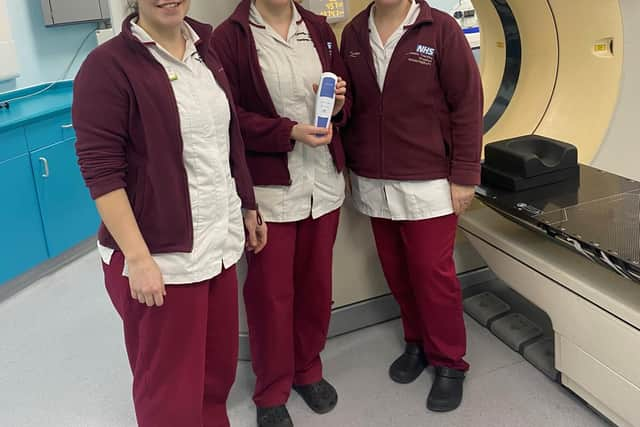
Olivia continued: “Either way, both options were causing significant delay, adding to the patient’s stress, impacting on CT capacity and affecting the workloads of staff from the other departments.
“Now we have our own vein finder, there is a much higher likelihood multiple cannulation attempts will be a thing of the past, benefiting the 350-400 patients annually, who were part of the multiple cannulation attempt group. It will also help us be more time efficient and save the department more than £3,000 a year in wasted cannulas.”
Sue Swire, fundraising manager for Rosemere Cancer Foundation, said: “We are delighted to fund this project as anything that can help alleviate patient stress and pain is our top priority.
“We are very grateful to Olivia and her colleagues for making us aware of the benefits of the radiotherapy department having its own vein finder.”
Rosemere Cancer Foundation works to bring world class cancer treatments and services to cancer patients from throughout Lancashire and South Cumbria being treated at either Rosemere Cancer Centre, the region’s specialist cancer treatment and radiotherapy centre at the Royal Preston Hospital, or one of eight local hospital cancer units across the two counties.
The charity funds cutting edge equipment, research, training and other cancer services and therapies that the NHS is unable to afford. For further information on its work, including how to make a donation, visit www.rosemere.org.uk